


doi: 10.1080/01973533.2014.917973.
Communicating without the Face: Holistic Perception of Emotions of People with Facial Paralysis
Affiliations
- PMID: 26412919
- PMCID: PMC4581447
- DOI: 10.1080/01973533.2014.917973
Item in Clipboard
Communicating without the Face: Holistic Perception of Emotions of People with Facial Paralysis
Basic Appl Soc Psych.
.
Abstract
People with facial paralysis (FP) report social difficulties, but some attempt to compensate by increasing expressivity in their bodies and voices. We examined perceivers' emotion judgments of videos of people with FP to understand how they interpret the combination of an inexpressive face with an expressive body and voice. Results suggest perceivers form less favorable impressions of people with severe FP, but compensatory expression is effective in improving impressions. Perceivers seemed to form holistic impressions when rating happiness and possibly sadness. Findings have implications for basic emotion research and social functioning interventions for people with FP.
Figures
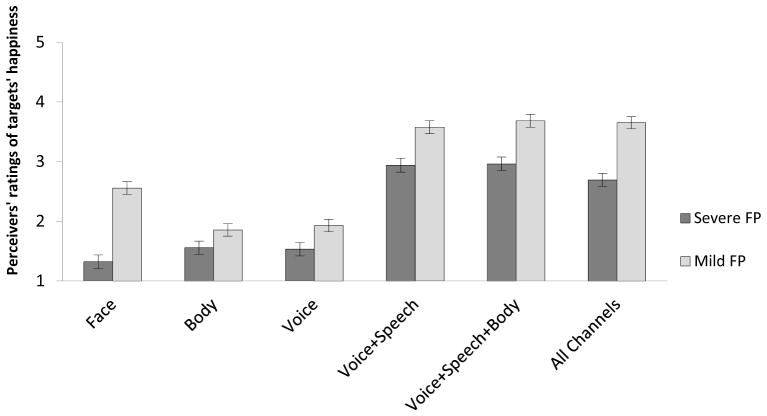
Perceivers’ ratings of targets recalling a happy event. Error bars represent standard errors.
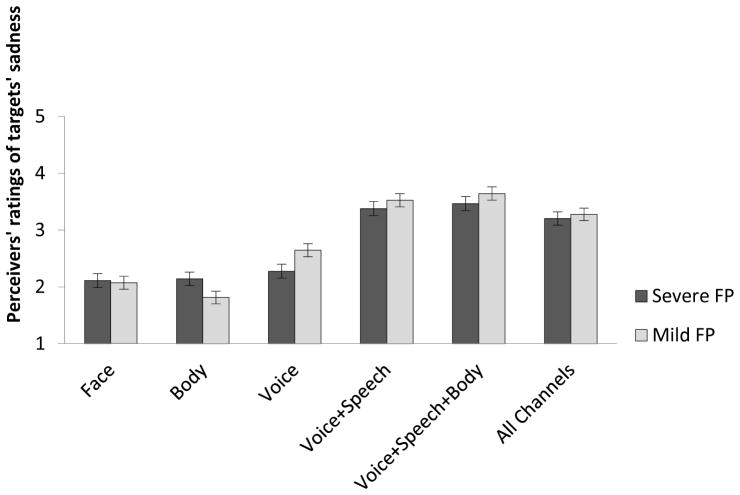
Perceivers’ ratings of targets recalling a sad event. Error bars represent standard errors.
References
-
- Ambady N, Rosenthal R. Thin slices of expressive behavior as predictors of interpersonal consequences: A meta-analysis. Psychological Bulletin. 1992;111(2):256–274. doi: 10.1037/0033-2909.111.2.256. - DOI
-
- Ambady N, Bernieri FJ, Richeson JA. Toward a histology of social behavior: Judgmental accuracy from thin slices of the behavioral stream. Advances in Experimental Social Psychology. 2000;32:201–271.
-
- Aviezer H, Trope Y, Todorov A. Body cues, not facial expressions, discriminate between intense positive and negative emotions. Science. 2012a;338(6111):1225–1229. - PubMed
-
- Aviezer H, Trope Y, Todorov A. Holistic person processing: Faces with bodies tell the whole story. Journal of personality and social psychology. 2012b;103(1):20. - PubMed
-
- Barkhuysen P, Krahmer E, Swerts M. Crossmodal and incremental perception of audiovisual cues to emotional speech. Language and speech. 2010;53(1):3–30. - PubMed
Grants and funding
LinkOut - more resources
Full Text Sources
Other Literature Sources