Review
. 2015 Sep;8(3):109-14.
doi: 10.14802/jmd.15018. Epub 2015 Sep 10.

What Is Wrong with Balance in Parkinson's Disease?

Affiliations
Review

What Is Wrong with Balance in Parkinson's Disease?

Jeong-Ho Park et al. J Mov Disord. 2015 Sep.

Abstract

Postural instability and resulting falls are major factors determining quality of life, morbidity, and mortality in individuals with Parkinson's disease (PD). A better understanding of balance impairments would improve management of balance dysfunction and prevent falls in patients with PD. The effects of bradykinesia, rigidity, impaired proprioception, freezing of gait and attention on postural stability in patients with idiopathic PD have been well characterized in laboratory studies. The purpose of this review is to systematically summarize the types of balance impairments contributing to postural instability in people with PD.

Keywords: Balance; Falls; Management; Parkinson’s disease; Posture.


Conflict of interest statement

Conflicts of Interest

OHSU and Dr. Horak have a significant financial interest in APDM, a company that may have a commercial interest in the results of this research and technology. This potential institutional and individual conflict has been reviewed and managed by OHSU.

Figures
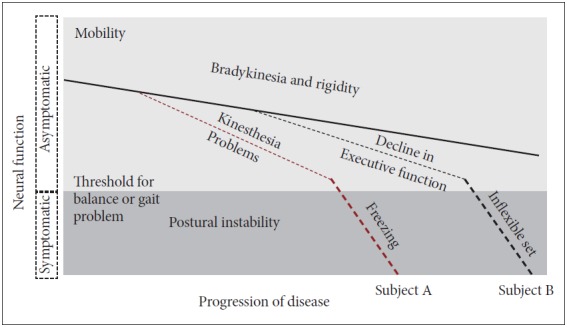
Figure 1.
Figure 1.
Model for effects of progression of Parkinson’s disease (PD) on postural instability. All patients with idiopathic PD show progression of bradykinesia and rigidity that impairs postural control. However, later in the disease process, individual patients also show quite variable involvement of kinesthesia (proprioception), freezing of gait, decline of executive function and inflexible motor set that will result in a variety of types of mobility disorders among patients with PD.
Figure 2.
Figure 2.
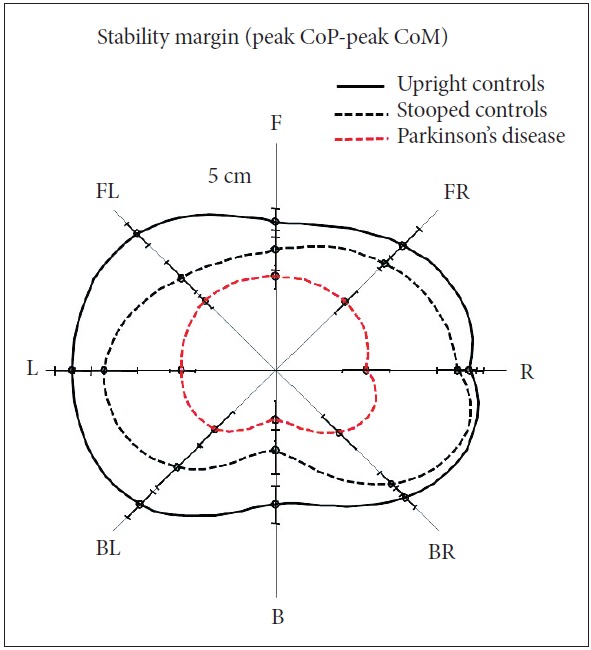
Stooped (flexed) initial posture in healthy control subjects reduces postural stability margin (peak CoPpeak CoM) in response to multidirectional perturbations, especially backwards, like patients with Parkinson’s disease (PD). Stability margin was calculated in response to surface translations in 8 directions in 10 healthy control subjects standing upright and standing stooped and in 10 patients with PD who had a stooped posture. Adapted from Jacobs et al. [19]. CoM: center of mass, CoP: center of pressure, F: forward, FR: forward right, R: right, BR: backward right, B: backward, BL: backward left, L: left, FL: forward left.
Figure 3.
Figure 3.
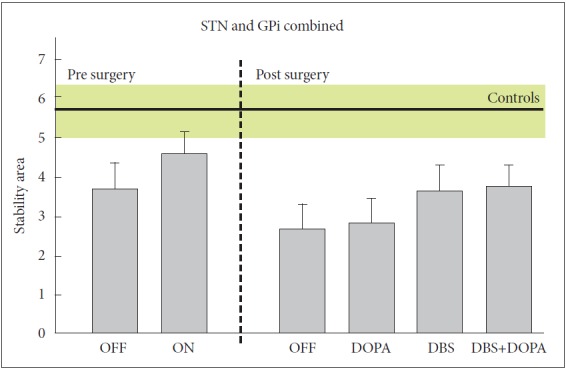
Effects of DBS surgery and levodopa on postural stability in response to external perturbations. The DBS group means (SE) includes 14 patients with PD with stimulators in bilateral STN and 14 patients with stimulators in GPi and are compared to postural stability in 9 control subjects (mean and SE in green). Postural stability area is the difference between displacement of the center of pressure by postural response and displacement of the body center of mass following backward translations of the support surface. The smaller the stability areas, the worse the balance function. Adapted from St George et al. [26]. STN: subthalamic nucleus, GPi: globuspallidusinterna, OFF: unmedicated state, ON: best medicated state with dopaminergic drugs, OFF/OFF: DBS and medication both off, DOPA: medication on with DBS off (on/off), DBS: DBS on with medication off (off/on), ON/ON: DBS and medication both on.
Figure 4.
Figure 4.
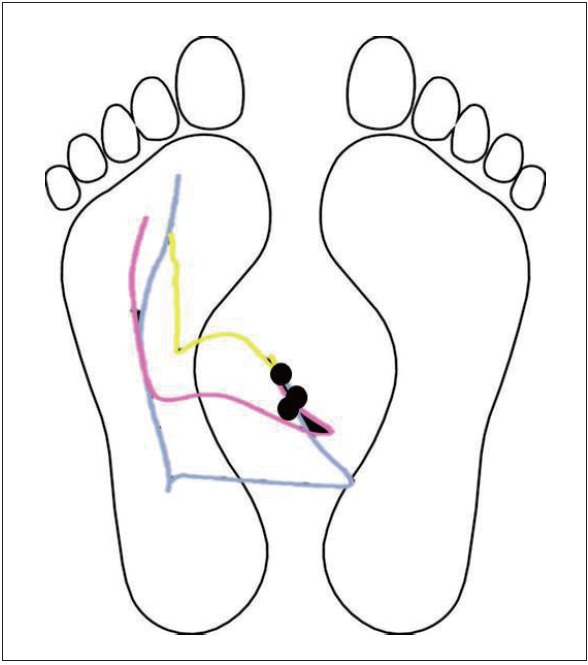
Schematic comparing trajectories of center of pressure (CoP) prior to step initiation in healthy young, healthy elderly and patients with Parkinson’s disease (PD). Left is stance foot and right is step initiation foot. Black dots indicate initial CoP position over the base of support at the standing position. Yellow line is CoP displacement in a subject with PD, pink line CoP from a healthy elderly subject, and blue line from a healthy young subject.

References

    1. Kerr GK, Worringham CJ, Cole MH, Lacherez PF, Wood JM, Silburn PA. Predictors of future falls in Parkinson disease. Neurology. 2010;75:116–124. - PubMed
    1. Rahman S, Griffin HJ, Quinn NP, Jahanshahi M. Quality of life in Parkinson’s disease: the relative importance of the symptoms. Mov Disord. 2008;23:1428–1434. - PubMed
    1. Williams DR, Watt HC, Lees AJ. Predictors of falls and fractures in bradykinetic rigid syndromes: a retrospective study. J Neurol Neurosurg Psychiatry. 2006;77:468–473. - PMC - PubMed
    1. Stolze H, Klebe S, Zechlin C, Baecker C, Friege L, Deuschl G. Falls in frequent neurological diseases--prevalence, risk factors and aetiology. J Neurol. 2004;251:79–84. - PubMed
    1. Pickering RM, Grimbergen YA, Rigney U, Ashburn A, Mazibrada G, Wood B, et al. A meta-analysis of six prospective studies of falling in Parkinson’s disease. Mov Disord. 2007;22:1892–1900. - PubMed