


Detection of Growth Hormone Deficiency in Adults with Chronic Traumatic Brain Injury
- PMID: 26414093
- PMCID: PMC5011623
- DOI: 10.1089/neu.2015.4127
Detection of Growth Hormone Deficiency in Adults with Chronic Traumatic Brain Injury
Abstract
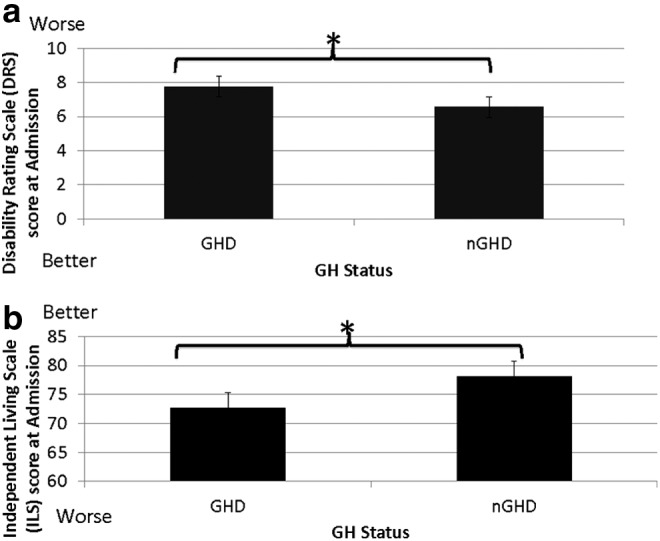
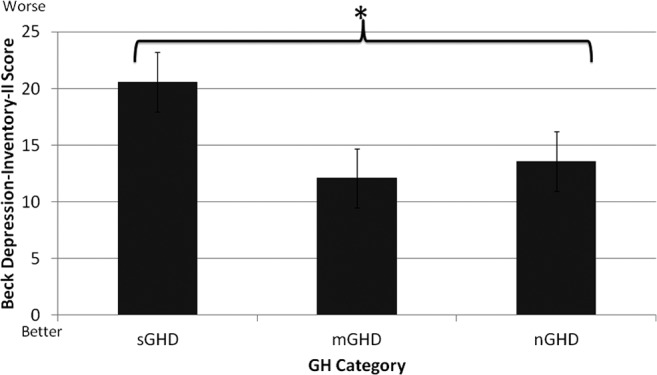
This study examined the prevalence of growth hormone deficiency (GHD) in patients with traumatic brain injury (TBI) during the post-acute phase of recovery and whether GHD was associated with increased disability, decreased independence, and depression. A secondary objective was to determine the accuracy of insulin-like growth factor-1 (IGF-1) levels in predicting GHD in patients with TBI. Anterior pituitary function was assessed in 235 adult patients with TBI through evaluation of fasting morning hormone levels. GH levels were assessed through provocative testing, specifically the glucagon stimulation test. GHD was diagnosed in a significant number of patients, with 45% falling into the severe GHD (≤3 μg/L) category. IGF-1 levels were not predictive of GHD. Patients with GHD were more disabled and less independent compared with those patients who were not GHD. Those patients with more severe GHD also showed decreased levels of cortisol and testosterone. Symptoms of depression were also more prevalent in this group. In addition, patients with severe GHD had delayed admission to post-acute rehabilitation. This study confirms the high prevalence of GHD in patients with TBI and the necessity to monitor clinical symptoms and perform provocative testing to definitively diagnose GHD.
Keywords: adult brain injury; clinical management of CNS injury; growth hormone deficiency; human studies; hypopituitarism.
Figures


References
-
- Faul M., Xu L., Wald M.M., and Coronado V.G. (2010). Traumatic brain injury in the United States: Emergency department visits, hospitalizations, and deaths. Centers for Disease Control and Prevention, National Center for Injury Prevention and Control: Atlanta, GA
-
- Dams-O'Connor K., Spielman L., Singh A., Gordon W.A., Lingsma H.F., Maas A. I., Manley G.T., Mukherjee P., Okonkwo D.O., Puccio A.M., Schnyer D.M., Valadka A.B., Yue J.K., Yuh E.L.; TRACK–TBI Investigators. (2013). The impact of previous traumatic brain injury on health and functioning: A TRACK-TBI study. J. Neurotrauma 30, 2014–2020 - PMC - PubMed
-
- Selassie A.W., Zaloshnj E.P., Langlois J.A., Miller T., Jones P., and Steiner C. (2008). Incidence of long-term disability following traumatic brain injury hospitalization, United States, 2003. J. Head Trauma Rehabil. 23, 123–131 - PubMed
-
- Bondanelli M., De Marinis L., Ambrosio M.R., Monesi M., Valle D., Zatelli M.C., Fusco A., Bianchi A., Farneti M., and degli Umberti E.C. (2004). Occurrence of pituitary dysfunction following traumatic brain injury. J. Neurotrauma 21, 685–696 - PubMed
-
- Aimaretti G., Ambrosio M.R., Di Somma C., Gasperi M., Cannavò S., Scaroni C., Fusco A., Del Monte P., De Menis E., Faustini-Fustini M., Grimaldi F., Logoluso F., Razzore P., Rovere S., Benvenga S., degli Uberti E.C., De Marinis L., Lombardi G., Mantero F., Martino E., Giordano G., and Ghigo E. (2005). Residual pituitary function after brain injury-induced hypopituitarism: a prospective 12-month study. J. Clin. Endocrinol. Metab. 90, 6085–6092 - PubMed
MeSH terms
Substances
LinkOut - more resources
Full Text Sources
Other Literature Sources
Medical
Miscellaneous
