


Treatment of prosthetic joint infections due to Propionibacterium. Similar results in 60 patients treated with and without rifampicin
- PMID: 26414972
- PMCID: PMC4940594
- DOI: 10.3109/17453674.2015.1094613
Treatment of prosthetic joint infections due to Propionibacterium. Similar results in 60 patients treated with and without rifampicin
Abstract
Background and purpose: Currently, Propionibacterium is frequently recognized as a causative microorganism of prosthetic joint infection (PJI). We assessed treatment success at 1- and 2-year follow-up after treatment of Propionibacterium-associated PJI of the shoulder, hip, and knee. Furthermore, we attempted to determine whether postoperative treatment with rifampicin is favorable.
Patients and methods: We conducted a retrospective cohort study in which we included patients with a primary or revision joint arthroplasty of the shoulder, hip, or knee who were diagnosed with a Propionibacterium-associated PJI between November 2008 and February 2013 and who had been followed up for at least 1 year.
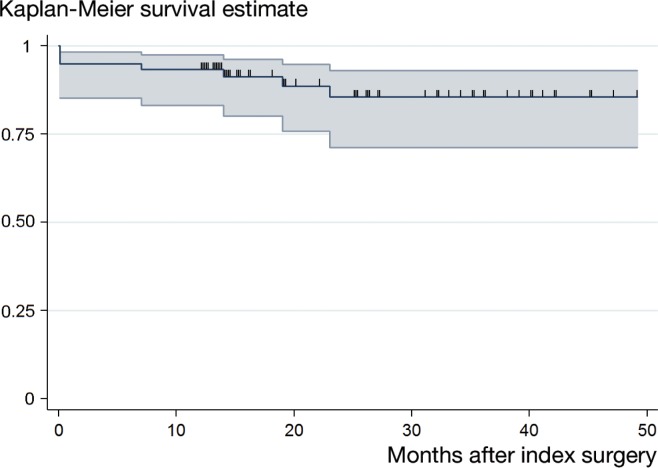
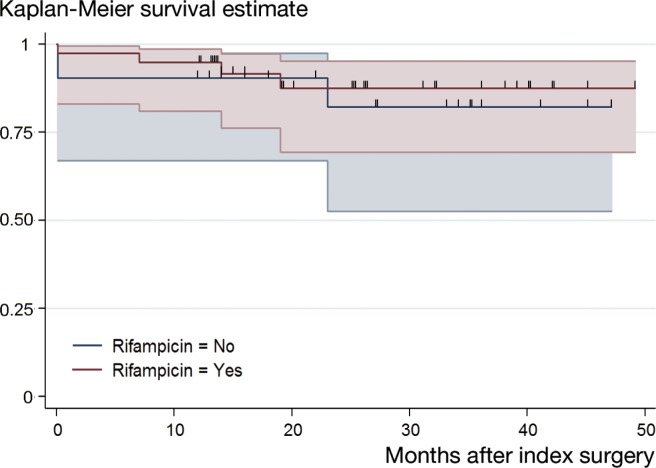
Results: We identified 60 patients with a Propionibacterium-associated PJI with a median duration of 21 (0.1-49) months until the occurrence of treatment failure. 39 patients received rifampicin combination therapy, with a success rate of 93% (95% CI: 83-97) after 1 year and 86% (CI: 71-93) after 2 years. The success rate was similar in patients who were treated with rifampicin and those who were not.
Interpretation: Propionibacterium-associated PJI treated with surgery in combination with long-term antibiotic administration had a successful outcome at 1- and 2-year follow-up irrespective of whether the patient was treated with rifampicin. Prospective studies are needed to determine whether the use of rifampicin is beneficial in the treatment of Propionibacterium-associated PJI.
Figures
Comment in
-
Treatment of prosthetic joint infections due to Propionibacterium.Acta Orthop. 2016 Feb;87(1):87. doi: 10.3109/17453674.2015.1120132. Epub 2015 Nov 26. Acta Orthop. 2016. PMID: 26610258 Free PMC article. No abstract available.
-
Treatment of prosthetic joint infections due to Propionibacterium--reply.Acta Orthop. 2016 Feb;87(1):87. Acta Orthop. 2016. PMID: 27119125 No abstract available.
References
-
- Bayston R, Ashraf W, Barker-Davies R, Tucker E, Clement R, Clayton J, Freeman B J, Nuradeen B.. Biofilm formation by Propionibacterium acnes on biomaterials in vitro and in vivo: impact on diagnosis and treatment. J Biomed Mater Res A 2007a; 81 (3): 705-9. - PubMed
-
- Bayston R, Nuradeen B, Ashraf W, Freeman B J.. Antibiotics for the eradication of Propionibacterium acnes biofilms in surgical infection. J Antimicrob Chemother 2007b; 60 (6): 1298-301. - PubMed
Publication types
MeSH terms
Substances
LinkOut - more resources
Full Text Sources
Other Literature Sources