


[Impact of pharmaceutical intervention in preventing relapses in depression in Primary Care]
- PMID: 26415743
- PMCID: PMC6877882
- DOI: 10.1016/j.aprim.2015.05.009
[Impact of pharmaceutical intervention in preventing relapses in depression in Primary Care]
Abstract
Objective: To evaluate the long-term impact of a brief pharmacist intervention (PI) compared with usual care (UC) on prevention of depression relapse.
Design: randomised controlled clinical trial
Setting: Primary Care
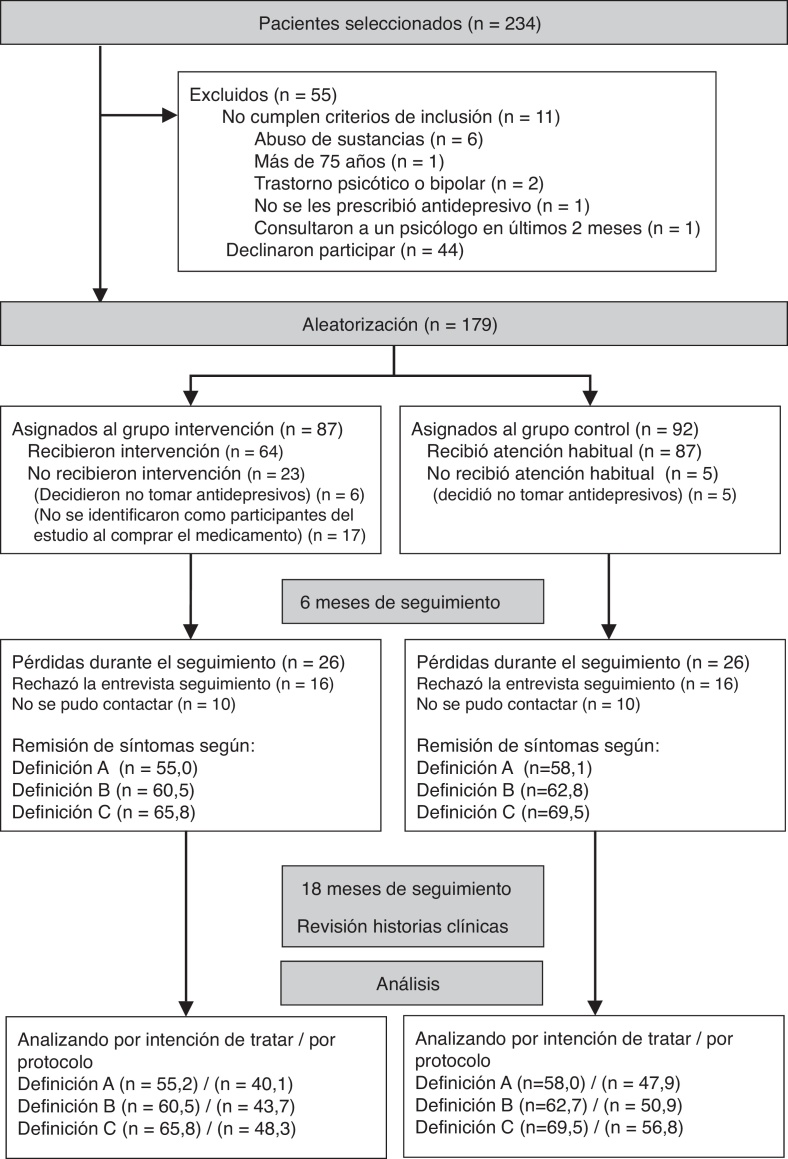
Participants: Of the 179 depressed patients initiating antidepressants, the 113 whose clinical symptoms had remitted (main definition) at 6 months assessment were selected for this secondary study (PI=58; UC=55).
Intervention: PI was an interview to promote medication adherence when patients get antidepressants from pharmacy.
Main measurements: Baseline, 3 months, and six-months follow-up assessments were made. The severity of depressive symptoms was evaluated with PHQ9. Patients presenting a remission of symptoms were selected. The patient medical records were reviewed to identify a relapse in the following 12 months by using 4 indicators.
Results: There was a lower proportion of patients that relapsed in the PI group than in the UC group 18 months after initiation of treatment, but the difference was not statistically significant either in the intent-to-treat analysis (OR=0.734 [95%CI; 0.273-1.975]) or the per-protocol analysis (OR=0.615 [95%CI; 0.183 -2.060]). All the sensitivity analyses showed consistent results. The sample size and adherence to the protocol in the intervention group were low.
Conclusion: PI group showed a non-statistically significant tendency towards presenting fewer relapses. This could be related to the improvement in adherence among patients that received the intervention.
Objetivo: Evaluar el impacto a largo plazo de una intervención farmacéutica (IF) respecto a la atención habitual (AH) en la prevención de recaídas en depresión.
Diseño: Ensayo clínico aleatorizado (estudio PRODEFAR).
Emplazamiento: Atención primaria.
Participantes: Ciento setenta y nueve pacientes con depresión mayor que inician antidepresivos, de estos, se seleccionaron para este análisis secundario los 113 cuyos síntomas habían remitido (definición principal) a los 6 meses (grupo intervención [GI] = 58; grupo control [GC] = 55).
Intervención: Se realizó una entrevista personal en la farmacia comunitaria para mejorar la adhesión terapéutica durante la dispensación de medicación.
Mediciones principales: Se realizaron 3 mediciones (línea base, 3 y 6 meses). La gravedad de síntomas depresivos (PHQ-9) fue evaluada a los 6 meses y se seleccionaron aquellos pacientes que presentaban remisión. Se revisaron sus historias clínicas para identificar recaídas, mediante 4 indicadores, en los siguientes 12 meses.
Resultados: La proporción de recaídas (variable principal) fue menor en el GI respecto al GC a los 18 meses de haber iniciado el tratamiento, pero la diferencia no fue estadísticamente significativa, ni en análisis por intención de tratar (OR = 0,734 [IC 95% 0,273;1,975]) ni en el análisis por protocolo (OR = 0,615 [95% CI 0,183; 2,060]). Todos los análisis de sensibilidad mostraron resultados consistentes. El tamaño de la muestra y la adhesión al protocolo en el GI fueron bajos.
Conclusión: El GI mostró una tendencia no significativa a presentar un menor número de recaídas. Esto podría relacionarse con la mejora en la adhesión entre los pacientes que recibieron la IF.
Keywords: Adherencia terapéutica; Antidepresivo; Antidepressants; Atención primaria; Community Pharmacies; Depresión; Depression; Farmacia comunitaria; Medication Adherence; Primary Health Care; Recaída; Relapse.
Copyright © 2015 Elsevier España, S.L.U. All rights reserved.
References
-
- Rubio-Valera M., Serrano-Blanco A., Magdalena-Belio J., Fernández A., García-Campayo J., March Pujol M. Effectiveness of pharmacist care in the improvement of adherence to antidepressants: A systematic review and meta-analysis. Ann Pharmacother. 2011;45:39–48. - PubMed
-
- Rubio-Valera M., March P.M., Fernandez A., Peñarrubia-María M.T., Travé P., López del Hoyo Y. Evaluation of a pharmacist intervention on patients initiating pharmacological treatment for depression: A randomized controlled superiority trial. Eur Neuropsychopharmacol. 2013;23:1057–1066. - PubMed
-
- Geddes J.R., Carney S.M., Davies C., Furukawa T.A., Kupfer D.J., Frank E. Relapse prevention with antidepressant drug treatment in depressive disorders: A systematic review. Lancet. 2003;361:653–661. - PubMed
-
- Furukawa T.A., Cipriani A., Barbue C., Geddes J.R. Long-term treatment of depression with antidepressants: A systematic narrative review. Can J Psychiatry. 2007;52:545–552. - PubMed
Publication types
MeSH terms
Substances
LinkOut - more resources
Full Text Sources
Other Literature Sources
Medical
Research Materials
Miscellaneous
