


Teaching history taking to medical students: a systematic review
- PMID: 26415941
- PMCID: PMC4587833
- DOI: 10.1186/s12909-015-0443-x
Teaching history taking to medical students: a systematic review
Abstract
Background: This paper is an up-to-date systematic review on educational interventions addressing history taking. The authors noted that despite the plethora of specialized training programs designed to enhance students' interviewing skills there had not been a review of the literature to assess the quality of each published method of teaching history taking in undergraduate medical education based on the evidence of the program's efficacy.
Methods: The databases PubMed, PsycINFO, Google Scholar, opengrey, opendoar and SSRN were searched using key words related to medical education and history taking. Articles that described an educational intervention to improve medical students' history-taking skills were selected and reviewed. Included studies had to evaluate learning progress. Study quality was assessed using the Medical Education Research Study Quality Instrument (MERSQI).
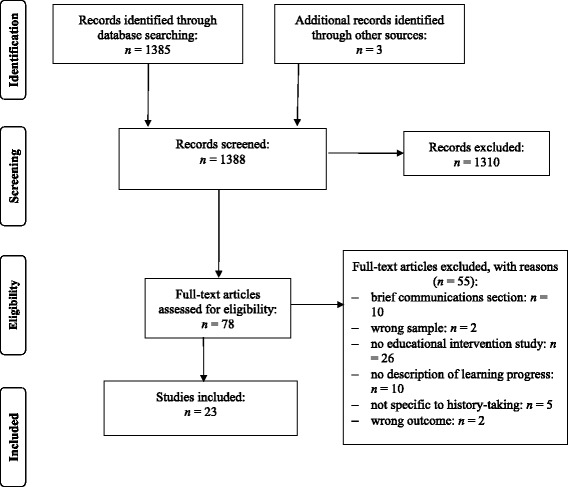
Results: Seventy-eight full-text articles were identified and reviewed; of these, 23 studies met the final inclusion criteria. Three studies applied an instructional approach using scripts, lectures, demonstrations and an online course. Seventeen studies applied a more experiential approach by implementing small group workshops including role-play, interviews with patients and feedback. Three studies applied a creative approach. Two of these studies made use of improvisational theatre and one introduced a simulation using Lego® building blocks. Twenty-two studies reported an improvement in students' history taking skills. Mean MERSQI score was 10.4 (range 6.5 to 14; SD = 2.65).
Conclusions: These findings suggest that several different educational interventions are effective in teaching history taking skills to medical students. Small group workshops including role-play and interviews with real patients, followed by feedback and discussion, are widespread and best investigated. Feedback using videotape review was also reported as particularly instructive. Students in the early preclinical state might profit from approaches helping them to focus on interview skills and not being distracted by thinking about differential diagnoses or clinical management. The heterogeneity of outcome data and the varied ways of assessment strongly suggest the need for further research as many studies did not meet basic methodological criteria. Randomized controlled trials using external assessment methods, standardized measurement tools and reporting long-term data are recommended to evaluate the efficacy of courses on history taking.
Figures
References
-
- Nichols LO, Mirvis DM. Physician-patient communication: does it matter? Tenn. Med. 1998;91(3):94–96. - PubMed
-
- Davidoff F, Deutsch S, Egan KL, Ende J. Who Has Seen A Blood Sugar? - Reflections on Medical Education. Edited by the American College of Physicians. Philadelphia: American College of Physicians; 1996.
-
- Engel GE, Morgan WL. Interviewing and patient care. Philadelphia: Saunders; 1973.
-
- Lipkin M., Jr . The medical interview and related skills. In: Branch W, editor. Office Practice of Medicine. Philadelphia: WB Saunders Co; 1987. pp. 1287–306.
Publication types
MeSH terms
LinkOut - more resources
Full Text Sources
Other Literature Sources
Medical
Miscellaneous
