


Is accurate and reliable blood loss estimation the 'crucial step' in early detection of postpartum haemorrhage: an integrative review of the literature
- PMID: 26415952
- PMCID: PMC4587838
- DOI: 10.1186/s12884-015-0653-6
Is accurate and reliable blood loss estimation the 'crucial step' in early detection of postpartum haemorrhage: an integrative review of the literature
Abstract
Background: Postpartum haemorrhage (PPH) is the leading cause of maternal mortality in low-income countries and severe maternal morbidity in many high-income countries. Poor outcomes following PPH are often attributed to delays in the recognition and treatment of PPH. Experts have suggested that improving the accuracy and reliability of blood loss estimation is the crucial step in preventing death and morbidity from PPH. However, there is little guidance on how this can be achieved. The aim of this integrative review was to evaluate the various methods of assessing maternal blood loss during childbirth.
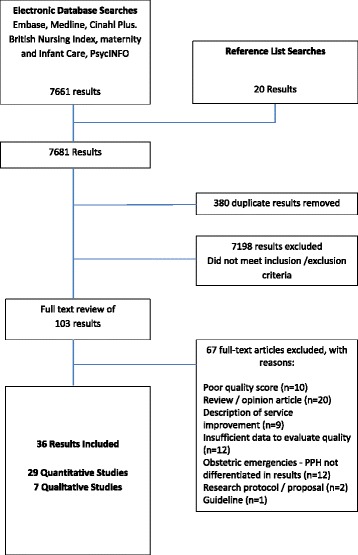
Methods: A systematic, integrative review of published research studies was conducted. All types of studies were included if they developed, tested, or aimed to improve methods and skills in quantifying blood loss during childbirth, or explored experiences of those involved in the process.
Results: Thirty-six studies were included that evaluated the accuracy of visual estimation; tested methods to improve skills in measurement; examined their effect on PPH diagnosis and treatment, and / or explored additional factors associated with blood loss evaluation. The review found that health professionals were highly inaccurate at estimating blood loss as a volume. Training resulted in short term improvements in skills but these were not retained and did not improve clinical outcomes. Multi-faceted interventions changed some clinical practices but did not reduce the incidence of severe PPH or the timing of responses to excessive bleeding. Blood collection bags improved the accuracy of estimation but did not prevent delays or progression to severe PPH. Practitioners commonly used the nature and speed of blood flow, and the condition of the woman to indicate that the blood loss was abnormal.
Conclusions: Early diagnosis of PPH should improve maternal outcomes, but there is little evidence that this can be achieved through improving the accuracy of blood loss volume measurements. The diagnosis may rely on factors other than volume, such as speed of blood flow and nature of loss. A change in direction of future research is required to explore these in more detail.
References
-
- Say L, Chou D, Gemmill A, Tunçalp Ö, Moller AB, Daniels J, et al. Global causes of maternal death: a WHO systematic analysis. Lancet. 2014;2:e323–e333. - PubMed
-
- Knight M, Callaghan W, Berg C, Alexander S, Bouvier-Colle MH, Ford J, et al. Trends in postpartum hemorrhage in high resource countries: a review and recommendations from the International Postpartum Hemorrhage Collaborative Group. BMC Pregnancy Childbirth. 2009;9:55–65. doi: 10.1186/1471-2393-9-55. - DOI - PMC - PubMed
-
- CMACE Saving Mothers’ Lives: Reviewing maternal deaths to make motherhood safer 2006–2008. BJOG. 2011;118:1–203. - PubMed
-
- World Health Organization (WHO) Recommendations on Prevention and Treatment of Postpartum Haemorrhage. Geneva: WHO; 2012. - PubMed
Publication types
MeSH terms
Grants and funding
LinkOut - more resources
Full Text Sources
Other Literature Sources
Medical
