


CD56dimCD57+NKG2C+ NK cell expansion is associated with reduced leukemia relapse after reduced intensity HCT
- PMID: 26416461
- PMCID: PMC4740203
- DOI: 10.1038/leu.2015.260
CD56dimCD57+NKG2C+ NK cell expansion is associated with reduced leukemia relapse after reduced intensity HCT
Abstract
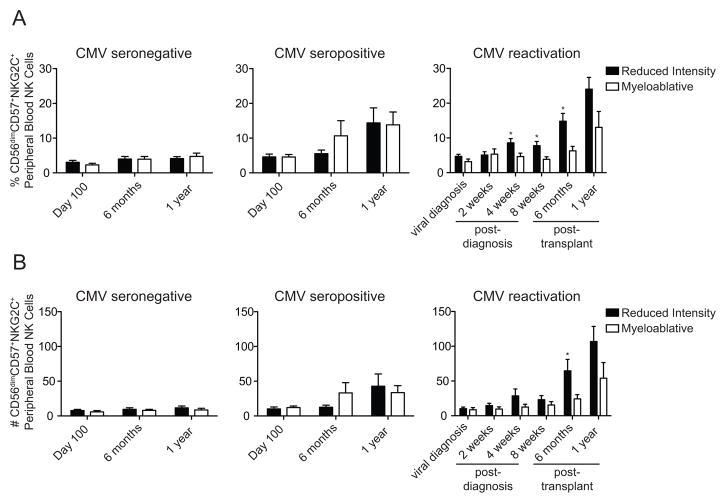
We have recently described a specialized subset of human natural killer (NK) cells with a CD56(dim)CD57(+)NKG2C(+) phenotype that expand specifically in response to cytomegalovirus (CMV) reactivation in hematopoietic cell transplant (HCT) recipients and exhibit properties characteristic of adaptive immunity. We hypothesize that these cells mediate relapse protection and improve post-HCT outcomes. In 674 allogeneic HCT recipients, we found that those who reactivated CMV had lower leukemia relapse (26% (17-35%), P=0.05) and superior disease-free survival (DFS) (55% (45-65%) P=0.04) 1 year after reduced intensity conditioning (RIC) compared with CMV seronegative recipients who experienced higher relapse rates (35% (27-43%)) and lower DFS (46% (38-54%)). This protective effect was independent of age and graft-vs-host disease and was not observed in recipients who received myeloablative regimens. Analysis of the reconstituting NK cells demonstrated that CMV reactivation is associated with both higher frequencies and greater absolute numbers of CD56(dim)CD57(+)NKG2C(+) NK cells, particularly after RIC HCT. Furthermore, expansion of these cells at 6 months posttransplant independently trended toward a lower 2-year relapse risk. Together, our data suggest that the protective effect of CMV reactivation on posttransplant relapse is in part driven by adaptive NK cell responses.
Conflict of interest statement
The authors declare no competing financial interest
Figures


References
-
- Cooley S, Weisdorf DS. Natural killer cells and tumor control. Curr Opin Hematol. 2010;17:514–521. - PubMed
-
- Jacobs R, Stoll M, Stratmann G, Leo R, Link H, Schmidt RE. CD16− CD56+ natural killer cells after bone marrow transplantation. Blood. 1992;79:3239–3244. - PubMed
-
- Nguyen S, Dhedin N, Vernant JP, et al. NK-cell reconstitution after haploidentical hematopoietic stem-cell transplantations: immaturity of NK cells and inhibitory effect of NKG2A override GvL effect. Blood. 2005;105:4135–4142. - PubMed
-
- Vago L, Forno B, Sormani MP, et al. Temporal, quantitative, and functional characteristics of single-KIR-positive alloreactive natural killer cell recovery account for impaired graft-versus-leukemia activity after haploidentical hematopoietic stem cell transplantation. Blood. 2008;112:3488–3499. - PubMed
Publication types
MeSH terms
Substances
Grants and funding
- 1R01 CA181045/CA/NCI NIH HHS/United States
- P30 CA77598/CA/NCI NIH HHS/United States
- P30CA033572/CA/NCI NIH HHS/United States
- P30 CA077598/CA/NCI NIH HHS/United States
- R01 CA181045/CA/NCI NIH HHS/United States
- P01 CA065493/CA/NCI NIH HHS/United States
- R01 CA077544/CA/NCI NIH HHS/United States
- 5R01 CA077544/CA/NCI NIH HHS/United States
- UL1 TR000114/TR/NCATS NIH HHS/United States
- R01 HL122216/HL/NHLBI NIH HHS/United States
- R01CA72669/CA/NCI NIH HHS/United States
- R35 CA197292/CA/NCI NIH HHS/United States
- P01 CA111412/CA/NCI NIH HHS/United States
- P30 CA033572/CA/NCI NIH HHS/United States
- R01 CA072669/CA/NCI NIH HHS/United States
LinkOut - more resources
Full Text Sources
Other Literature Sources
Medical
Research Materials
Miscellaneous
