. 2015 May;1(1):52-59.
doi: 10.1159/000380765.

Disordered ripples are a common feature of genetically distinct mouse models relevant to schizophrenia

Affiliations

Disordered ripples are a common feature of genetically distinct mouse models relevant to schizophrenia

Cara Altimus et al. Mol Neuropsychiatry. 2015 May.

Abstract

We present results from a novel comparative approach to the study of mechanisms of psychiatric disease. Previous work examined neural activity patterns in the hippocampus of a freely behaving mouse model associated with schizophrenia, the calcineurin knockout mouse. Here we examined a genetically distinct mouse that exhibits a similar set of behavioral phenotypes associated with schizophrenia, a transgenic model expressing a putative dominant-negative DISC1 (DN-DISC1). Strikingly, the principal finding of the earlier work is replicated in the DN-DISC1 mice, that is, a selective increase in the numbers of sharp-wave ripple events in the local hippocampal LFP, while at the same time other LFP patterns such as theta and gamma are unaffected. Sharp-wave ripples are thought to arise from hippocampal circuits, and reflect the coordinated activity of the principal excitatory cells of the hippocampus, in specific patterns that represent reactivated memories of previous experiences and imagined future experiences that predict behavior. These findings suggest that multiple genetic alterations could converge on distinct patterns of aberrant neurophysiological function to give rise to common behavioral phenotypes in psychiatric disease.


Figures
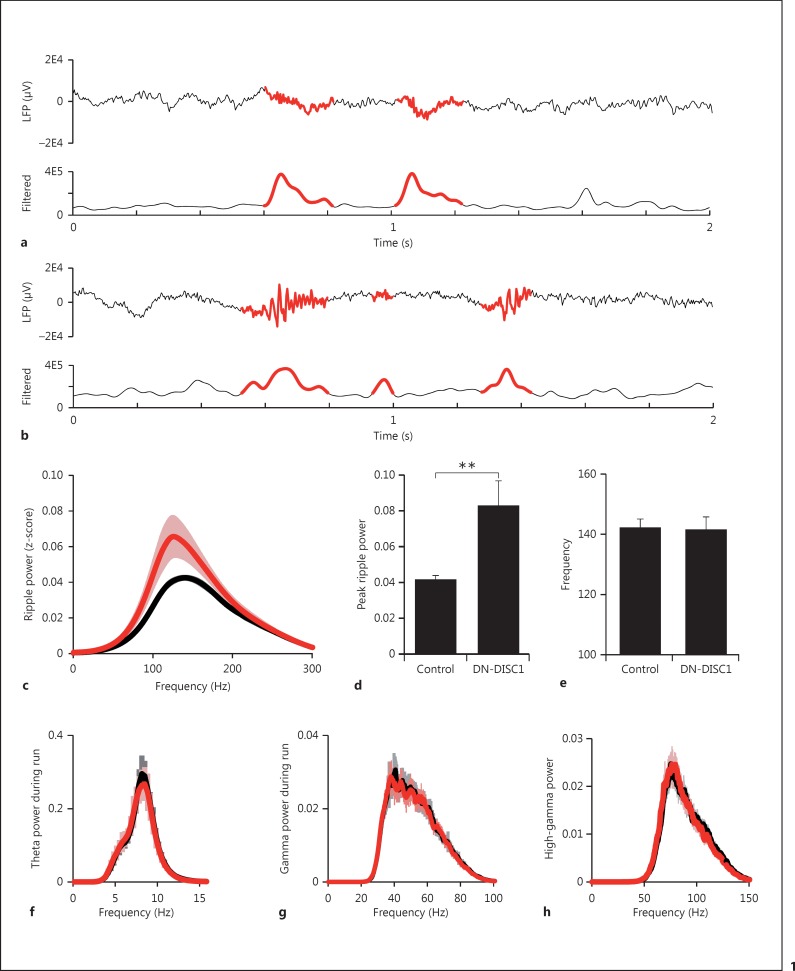
Fig. 1
Fig. 1
DN-DISC1 animals show specific alterations in ripple activity. For both control (a) and DN-DISC1 (b) animals, the average of 3 LFP traces is shown in the upper panels with ripple events highlighted in red. In the lower panels, the amplitude of the filtered trace is shown with ripple events highlighted in red. c Comparison of spectral power of z-scored EEG filtered in the ripple frequency band (100-300 Hz) for control (black) and DN-DISC1 (red) animals during quiet wake ripple events. The mean total power of ripple events is more than 2-fold increased in DN-DISC1 animals (d); however, no change is observed in the peak ripple frequency of DN-DISC1 animals (e). f Spectral power of z-scored EEG filtered in the theta frequency band (4-12 Hz) during run shows overall similarity between control (black) and DN-DISC1 animals (red) of the run-associated oscillatory activity. g Spectral power of gamma (25-80) during run. h Spectral power in high gamma (65-140) during quiet wake. No changes were found between control and DN-DISC1 animals in either peak frequency or mean total power for theta, gamma, or high-gamma frequency ranges. ** p < 0.01.
Fig. 2
Fig. 2
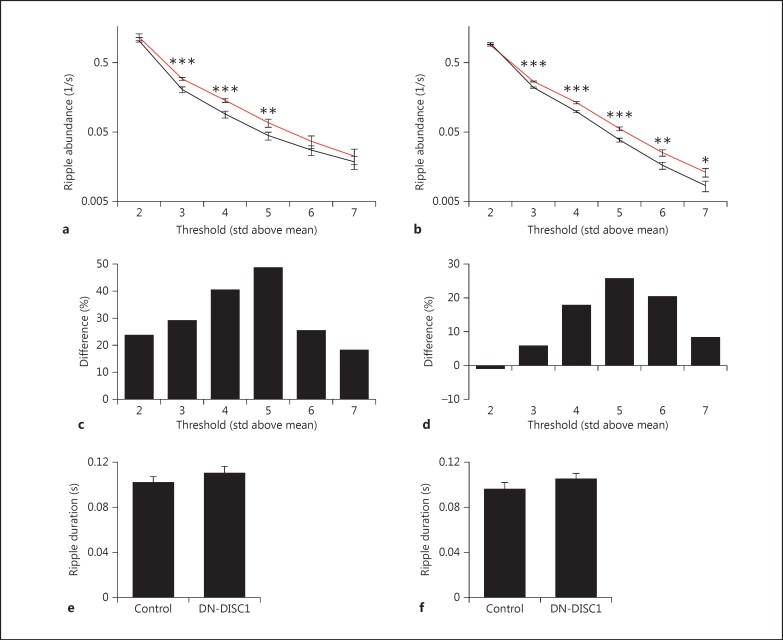
DN-DISC1 animals have increased ripple activity. The number of ripple events per second is significantly greater in DN-DISC1 animals across multiple thresholds (2-7 SD) on the track (a) and in the home cage (b). * p < 0.05; ** p < 0.01; *** p < 0.001. Binned data show that the most dramatic increase in events occurs between 4 and 6 SD above the mean and tapers at thresholds above and below both on the track (c) and in the home cage (d). No change in ripple duration was detected between control and DN-DISC1 animals on the track (e) and in the home cage (f).

References

    1. McCarroll SA, Hyman SE. Progress in the genetics of polygenic brain disorders: significant new challenges for neurobiology. Neuron. 2013;80:578–587. - PMC - PubMed
    1. O'Tuathaigh CM, Waddington JL. Mutant mouse models: phenotypic relationships to domains of psychopathology and pathobiology in schizophrenia. Schizophr Bull. 2010;36:243–245. - PMC - PubMed
    1. Zeng H, Chattarji S, Barbarosie M, Rondi-Reig L, Philpot BD, Miyakawa T, Bear MF, Tonegawa S. Forebrain-specific calcineurin knockout selectively impairs bidirectional synaptic plasticity and working/episodic-like memory. Cell. 2001;107:617–629. - PubMed
    1. Miyakawa T, Leiter LM, Gerber DJ, Gainetdinov RR, Sotnikova TD, Zeng H, Caron MG, Tonegawa S. Conditional calcineurin knockout mice exhibit multiple abnormal behaviors related to schizophrenia. Proc Natl Acad Sci USA. 2003;100:8987–8992. - PMC - PubMed
    1. Suh J, Foster DJ, Davoudi H, Wilson MA, Tonegawa S. Impaired hippocampal ripple-associated replay in a mouse model of schizophrenia. Neuron. 2013;80:484–493. - PMC - PubMed

LinkOut - more resources