Review
. 2015:2015:678164.
doi: 10.1155/2015/678164. Epub 2015 Aug 31.

The Bidirectional Relationship between Sleep and Immunity against Infections

Affiliations
Review

The Bidirectional Relationship between Sleep and Immunity against Infections

Elizabeth G Ibarra-Coronado et al. J Immunol Res. 2015.

Abstract

Sleep is considered an important modulator of the immune response. Thus, a lack of sleep can weaken immunity, increasing organism susceptibility to infection. For instance, shorter sleep durations are associated with a rise in suffering from the common cold. The function of sleep in altering immune responses must be determined to understand how sleep deprivation increases the susceptibility to viral, bacterial, and parasitic infections. There are several explanations for greater susceptibility to infections after reduced sleep, such as impaired mitogenic proliferation of lymphocytes, decreased HLA-DR expression, the upregulation of CD14+, and variations in CD4+ and CD8+ T lymphocytes, which have been observed during partial sleep deprivation. Also, steroid hormones, in addition to regulating sexual behavior, influence sleep. Thus, we hypothesize that sleep and the immune-endocrine system have a bidirectional relationship in governing various physiological processes, including immunity to infections. This review discusses the evidence on the bidirectional effects of the immune response against viral, bacterial, and parasitic infections on sleep patterns and how the lack of sleep affects the immune response against such agents. Because sleep is essential in the maintenance of homeostasis, these situations must be adapted to elicit changes in sleep patterns and other physiological parameters during the immune response to infections to which the organism is continuously exposed.


Figures

Figure 1
Figure 1
Connectivity between viral infections and sleep. Sleep disorders that are caused by parasites include increased duration of slow sleep wave (SWS), periods of wakefulness, and a decrease in rapid eye movement sleep (REM), as well as, in general, sleep efficiency. Other disorders comprise alterations in electroencephalographic characteristics, such as reductions in sleep-spindle and K-complex densities. These changes may be caused by activation of the immune system and the consequent production of cytokines that have various effects on CNS structures, modulating the form and quantity of sleep. Such pathogens can disrupt sleep indirectly, causing respiratory dysfunction, obsessive-compulsive disorder, and mutism, all leading to sleep disturbances, such as sleep apnea-hypopnea syndrome, that accompany psychiatric disorders.
Figure 2
Figure 2
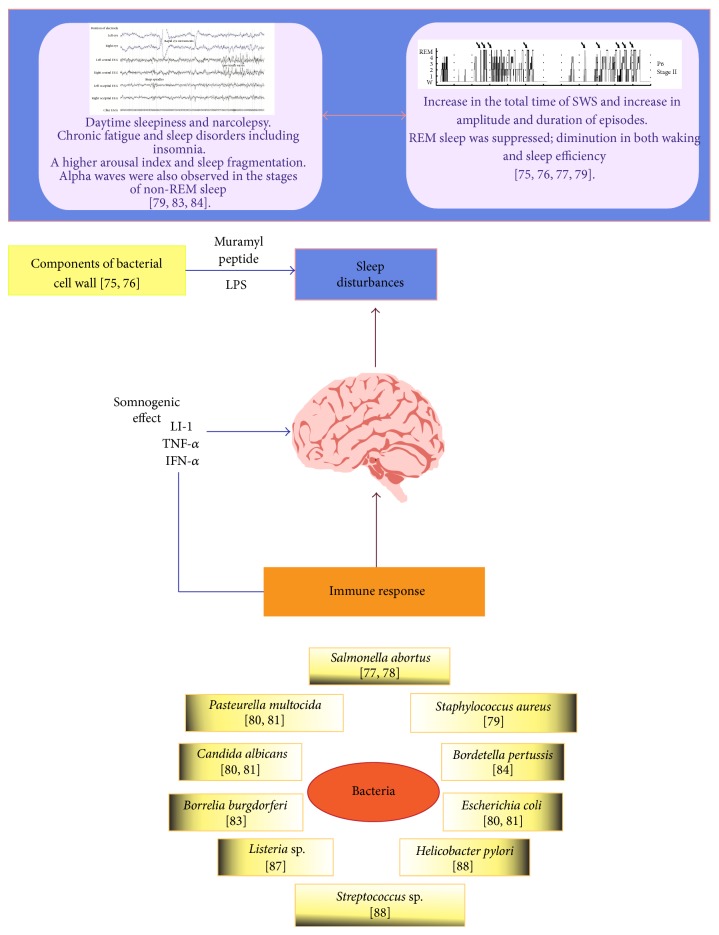
Effect of bacterial infections on the sleep process. The sleep disorders that are caused by bacteria include daytime sleepiness and narcolepsy, chronic fatigue, and insomnia, which are accompanied by higher arousal index and sleep fragmentation. Bacterial infections also cause other alterations, such as increases in the duration of slow sleep wave (SWS) and periods of wakefulness. Also, rapid eye movement (REM) sleep and sleep efficiency decrease in bacterial infections. Wall components of bacteria (primarily LPS) are strong inducers of proinflammatory cytokines, which is one possible mechanism by which the infection causes sleep disorders.
Figure 3
Figure 3
Relationship between sleep and parasitic infections. The sleep disorders that are caused by parasites include changes in sleep patterns, such as the amount of total sleep, and in the duration of each stage (wakefulness, sleep stages 1 and 2, slow wave sleep, and REM sleep). Other disorders comprise alterations in the sleep-wake transition at sleep onset and between sleep stages and electroencephalographic disorders. The disorders in parasitic infections, such as trypanosomiasis and trichinosis, have an immune component. The prostaglandins PGD2, PGE2, and PGF2a are induced by these infections; PGDs are somnogenic substances, explaining the effects of these parasites on sleep. The disorders in sleep due to parasites can modify certain behaviors to facilitate parasitic infection and completion of the life cycle.
Figure 4
Figure 4
Bidirectional interactions between immunity to infections and sleep. The immune response to the invasion of a pathogen and the consequent secretion of immunological mediators, such as interleukins and cytokines, are accompanied by responses by the endocrine and nervous systems, such as the secretion of cortisol and epinephrine. These substances can cross the blood-brain barrier to reach their receptors in various neural structures or may have a vagal input to modulate the responses that maintain homeostasis. This modulation can also be exploited by pathogens to ensure establishment of the infection and completion of its life cycle. However, this series of events has a complex relationship: infections can modulate patterns of behavior, such as sleep, and such primary functions can alter immune and endocrine system functions. For example, the effects of sleep deprivation on the immune and endocrine response support that sleep is fundamental in maintaining homeostasis—its absence leads to physiological disorders and possibly death. Thus, complex systems must be studied to identify the interactions between 2 or more variables in various contexts to determine the mechanisms that are involved in preserving this balance.

References

    1. Benington J. H., Heller H. C. Restoration of brain energy metabolism as the function of sleep. Progress in Neurobiology. 1995;45(4):347–360. doi: 10.1016/0301-0082(94)00057-o. - DOI - PubMed
    1. Mackiewicz M., Shockley K. R., Romer M. A., et al. Macromolecule biosynthesis: a key function of sleep. Physiological Genomics. 2007;31(3):441–457. doi: 10.1152/physiolgenomics.00275.2006. - DOI - PubMed
    1. Dimitrov S., Lange T., Nohroudi K., Born J. Number and function of circulating human antigen presenting cells regulated by sleep. Sleep. 2007;30(4):401–411. - PubMed
    1. Yehuda S., Sredni B., Carasso R. L., Kenigsbuch-Sredni D. REM sleep deprivation in rats results in inflammation and interleukin-17 elevation. Journal of Interferon & Cytokine Research. 2009;29(7):393–398. doi: 10.1089/jir.2008.0080. - DOI - PubMed
    1. Zager A., Andersen M. L., Ruiz F. S., Antunes I. B., Tufik S. Effects of acute and chronic sleep loss on immune modulation of rats. The American Journal of Physiology—Regulatory Integrative and Comparative Physiology. 2007;293(1):R504–R509. doi: 10.1152/ajpregu.00105.2007. - DOI - PubMed

Publication types

LinkOut - more resources