


The HAS-BLED Score for Predicting Major Bleeding Risk in Anticoagulated Patients With Atrial Fibrillation: A Systematic Review and Meta-analysis
- PMID: 26418409
- PMCID: PMC6490831
- DOI: 10.1002/clc.22435
The HAS-BLED Score for Predicting Major Bleeding Risk in Anticoagulated Patients With Atrial Fibrillation: A Systematic Review and Meta-analysis
Abstract
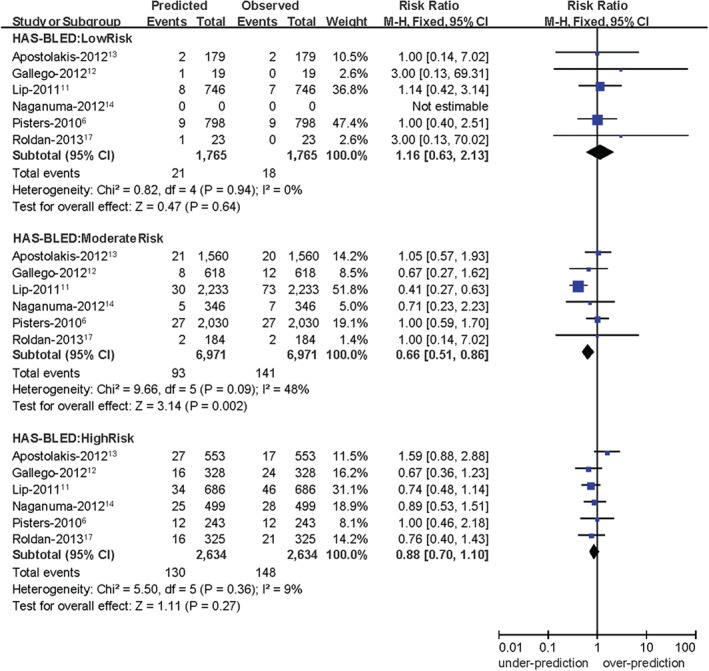
Our objective was to compare the diagnostic accuracy between the HAS-BLED score and any of HEMORR2 HAGES, ATRIA, CHADS2 , or CHA2 DS2 -VASc scores in anticoagulated patients with atrial fibrillation. We systematically searched the Cochrane Library, MEDLINE, PubMed, and Embase databases for relevant studies. Data were extracted and analyzed according to predefined clinical endpoints. Eleven studies were identified. Discrimination analysis demonstrates that HAS-BLED has no significant C-statistic differences for bleeding risk prediction compared with ATRIA or HEMORR2 HAGES, but it has significant differences compared with CHADS2 or CHA2 DS2 -VASc. The significant positive net reclassification improvement and integrated discrimination improvement values also show that HAS-BLED is superior to that of any of HEMORR2 HAGES, ATRIA, CHADS2 , or CHA2 DS2 -VASc scores. According to calibration analysis of HAS-BLED, it overpredicts the risk of bleeding in the low (risk ratio [RR]: 1.16, 95% confidence interval [CI]: 0.63-2.13, P = 0.64) risk stratification but underpredicts that in the moderate (RR: 0.66, 95% CI: 0.51-0.86, P = 0.002) and high (RR: 0.88, 95% CI: 0.70-1.10, P = 0.27) risk stratifications. The HAS-BLED score not only performs better than the HEMORR2 HAGES and ATRIA bleeding scores, but it also is superior to the CHADS2 and CHA2 DS2 -VASc stroke scores for bleeding prediction. The HAS-BLED score should be the optimal choice to assess major bleeding risk in clinical practice.
© 2015 Wiley Periodicals, Inc.
Figures
Comment in
-
Assessing Bleeding Risk With the HAS-BLED Score: Balancing Simplicity, Practicality, and Predictive Value in Bleeding-Risk Assessment.Clin Cardiol. 2015 Sep;38(9):562-4. doi: 10.1002/clc.22436. Clin Cardiol. 2015. PMID: 26418410 Free PMC article. No abstract available.
References
-
- Lloyd‐Jones D, Adams RJ, Brown TM, et al. Executive summary: heart disease and stroke statistics—2010 update: a report from the American Heart Association [published correction appears in Circulation. 2010;121:e259]. Circulation. 2010;121:948–954. - PubMed
-
- Camm AJ, Lip GY, De Caterina R, et al. 2012 focused update of the ESC Guidelines for the management of atrial fibrillation: an update of the 2010 ESC Guidelines for the management of atrial fibrillation—developed with the special contribution of the European Heart Rhythm Association. Europace. 2012;14:1385–1413. - PubMed
-
- Gorin L, Fauchier L, Nonin E, et al. Prognosis and guideline‐adherent antithrombotic treatment in patients with atrial fibrillation and atrial flutter: implications of undertreatment and overtreatment in real‐life clinical practice: the Loire Valley Atrial Fibrillation Project. Chest. 2011;140:911–917. - PubMed
-
- Gage BF, Yan Y, Milligan PE, et al. Clinical classification schemes for predicting hemorrhage: results from the National Registry of Atrial Fibrillation (NRAF). Am Heart J. 2006;151:713–719. - PubMed
Publication types
MeSH terms
Substances
LinkOut - more resources
Full Text Sources
Other Literature Sources
Medical
