


Genetic parameters and signatures of selection in two divergent laying hen lines selected for feather pecking behaviour
- PMID: 26419343
- PMCID: PMC4589119
- DOI: 10.1186/s12711-015-0154-0
Genetic parameters and signatures of selection in two divergent laying hen lines selected for feather pecking behaviour
Abstract
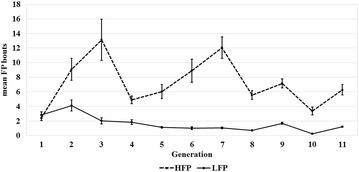
Background: Feather pecking (FP) in laying hens is a well-known and multi-factorial behaviour with a genetic background. In a selection experiment, two lines were developed for 11 generations for high (HFP) and low (LFP) feather pecking, respectively. Starting with the second generation of selection, there was a constant difference in mean number of FP bouts between both lines. We used the data from this experiment to perform a quantitative genetic analysis and to map selection signatures.
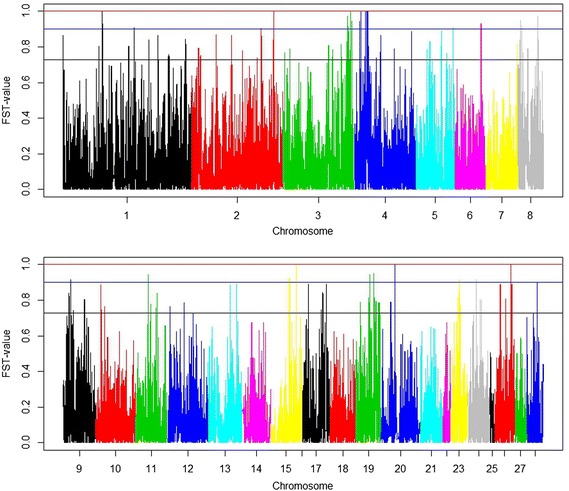
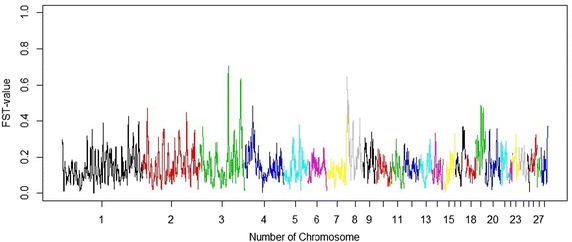
Methods: Pedigree and phenotypic data were available for the last six generations of both lines. Univariate quantitative genetic analyses were conducted using mixed linear and generalized mixed linear models assuming a Poisson distribution. Selection signatures were mapped using 33,228 single nucleotide polymorphisms (SNPs) genotyped on 41 HFP and 34 LFP individuals of generation 11. For each SNP, we estimated Wright's fixation index (FST). We tested the null hypothesis that FST is driven purely by genetic drift against the alternative hypothesis that it is driven by genetic drift and selection.
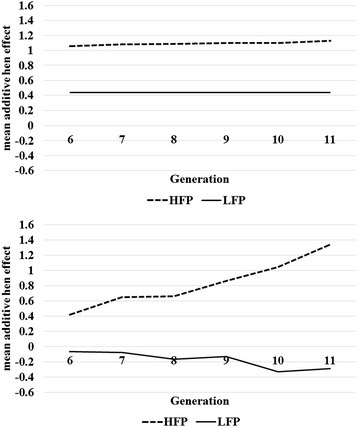
Results: The mixed linear model failed to analyze the LFP data because of the large number of 0s in the observation vector. The Poisson model fitted the data well and revealed a small but continuous genetic trend in both lines. Most of the 17 genome-wide significant SNPs were located on chromosomes 3 and 4. Thirteen clusters with at least two significant SNPs within an interval of 3 Mb maximum were identified. Two clusters were mapped on chromosomes 3, 4, 8 and 19. Of the 17 genome-wide significant SNPs, 12 were located within the identified clusters. This indicates a non-random distribution of significant SNPs and points to the presence of selection sweeps.
Conclusions: Data on FP should be analysed using generalised linear mixed models assuming a Poisson distribution, especially if the number of FP bouts is small and the distribution is heavily peaked at 0. The FST-based approach was suitable to map selection signatures that need to be confirmed by linkage or association mapping.
Figures
References
-
- Van Krimpen MM, Kwakkel RP, Reuvekamp BFJ, Van Der Peet-Schwering CMC, Den Hartog LA, Verstegen MWA. Impact of feeding management on feather pecking in laying hens. World Poult Sci J. 2005;61:663–686. doi: 10.1079/WPS200478. - DOI
-
- Kjaer JB, Bessei W. The interrelationships of nutrition and feather pecking in the domestic fowl. Arch Geflügelk. 2013;77:1–9.
-
- Wysocki M, Bessei W, Kjaer JB, Bennewitz J. Genetic and physiological factors influencing feather pecking in chickens. World Poultry Sci J. 2010;66:659–671. doi: 10.1017/S0043933910000644. - DOI
Publication types
MeSH terms
LinkOut - more resources
Full Text Sources
Other Literature Sources
Miscellaneous
