


The developmental inter-relationships between activity, novelty preferences, and delay discounting in male and female rats
- PMID: 26419783
- PMCID: PMC5237806
- DOI: 10.1002/dev.21368
The developmental inter-relationships between activity, novelty preferences, and delay discounting in male and female rats
Abstract
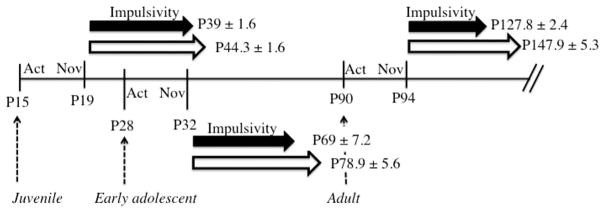
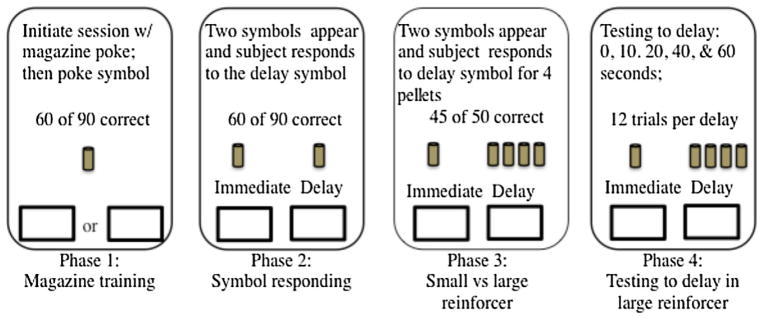
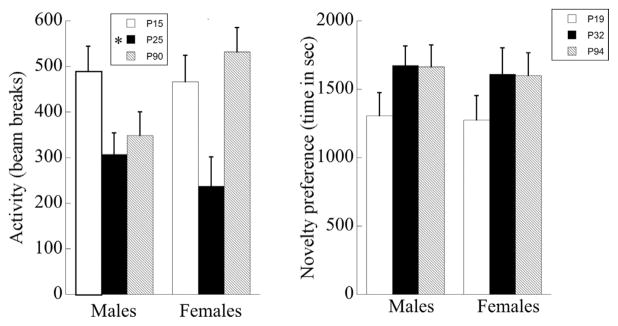
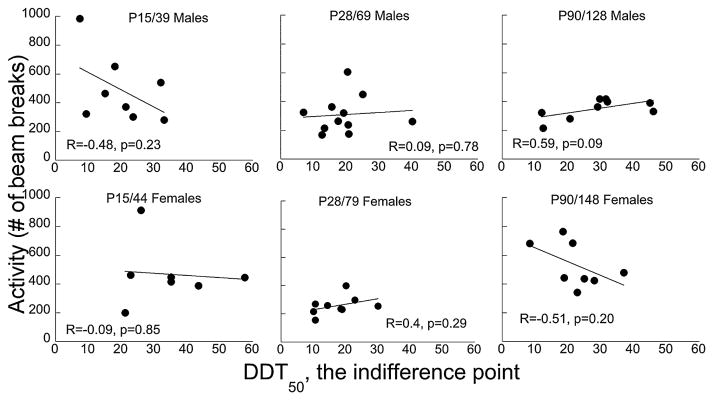
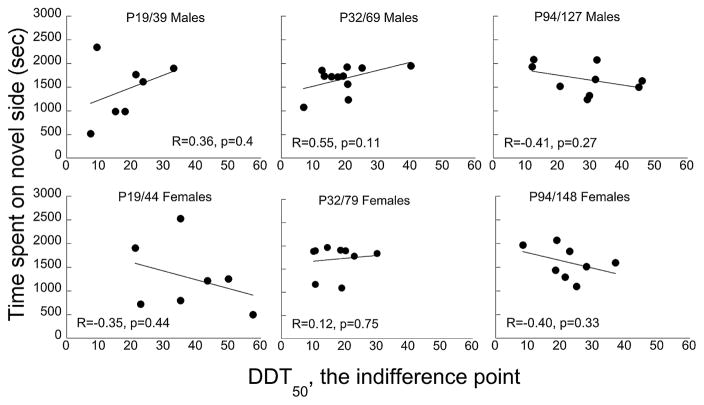
Increased locomotion, novelty-seeking, and impulsivity are risk factors associated with substance use. In this study, the inter-relationships between activity, novelty preferences, and delay discounting, a measure of impulsivity, were examined across three stages: juvenile/early adolescence (postnatal Day [P] 15, 19, and 42 for activity, novelty, and impulsivity, respectively), adolescent/late adolescent (P28, 32, 73), and adult (P90, 94, 137) in male and female rats. Our estimates of impulsive choice, where animals were trained to criterion, revealed an age × sex interaction where early adolescent females had the lowest levels of impulsivity. The relationships of activity and novelty to impulsivity significantly changed across age within each sex. Early adolescent males with high activity, but low novelty preferences, were more impulsive; however, low activity and high novelty preferences were related to high impulsivity in adult males. Female activity gradually increased across age, but did not show a strong relationship with impulsivity. Novelty preferences are moderately related to impulsivity into adulthood in females. These data show that males and females have different developmental trajectories for these behaviors. Males show greater sensation-seeking (e.g., activity) and risky behavior (e.g., novelty preferences) earlier in life, whereas these behaviors emerge during adolescence in females.
Keywords: delay discounting; development; impulsivity; novelty; rat; sex differences.
© 2015 Wiley Periodicals, Inc.
Conflict of interest statement
The authors have no conflict of interests to declare.
Figures


References
-
- Adriani W, Laviola G. Elevated levels of impulsivity and reduced place conditioning with d-amphetamine: Two behavioral features of adolescence in mice. Behavioral Neuroscience. 2003;117:695–703. - PubMed
-
- Adriani W, Chiarotti F, Laviola G. Elevated novelty seeking and peculiar d-amphetamine sensitization in periadolescent mice compared with adult mice. Behavioral Neuroscience. 1998;112:1152–1166. - PubMed
-
- Andersen SL. Trajectories of brain development: Point of vulnerability or window of opportunity? Neuro-science and Biobehavioral Reviews. 2003;27:3–18. - PubMed
-
- Bardo MT, Rowlett JK, Harris MJ. Conditioned place preference using opiate and stimulant drugs: A meta-analysis. Neuroscience and Biobehavioral Reviews. 1995;19:39–51. - PubMed
Publication types
MeSH terms
Grants and funding
LinkOut - more resources
Full Text Sources
Other Literature Sources
