Review
. 2015 Nov;65(6):483-98.
doi: 10.1007/s12576-015-0399-y. Epub 2015 Sep 29.

Frontier studies on fatigue, autonomic nerve dysfunction, and sleep-rhythm disorder

Affiliations
Review

Frontier studies on fatigue, autonomic nerve dysfunction, and sleep-rhythm disorder

Masaaki Tanaka et al. J Physiol Sci. 2015 Nov.

Abstract

Fatigue is defined as a condition or phenomenon of decreased ability and efficiency of mental and/or physical activities, caused by excessive mental or physical activities, diseases, or syndromes. It is often accompanied by a peculiar sense of discomfort, a desire to rest, and reduced motivation, referred to as fatigue sensation. Acute fatigue is a normal condition or phenomenon that disappears after a period of rest; in contrast, chronic fatigue, lasting at least 6 months, does not disappear after ordinary rest. Chronic fatigue impairs activities and contributes to various medical conditions, such as cardiovascular disease, epileptic seizures, and death. In addition, many people complain of chronic fatigue. For example, in Japan, more than one third of the general adult population complains of chronic fatigue. It would thus be of great value to clarify the mechanisms underlying chronic fatigue and to develop efficient treatment methods to overcome it. Here, we review data primarily from behavioral, electrophysiological, and neuroimaging experiments related to neural dysfunction as well as autonomic nervous system, sleep, and circadian rhythm disorders in fatigue. These data provide new perspectives on the mechanisms underlying chronic fatigue and on overcoming it.

Keywords: Autonomic nervous system; Central nervous system; Circadian rhythm; Fatigue; Sleep.


Conflict of interest statement

The authors declare that we have no conflict of interest.

Figures
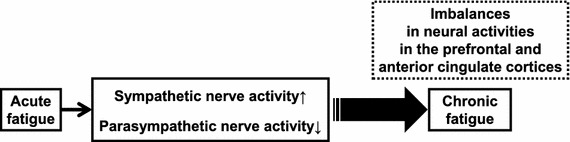
Fig. 1
Fig. 1
Autonomic function can be evaluated by electrocardiography or plethysmography. Frequency analysis of the data obtained from electrocardiography and accelerated plethysmography have revealed that enhanced sympathetic nerve activity based on a decrease in parasympathetic nerve activity is common in acute, sub-acute, and chronic fatigue. Alteration of autonomic function may result in changes and imbalances in neural activities in the central autonomic network of the brain, including the prefrontal and anterior cingulate cortices. Several interventions for the alleviation of fatigue are effective in decreasing sympathetic nerve activity. Evaluation of autonomic function contributes to investigating the effects of interventions for recovery from fatigue
Fig. 2
Fig. 2
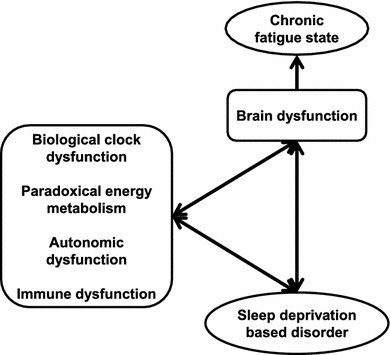
Chronic fatigue state induced by sleep deprivation. Accumulation of sleep deprivation caused brain dysfunction with/without biological dysfunctions. Fundamental biofunctions (biological clock, energy metabolism, autonomic activity, and immune system), sleep disorders, and brain functions interacted with each other and created negative chains. Chronic fatigue state was observed as the output of brain dysfunctions
Fig. 3
Fig. 3
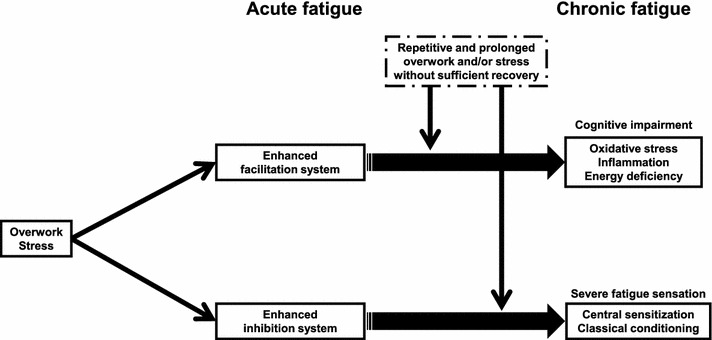
Hypothetical model of the development of chronic fatigue. When subjects are acutely fatigued through overwork and/or stress, they progressively increase their voluntary effort to maintain their performance to compensate for acute fatigue until the work requires a maximal effort. At that point, the facilitation system in the central nervous system is activated to overcome acute fatigue. The facilitation system consists of a re-entrant neural circuit that interconnects the limbic system, basal ganglia, thalamus, orbitofrontal cortex, prefrontal cortex, and anterior cingulate cortex, and a motivational input activates this system. In addition, as subjects become acutely fatigued, an alarm signal to take a rest (inhibitory system) is activated to avoid further fatigue. The inhibition system consists of a neural pathway that involves the insular and posterior cingulate cortices. After repetitive and prolonged overwork and/or stress that activates the facilitation system without sufficient recovery, the facilitation system dysfunctions, through neural damage to it caused by oxidative stress, inflammation, and energy deficiency. Subjects express impaired information processing in the central nervous system. In addition, repetitive and prolonged overwork and/or stress cause central sensitization and classical conditioning of the inhibition system. This conditioned inhibition system occurs in subjects with chronic fatigue, resulting in a long-lasting alarm signal to take a rest and a severe sustained fatigue sensation and functional disabilities
Fig. 4
Fig. 4
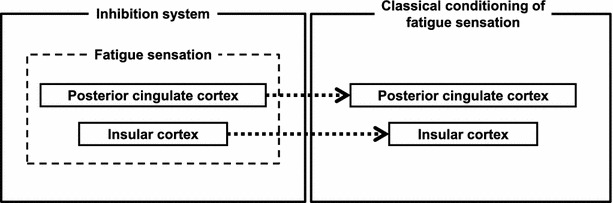
The brain regions involved in the neural mechanisms of fatigue sensation and those of classical conditioning of fatigue sensation. The neural mechanisms of fatigue sensation, which constitute the inhibition system of fatigue, include the posterior cingulate and insular cortices. The posterior cingulate and insular cortices are also involved in the neural mechanisms of the classical conditioning of fatigue sensation

References

    1. Kanaya N, Hirata N, Kurosawa S, Nakayama M, Namiki A. Differential effects of propofol and sevoflurane on heart rate variability. Anesthesiology. 2003;98:34–40. doi: 10.1097/00000542-200301000-00009. - DOI - PubMed
    1. Takusagawa M, Komori S, Umetani K, Ishihara T, Sawanobori T, Kohno I, Sano S, Yin D, Ijiri H, Tamura K. Alterations of autonomic nervous activity in recurrence of variant angina. Heart. 1999;82:75–81. doi: 10.1136/hrt.82.1.75. - DOI - PMC - PubMed
    1. No authors listed Heart rate variability: standards of measurement, physiological interpretation and clinical use. Task Force of the European Society of Cardiology and the North American Society of Pacing and Electrophysiology. Circulation. 1996;93:1043–1065. doi: 10.1161/01.CIR.93.5.1043. - DOI - PubMed
    1. Akselrod S, Gordon D, Ubel FA, Shannon DC, Barger AC, Cohen RJ. Power spectrum analysis of heart rate fluctuation: a quantitative probe of beat-to-beat cardiovascular control. Science. 1981;213:220–222. doi: 10.1126/science.6166045. - DOI - PubMed
    1. Pomeranz B, Macaulay RJ, Caudill MA, Kutz I, Adam D, Gordon D, Kilborn KM, Barger AC, Shannon DC, Cohen RJ, et al. Assessment of autonomic function in humans by heart rate spectral analysis. Am J Physiol. 1985;248:151–153. - PubMed

Publication types

MeSH terms