


Mesenchymal stem cell therapy for cirrhosis: Present and future perspectives
- PMID: 26420953
- PMCID: PMC4579873
- DOI: 10.3748/wjg.v21.i36.10253
Mesenchymal stem cell therapy for cirrhosis: Present and future perspectives
Abstract
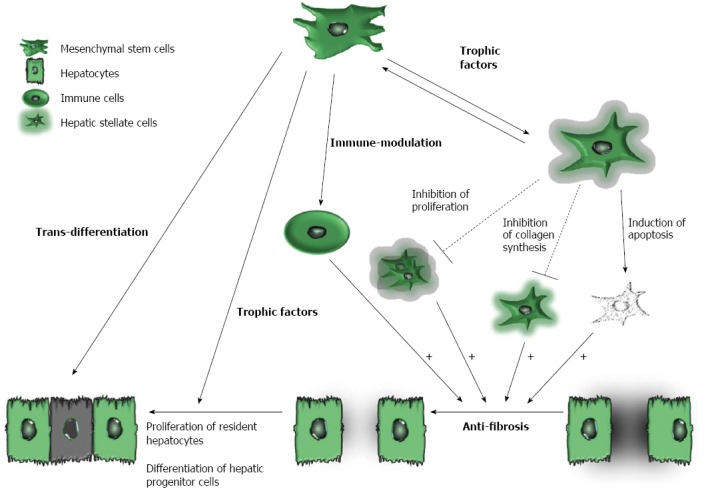
Cirrhosis occurs as a result of various chronic liver injuries, which may be caused by viral infections, alcohol abuse and the administration of drugs and chemicals. Recently, bone marrow cells (BMCs), hematopoietic stem cells (HSCs) and mesenchymal stem cells (MSCs) have been used for developing treatments for cirrhosis. Clinical trials have investigated the therapeutic potential of BMCs, HSCs and MSCs for the treatment of cirrhosis based on their potential to differentiate into hepatocytes. Although the therapeutic mechanisms of BMC, HSC and MSC treatments are still not fully characterized, the evidence thus far has indicated that the potential therapeutic mechanisms of MSCs are clearer than those of BMCs or HSCs with respect to liver regenerative medicine. MSCs suppress inflammatory responses, reduce hepatocyte apoptosis, increase hepatocyte regeneration, reverse liver fibrosis and enhance liver functionality. This paper summarizes the clinical studies that have used BMCs, HSCs and MSCs in patients with liver failure or cirrhosis. We also present the potential therapeutic mechanisms of BMCs, HSCs and MSCs for the improvement of liver function.
Keywords: Anti-fibrosis; Bone marrow cells; Cell therapy; Cirrhosis; Hematopoietic stem cells; Immune-modulation; Mesenchymal stem cells; Trophic factors.
Figures
References
-
- Fallowfield JA, Iredale JP. Targeted treatments for cirrhosis. Expert Opin Ther Targets. 2004;8:423–435. - PubMed
-
- Theise ND, Nimmakayalu M, Gardner R, Illei PB, Morgan G, Teperman L, Henegariu O, Krause DS. Liver from bone marrow in humans. Hepatology. 2000;32:11–16. - PubMed
-
- Houlihan DD, Newsome PN. Critical review of clinical trials of bone marrow stem cells in liver disease. Gastroenterology. 2008;135:438–450. - PubMed
-
- Souza BS, Nogueira RC, de Oliveira SA, de Freitas LA, Lyra LG, Ribeiro dos Santos R, Lyra AC, Soares MB. Current status of stem cell therapy for liver diseases. Cell Transplant. 2009;18:1261–1279. - PubMed
Publication types
MeSH terms
LinkOut - more resources
Full Text Sources
Other Literature Sources
Medical
