


Neuroanatomic Differences Associated With Stress Susceptibility and Resilience
- PMID: 26422005
- PMCID: PMC5885767
- DOI: 10.1016/j.biopsych.2015.08.009
Neuroanatomic Differences Associated With Stress Susceptibility and Resilience
Abstract
Background: We examined the neurobiological mechanisms underlying stress susceptibility using structural magnetic resonance imaging and diffusion tensor imaging to determine neuroanatomic differences between stress-susceptible and resilient mice. We also examined synchronized anatomic differences between brain regions to gain insight into the plasticity of neural networks underlying stress susceptibility.
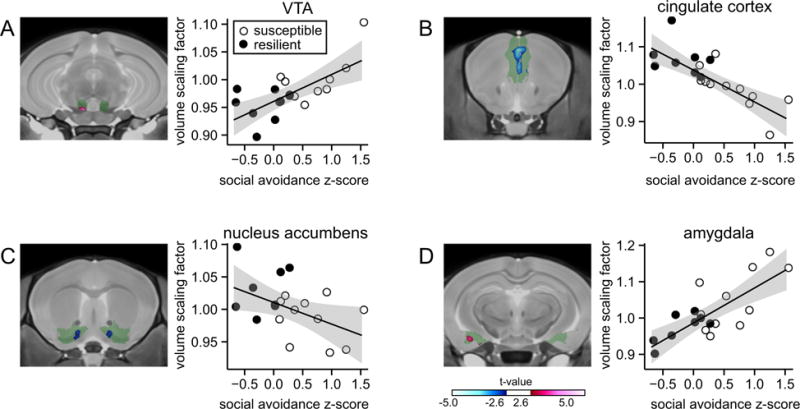
Methods: C57BL/6 mice underwent 10 days of social defeat stress and were subsequently tested for social avoidance. For magnetic resonance imaging, brains of stressed (susceptible, n = 11; resilient, n = 8) and control (n = 12) mice were imaged ex vivo at 56 µm resolution using a T2-weighted sequence. We tested for behavior-structure correlations by regressing social avoidance z-scores against local brain volume. For diffusion tensor imaging, brains were scanned with a diffusion-weighted fast spin echo sequence at 78 μm isotropic voxels. Structural covariance was assessed by correlating local volume between brain regions.
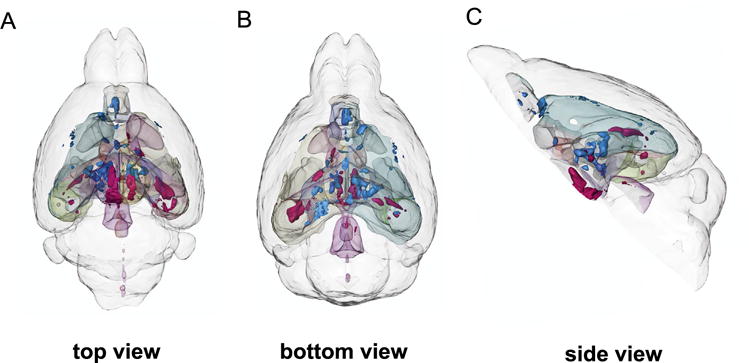
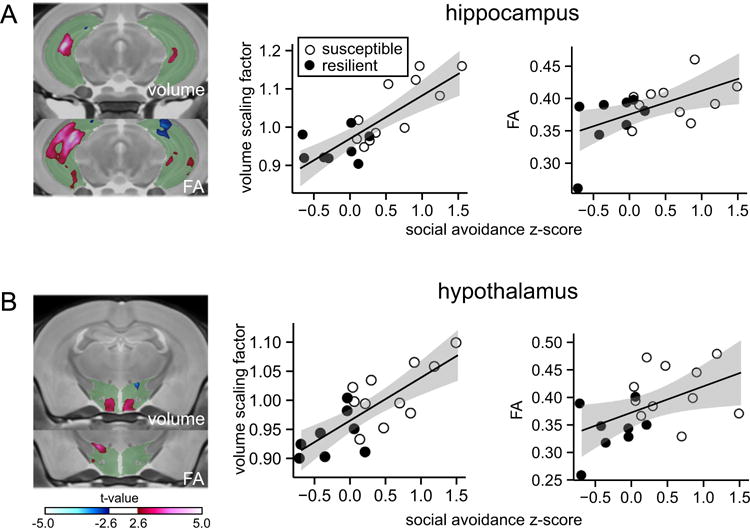
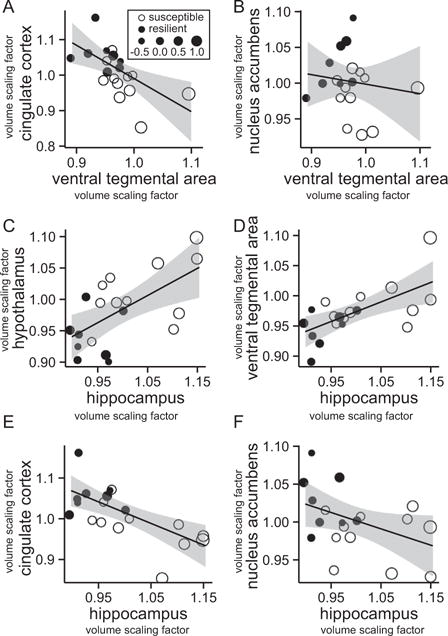
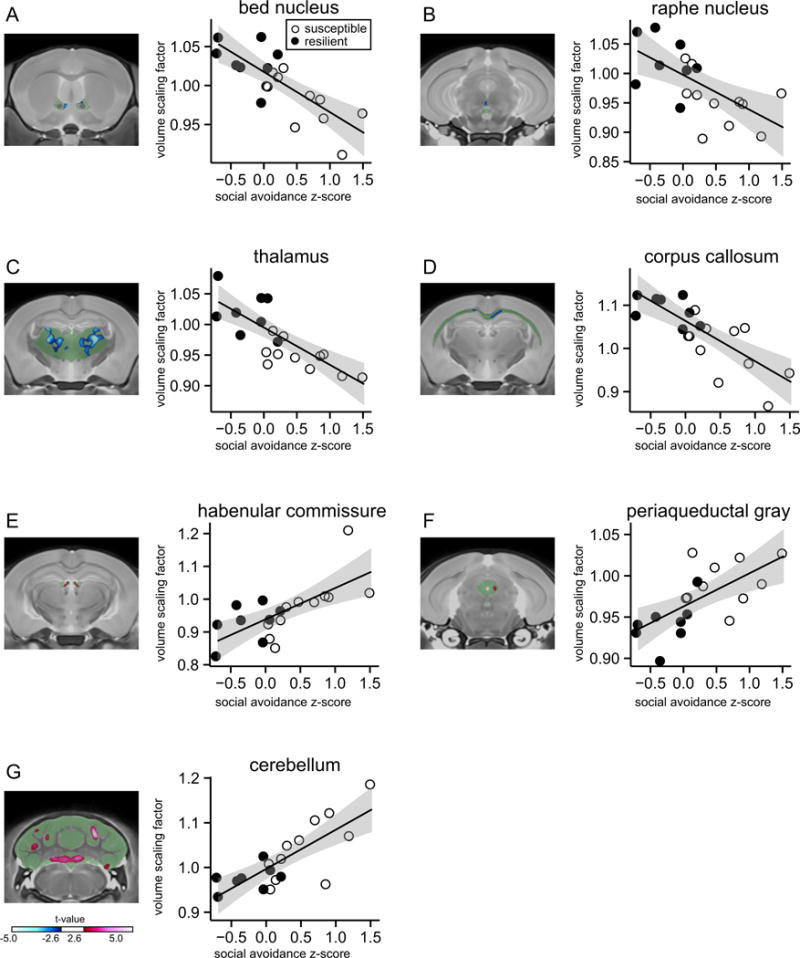
Results: Social avoidance correlated negatively with local volume of the cingulate cortex, nucleus accumbens, thalamus, raphe nuclei, and bed nucleus of the stria terminals. Social avoidance correlated positively with volume of the ventral tegmental area (VTA), habenula, periaqueductal gray, cerebellum, hypothalamus, and hippocampal CA3. Fractional anisotropy was increased in the hypothalamus and hippocampal CA3. We observed synchronized anatomic differences between the VTA and cingulate cortex, hippocampus and VTA, hippocampus and cingulate cortex, and hippocampus and hypothalamus. These correlations revealed different structural covariance between brain regions in susceptible and resilient mice.
Conclusions: Stress-integrative brain regions shape the neural architecture underlying individual differences in susceptibility and resilience to chronic stress.
Keywords: Chronic stress; Cingulate cortex; DTI; Depression; Hippocampus; MRI; Neural circuits; Ventral tegmental area.
Copyright © 2016. Published by Elsevier Inc.
Conflict of interest statement
The authors report no biomedical financial interests or potential conflicts of interest.
Figures
Comment in
-
Magnetic Resonance Imaging of Psychological Susceptibility and Resilience.Biol Psychiatry. 2016 May 15;79(10):e75-e77. doi: 10.1016/j.biopsych.2016.03.2102. Epub 2016 Mar 28. Biol Psychiatry. 2016. PMID: 27130853 Free PMC article. No abstract available.
References
-
- Kessler RC. The effects of stressful life events on depression. Annu Rev Psychol. 1997;48:191–214. - PubMed
-
- Hermans EJ, van Marle HJ, Ossewaarde L, Henckens MJ, Qin S, van Kesteren MT, et al. Stress-related noradrenergic activity prompts large-scale neural network reconfiguration. Science. 2011;334:1151–1153. - PubMed
Publication types
MeSH terms
Grants and funding
LinkOut - more resources
Full Text Sources
Other Literature Sources
Medical
Miscellaneous
