


Molecular analysis of clinical isolates previously diagnosed as Mycobacterium intracellulare reveals incidental findings of "Mycobacterium indicus pranii" genotypes in human lung infection
- PMID: 26423052
- PMCID: PMC4589961
- DOI: 10.1186/s12879-015-1140-4
Molecular analysis of clinical isolates previously diagnosed as Mycobacterium intracellulare reveals incidental findings of "Mycobacterium indicus pranii" genotypes in human lung infection
Abstract
Background: Mycobacterium intracellulare is a major cause of Mycobacterium avium complex lung disease in many countries. Molecular studies have revealed several new Mycobacteria species that are closely related to M. intracellulare. The aim of this study was to re-identify and characterize clinical isolates from patients previously diagnosed with M. intracellulare lung disease at the molecular level.
Methods: Mycobacterial isolates from 77 patients, initially diagnosed with M. intracellulare lung disease were re-analyzed by multi-locus sequencing and pattern of insertion sequences.
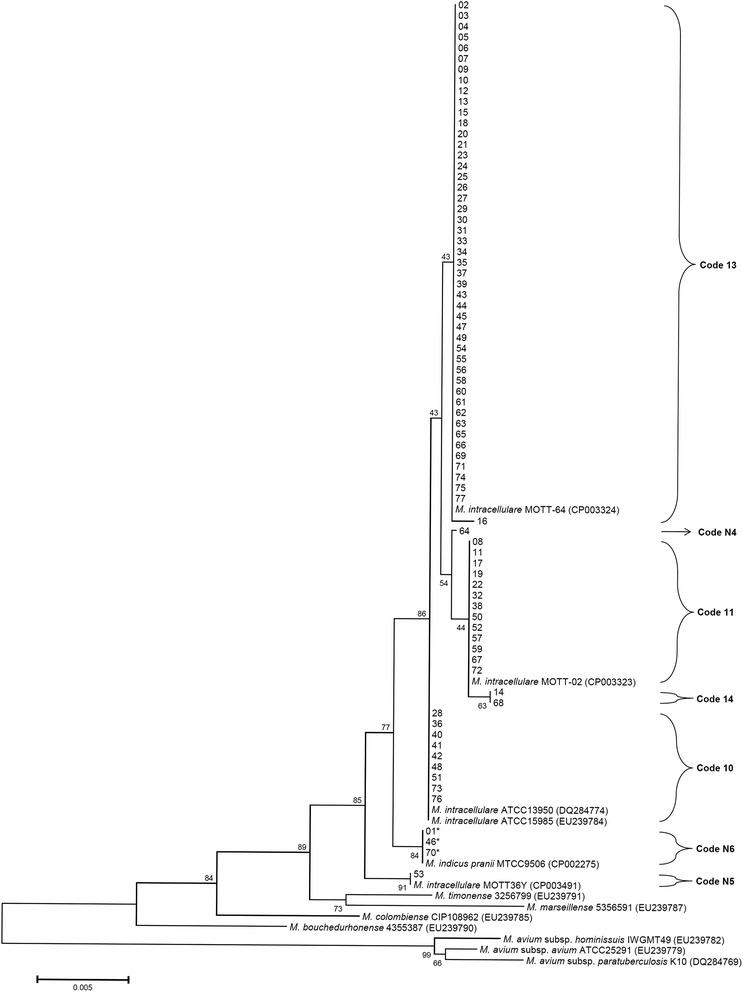
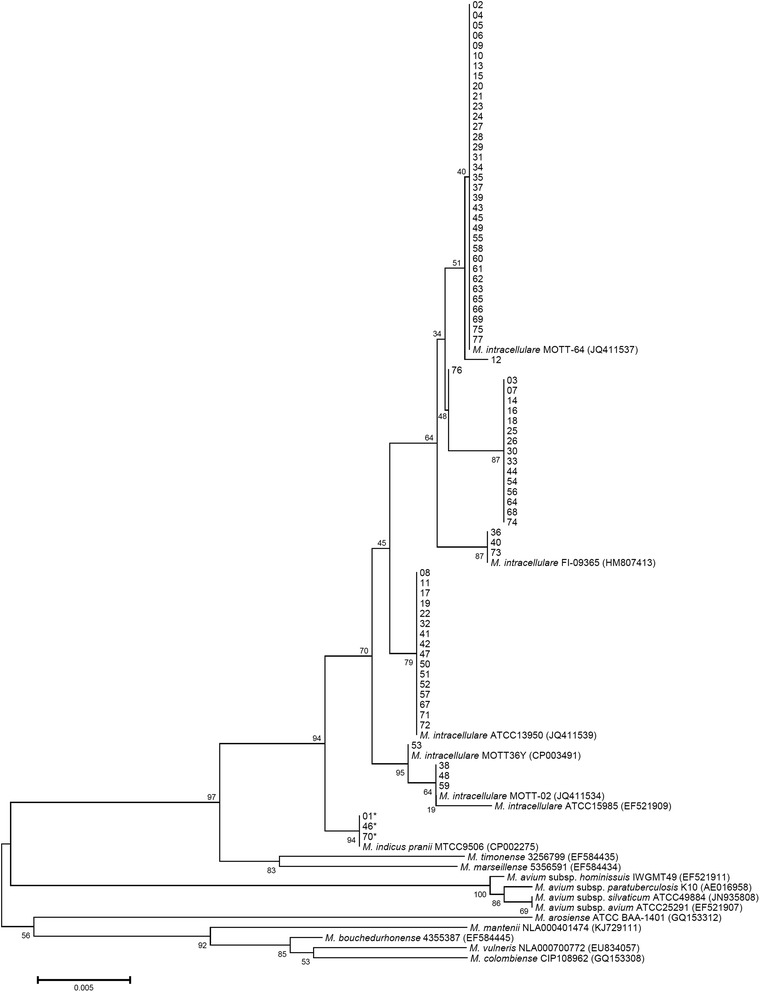
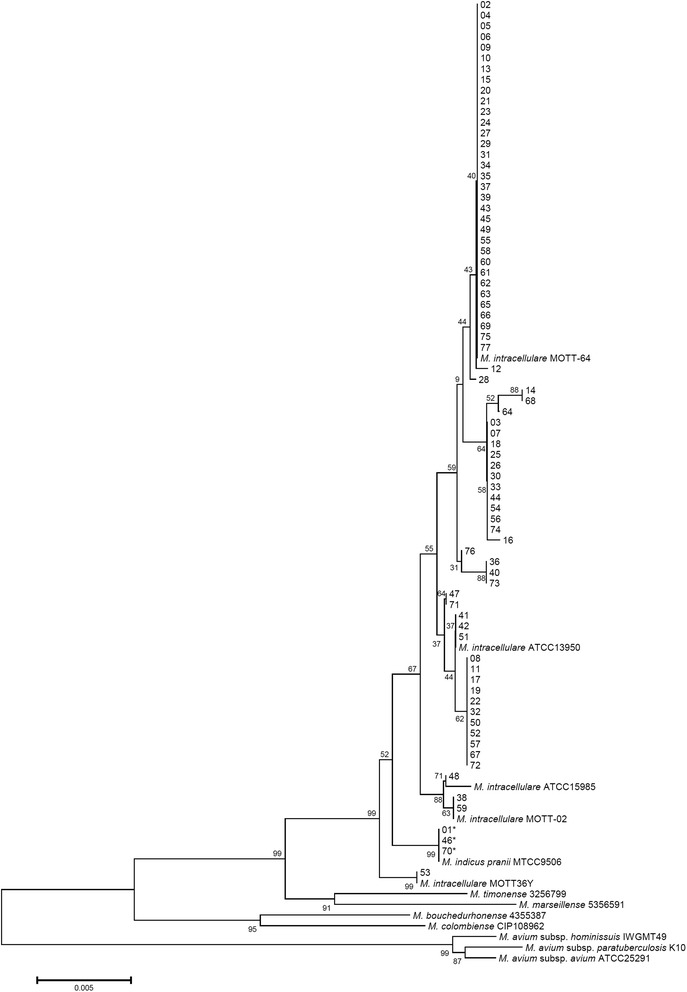
Results: Among the 77 isolates, 74 (96 %) isolates were designated as M. intracellulare based on multigene sequence-based analysis. Interestingly, the three remaining strains (4 %) were re-identified as "Mycobacterium indicus pranii" according to distinct molecular phylogenetic positions in rpoB and hsp65 sequence-based typing. In hsp65 sequevar analysis, code 13 was found in the majority of cases and three unreported codes were identified. In 16S-23S rRNA internal transcribed spacer (ITS) sequevar analysis, all isolates of both species were classified within the Min-A ITS sequevar. Interestingly, four of the M. intracellulare isolates harbored IS1311, a M. avium-specific element. Two of three patients infected with "M. indicus pranii" had persistent positive sputum cultures after antibiotic therapy, indicating the clinical relevance of this study.
Conclusions: This analysis highlights the importance of precise identification of clinical isolates genetically close to Mycobacterium species, and suggests that greater attention should be paid to nontuberculous mycobacteria lung disease caused by "M. indicus pranii".
Figures
Similar articles
-
Distribution and clinical significance of Mycobacterium avium complex species isolated from respiratory specimens.Diagn Microbiol Infect Dis. 2017 Jun;88(2):125-137. doi: 10.1016/j.diagmicrobio.2017.02.017. Epub 2017 Mar 2. Diagn Microbiol Infect Dis. 2017. PMID: 28291631
-
Association of ISMav6 with the Pattern of Antibiotic Resistance in Korean Mycobacterium avium Clinical Isolates but No Relevance between Their Genotypes and Clinical Features.PLoS One. 2016 Feb 9;11(2):e0148917. doi: 10.1371/journal.pone.0148917. eCollection 2016. PLoS One. 2016. PMID: 26859598 Free PMC article.
-
Ribosomal internal transcribed spacer sequences are identical among Mycobacterium avium-intracellulare complex isolates from AIDS patients, but vary among isolates from elderly pulmonary disease patients.Microbiology (Reading). 1995 Oct;141 ( Pt 10):2739-47. doi: 10.1099/13500872-141-10-2739. Microbiology (Reading). 1995. PMID: 7582034
-
Infection with the Mycobacterium avium complex in patients without predisposing conditions: a case report and literature review.Braz J Infect Dis. 2005 Apr;9(2):173-9. doi: 10.1590/s1413-86702005000200009. Epub 2005 Aug 18. Braz J Infect Dis. 2005. PMID: 16127595 Review.
-
Mycobacterium avium in the postgenomic era.Clin Microbiol Rev. 2007 Apr;20(2):205-29. doi: 10.1128/CMR.00036-06. Clin Microbiol Rev. 2007. PMID: 17428883 Free PMC article. Review.
Cited by
-
High genetic heterogeneity of Mycobacterium intracellulare isolated from respiratory specimens.BMC Microbiol. 2022 Jan 3;22(1):5. doi: 10.1186/s12866-021-02426-5. BMC Microbiol. 2022. PMID: 34979921 Free PMC article.
-
Comparative genomic analysis of Mycobacterium intracellulare: implications for clinical taxonomic classification in pulmonary Mycobacterium avium-intracellulare complex disease.BMC Microbiol. 2021 Apr 6;21(1):103. doi: 10.1186/s12866-021-02163-9. BMC Microbiol. 2021. PMID: 33823816 Free PMC article.
-
High diversity of clinical Mycobacterium intracellulare in China revealed by whole genome sequencing.Front Public Health. 2022 Nov 17;10:989587. doi: 10.3389/fpubh.2022.989587. eCollection 2022. Front Public Health. 2022. PMID: 36466540 Free PMC article.
-
Galleria mellonella-intracellular bacteria pathogen infection models: the ins and outs.FEMS Microbiol Rev. 2023 Mar 10;47(2):fuad011. doi: 10.1093/femsre/fuad011. FEMS Microbiol Rev. 2023. PMID: 36906279 Free PMC article. Review.
-
Association between 16S rRNA gene mutations and susceptibility to amikacin in Mycobacterium avium Complex and Mycobacterium abscessus clinical isolates.Sci Rep. 2021 Mar 17;11(1):6108. doi: 10.1038/s41598-021-85721-5. Sci Rep. 2021. PMID: 33731862 Free PMC article. Clinical Trial.
References
Publication types
MeSH terms
Substances
LinkOut - more resources
Full Text Sources
Other Literature Sources
Medical
Research Materials
