


Mosquito age and avian malaria infection
- PMID: 26424326
- PMCID: PMC4589955
- DOI: 10.1186/s12936-015-0912-z
Mosquito age and avian malaria infection
Abstract
Background: The immune system of many insects wanes dramatically with age, leading to the general prediction that older insects should be more susceptible to infection than their younger counterparts. This prediction is however challenged by numerous studies showing that older insects are more resistant to a range of pathogens. The effect of age on susceptibility to infections is particularly relevant for mosquitoes given their role as vectors of malaria and other diseases. Despite this, the effect of mosquito age on Plasmodium susceptibility has been rarely explored, either experimentally or theoretically.
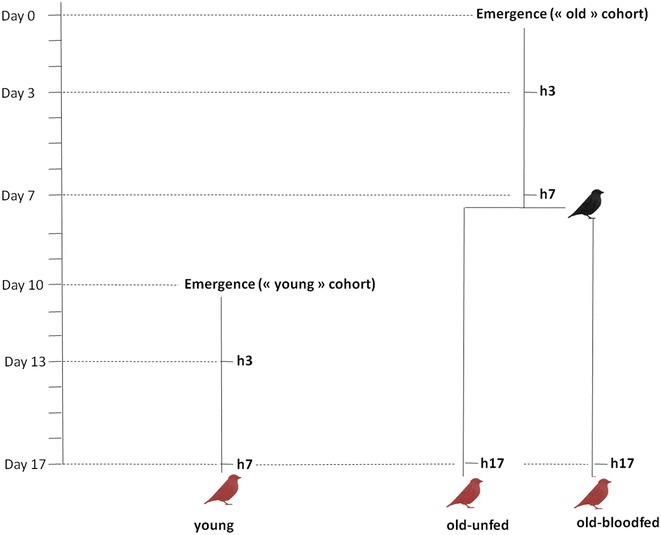
Methods: Experiments were carried out using the avian malaria parasite Plasmodium relictum and its natural vector in the field, the mosquito Culex pipiens. Both innate immune responses (number and type of circulating haemocytes) and Plasmodium susceptibility (prevalence and burden) were quantified in seven- and 17-day old females. Whether immunity or Plasmodium susceptibility are modulated by the previous blood feeding history of the mosquito was also investigated. To ensure repeatability, two different experimental blocks were carried out several weeks apart.
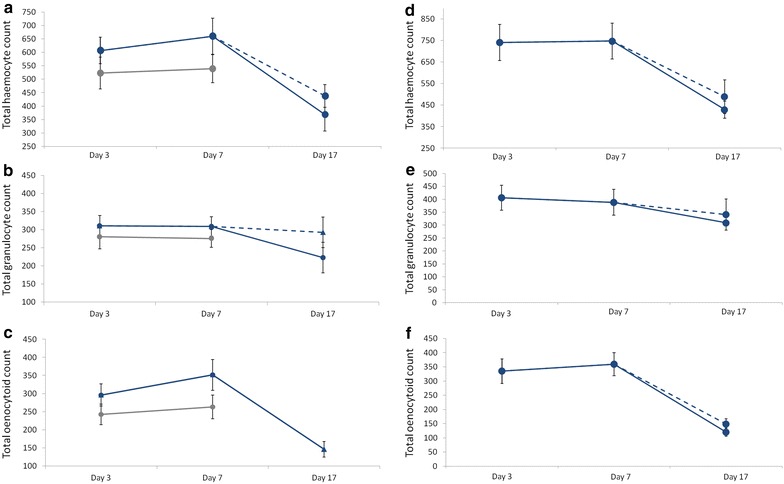
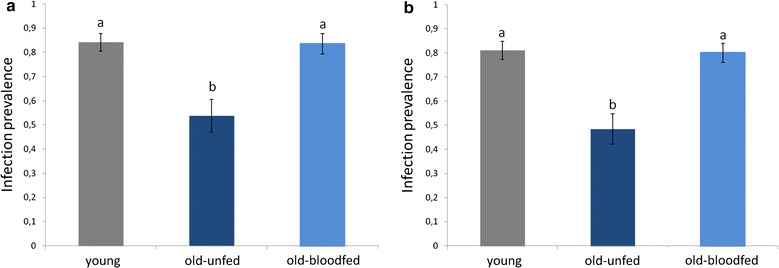
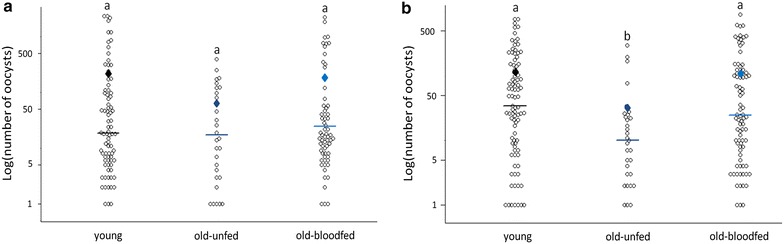
Results: Haemocyte numbers decrease drastically as the mosquitoes age. Despite this, older mosquitoes are significantly more resistant to a Plasmodium infection than their younger counterparts. Crucially, however, the age effect is entirely reversed when old mosquitoes have taken one previous non-infected blood meal.
Conclusions: The results agree with previous studies showing that older insects are often more resistant to infections than younger ones. These results suggest that structural and functional alterations in mosquito physiology with age may be more important than immunity in determining the probability of a Plasmodium infection in old mosquitoes. Possible explanations for why the effect is reversed in blood-fed mosquitoes are discussed. The reversal of the age effect in blood fed mosquitoes implies that age is unlikely to have a significant impact on mosquito susceptibility in the field.
Figures
References
-
- Manson P. On the development of Filaria sanguinis hominis, and on the mosquito considered as a nurse. J Linn Soc Lond Zool. 1878;14:304–311. doi: 10.1111/j.1096-3642.1878.tb01837.x. - DOI
-
- Ross R: Researches on malaria. Nobel Lect. 1902;1–116.
MeSH terms
LinkOut - more resources
Full Text Sources
Other Literature Sources
Medical
