. 2015 Sep 29;7(10):3977-88.
doi: 10.3390/toxins7103977.

Study of Adsorption and Flocculation Properties of Natural Clays to Remove Prorocentrum lima

Affiliations

Study of Adsorption and Flocculation Properties of Natural Clays to Remove Prorocentrum lima

Maria Carmen Louzao et al. Toxins (Basel). .

Abstract

High accumulations of phytoplankton species that produce toxins are referred to as harmful algal blooms (HABs). HABs represent one of the most important sources of contamination in marine environments, as well as a serious threat to public health, fisheries, aquaculture-based industries, and tourism. Therefore, methods effectively controlling HABs with minimal impact on marine ecology are required. Marine dinoflagellates of the genera Dinophysis and Prorocentrum are representative producers of okadaic acid (OA) and dinophysistoxins responsible for the diarrhetic shellfish poisoning (DSP) which is a human intoxication caused by the consumption of shellfish that bioaccumulate those toxins. In this work we explore the use of natural clay for removing Prorocentrum lima. We evaluate the adsorption properties of clays in seawater containing the dinoflagellates. The experimental results confirmed the cell removal through the flocculation of algal and mineral particles leading to the formation of aggregates, which rapidly settle and further entrain cells during their descent. Moreover, the microscopy images of the samples enable one to observe the clays in aggregates of two or more cells where the mineral particles were bound to the outer membranes of the dinoflagellates. Therefore, this preliminary data offers promising results to use these clays for the mitigation of HABs.

Keywords: Prorocentrum lima; adsorption; clay; dinoflagellate; flocculation.


Figures

Figure 1
Figure 1
Microscopy images of Prorocentrum lima cells; (A) 10X; (B) 40X.
Figure 2
Figure 2
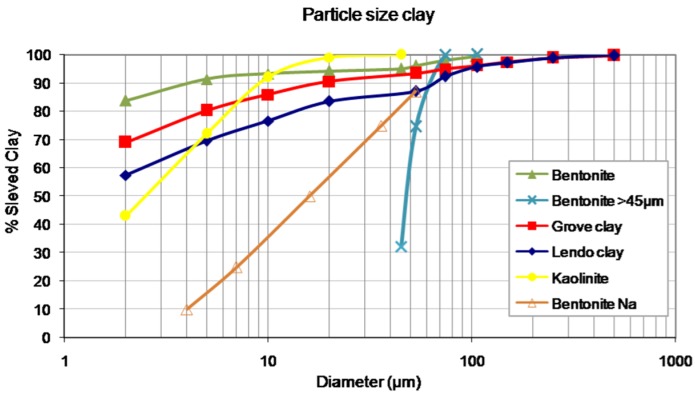
Particle size clay determined from the percentage of sieved clay for each pore diameter: Bentonite (83% < 2 µm), Bentonite > 45 µm (90% > 45 µm), Lendo Clay (57% < 2 µm), Grove Clay (69% < 2 µm), Kaolinite (43% < 2 µm), and Bentonite Na (80% < 70 µm).
Figure 3
Figure 3
Assay scheme. (1) Prorocentrum lima culture conditions and preparation of water columns; (2) Sampling and cell count; (3) Sample preparation for microscopy.
Figure 4
Figure 4
In vitro flocculation of clay particles and Prorocentrum lima in seawater. Seawater containing different clays was incubated with (orange label) or without (yellow label) Prorocentrum lima. Sedimentation of dinoflagellate cells was continuously recorded. (A) cells of Prorocentrum lima; (B,H) bentonite; (C,I) bentonite > 45 µm; (D,J) bentonite Na; (E,K) Grove clay; (F,L) Lendo clay; and (G,M) kaolinite.
Figure 5
Figure 5
Image of water column with aggregated particles of Prorocentrum lima cells and kaolinite clay (A) and water column with kaolinite clay alone (B).
Figure 6
Figure 6
Microscopy images of seawater containing different clays (right column) and flocs formed after incubation with Prorocentrum lima (left column). (A,B) bentonite; (C,D) bentonite > 45 µm; (E,F) bentonite Na; (G,H) Grove Clay; (I,J) Lendo Clay; and (K,L) Kaolinite. Scale bar = 50 µm.

References

    1. Anderson D.M., Cembella A.D., Hallegraeff G.M. Progress in understanding harmful algal blooms: Paradigm shifts and new technologies for research, monitoring, and management. Annu. Rev. Mar. Sci. 2012;4:143–176. doi: 10.1146/annurev-marine-120308-081121. - DOI - PMC - PubMed
    1. Prego-Faraldo M.V., Valdiglesias V., Mendez J., Eirin-Lopez J.M. Okadaic acid meet and greet: An insight into detection methods, response strategies and genotoxic effects in marine invertebrates. Mar. Drugs. 2013;11:2829–2845. doi: 10.3390/md11082829. - DOI - PMC - PubMed
    1. Doblin M.A., Dobbs F.C. Setting a size-exclusion limit to remove toxic dinoflagellate cysts from ships’ ballast water. Mar. Pollut. Bull. 2006;52:259–263. doi: 10.1016/j.marpolbul.2005.12.014. - DOI - PubMed
    1. Anderson D.M., Burkholder J.M., Cochlan W.P., Glibert P.M., Gobler C.J., Heil C.A., Kudela R., Parsons M.L., Rensel J.E., Townsend D.W., et al. Harmful algal blooms and eutrophication: Examining linkages from selected coastal regions of the United States. Harmful Algae. 2008;8:39–53. doi: 10.1016/j.hal.2008.08.017. - DOI - PMC - PubMed
    1. Miraglia M., Marvin H.J., Kleter G.A., Battilani P., Brera C., Coni E., Cubadda F., Croci L., de Santis B., Dekkers S., et al. Climate change and food safety: An emerging issue with special focus on Europe. Food Chem. Toxicol. 2009;47:1009–1021. doi: 10.1016/j.fct.2009.02.005. - DOI - PubMed

Publication types

LinkOut - more resources