. 2015 Oct 13;54(40):6274-83.
doi: 10.1021/acs.biochem.5b00860. Epub 2015 Oct 1.

Correlation of Thermal Stability and Structural Distortion of DNA Interstrand Cross-Links Produced from Oxidized Abasic Sites with Their Selective Formation and Repair

Affiliations

Correlation of Thermal Stability and Structural Distortion of DNA Interstrand Cross-Links Produced from Oxidized Abasic Sites with Their Selective Formation and Repair

Souradyuti Ghosh et al. Biochemistry. .

Abstract

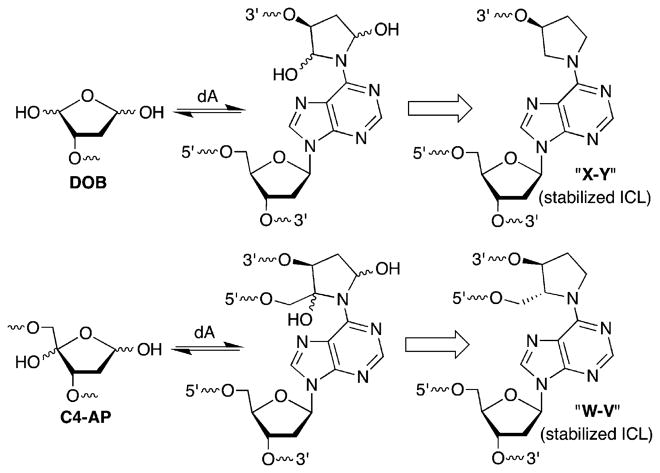
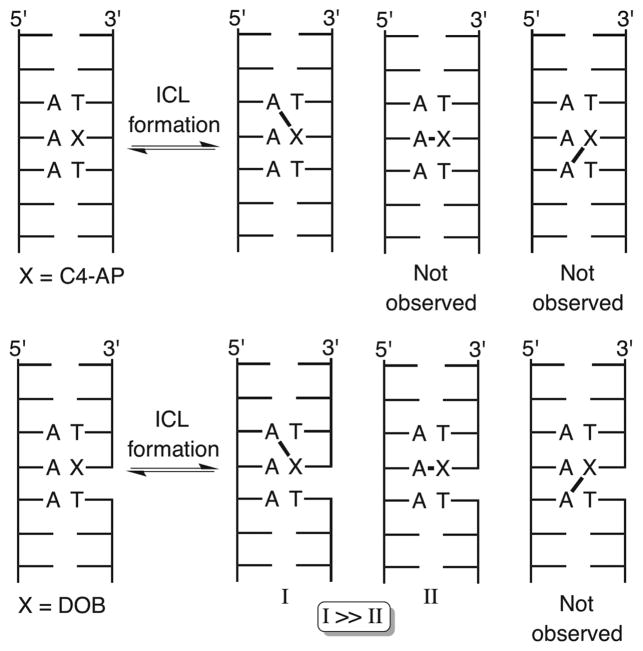
C4'-oxidized (C4-AP) and C5'-oxidized abasic sites (DOB) that are produced following abstraction of a hydrogen atom from the DNA backbone reversibly form cross-links selectively with dA opposite a 3'-adjacent nucleotide, despite the comparable proximity of an opposing dA. A previous report on UvrABC incision of DNA substrates containing stabilized analogues of the ICLs derived from C4-AP and DOB also indicated that the latter is repaired more readily by nucleotide excision repair [Ghosh, S., and Greenberg, M. M. (2014) Biochemistry 53, 5958-5965]. The source for selective cross-link formation was probed by comparing the reactivity of ICL analogues of C4-AP and DOB that mimic the preferred and disfavored cross-links with that of reagents that indirectly detect distortion by reacting with the nucleobases. The disfavored C4-AP and DOB analogues were each more reactive than the corresponding preferred cross-link substrates, suggesting that the latter are more stable, which is consistent with selective ICL formation. In addition, the preferred DOB analogue is more reactive than the respective C4-AP ICL, which is consistent with its more efficient incision by UvrABC. The conclusions drawn from the chemical probing experiments are corroborated by UV melting studies. The preferred ICLs exhibit melting temperatures higher than those of the corresponding disfavored isomers. These studies suggest that oxidized abasic sites form reversible interstrand cross-links with dA opposite the 3'-adjacent thymidine because these products are more stable and the thermodynamic preference is reflected in the transition states for their formation.


Conflict of interest statement

Notes

The authors declare no competing financial interest.

Figures
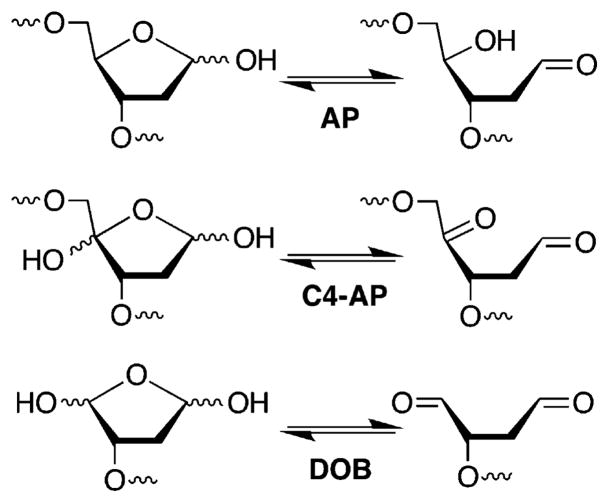
Figure 1
Figure 1
Abasic site structures.
Figure 2
Figure 2
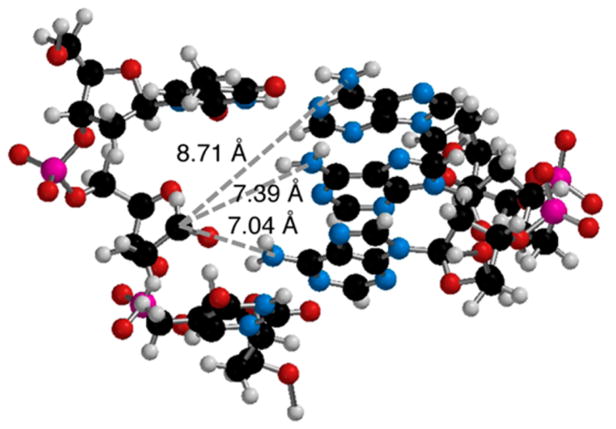
Molecular model of C4-AP in a 5′-d(TXT)/(AAA) sequence (X = C4-AP).
Figure 3
Figure 3
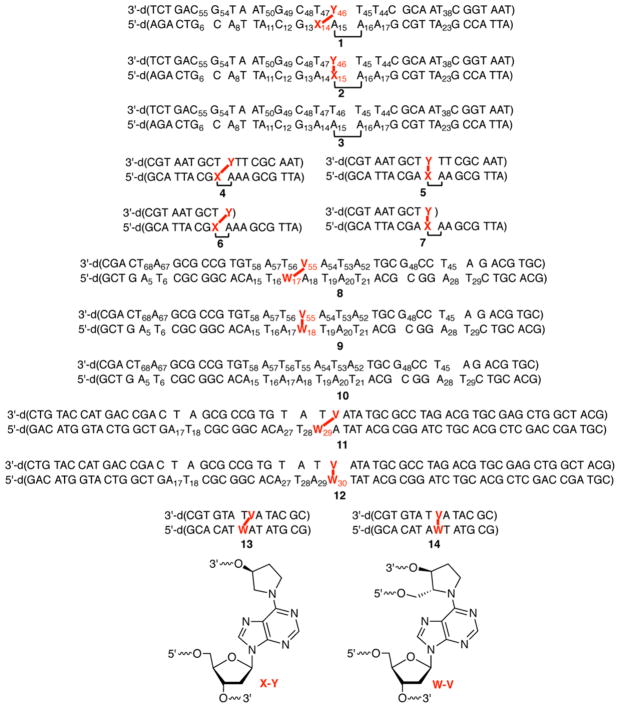
Cross-linked DNA substrates used in this study.
Figure 4
Figure 4
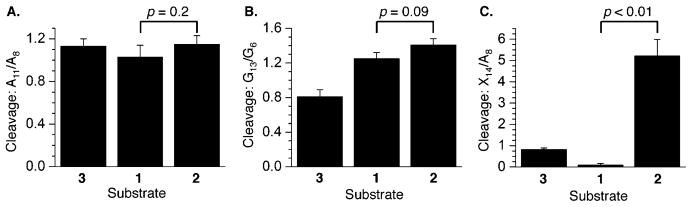
Chemical reactivity of DOB ICL analogues in 5′-32P-b-13 with (A) DEPC at A11 relative to A8, (B) DMS at G13 relative to G6, and (C) DEPC at X14 relative to A8 (X = A in 2 and 3, and X = cross-linked A in 1). P values were calculated using the Student’s t test (four replicates).
Figure 5
Figure 5
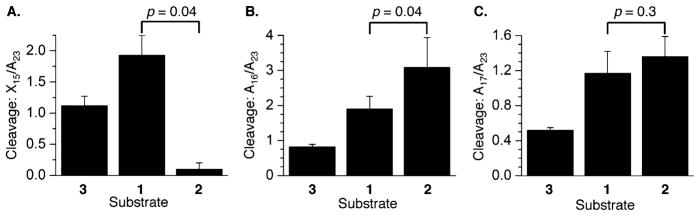
Chemical reactivity of DOB ICL analogues in 3′-32P-b-13 with DEPC at (A) X15 relative to A23 (X = A in 1 and 3, and X = cross-linked A in 2), (B) A16 relative to A23, and (C) A17 relative to A23. P values were calculated using the Student’s t test (four replicates).
Figure 6
Figure 6
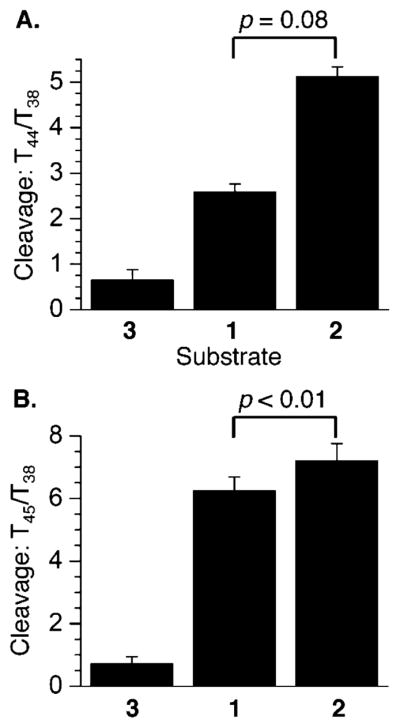
Chemical reactivity of DOB ICL analogues in 5′-32P-t-13 with KMnO4 at (A) T44 relative to T38 and (B) T45 relative to T38. P values were calculated using the Student’s t test (four replicates).
Figure 7
Figure 7
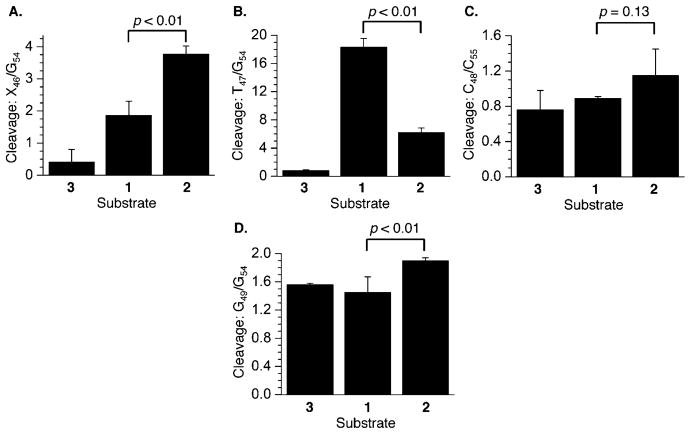
Chemical reactivity of DOB ICL analogues in 3′-32P-t-13 at (A) X46 relative to G54 (X = T in 3, and X = cross-linked abasic site in 1 and 2) with hydroxyl radical, (B) T47 relative to G54 with KMnO4, (C) C48 relative to C55 with hydroxylamine, and (D) G49 relative to G54 with DMS. P values were calculated using the Student’s t test (four replicates).
Figure 8
Figure 8
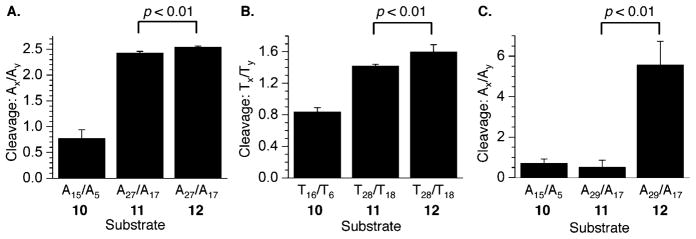
Chemical reactivity of C4-AP ICL analogues in 5′-32P-b-1012 upon (A) reaction with DEPC, (B) reaction with KMnO4, and (C) reaction with DEPC. P values were calculated using the Student’s t test (four replicates).
Figure 9
Figure 9
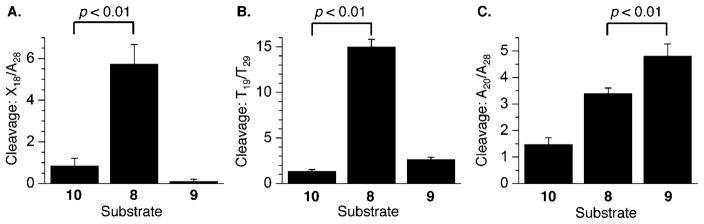
Chemical reactivity of C4-AP ICL analogues in 3′-32P-b-810 at (A) X18 relative to A28 (X = A in 8 and 10, and X = cross-linked A in 9) with DEPC, (B) T19 relative to T29 with KMnO4, and (C) A20 relative to A28 with DEPC. P values were calculated using the Student’s t test (four replicates).
Figure 10
Figure 10
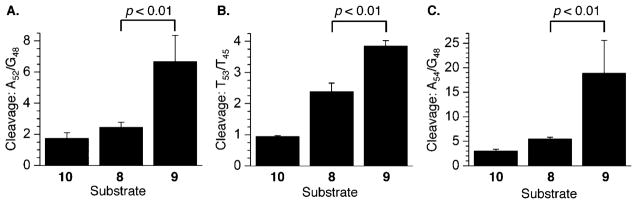
Chemical reactivity of C4-AP ICL analogues in 5′-32P-t-810 at (A) A52 relative to G48 with DEPC, (B) T53 relative to T45 with KMnO4, and (C) A54 relative to G48 with DEPC. P values were calculated using the Student’s t test (four replicates).
Figure 11
Figure 11
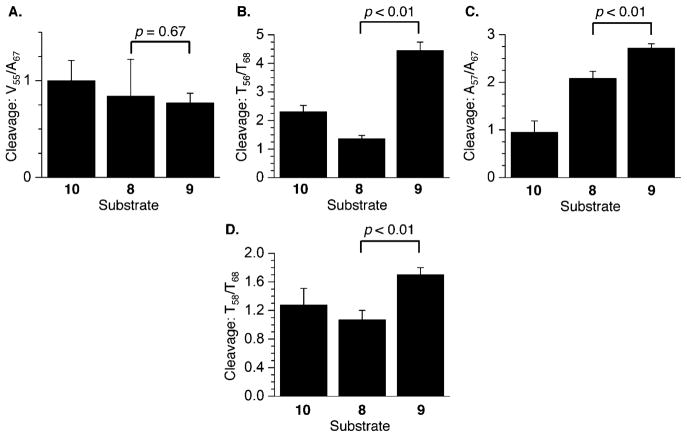
Chemical reactivity of C4-AP ICL analogues in 3′-32P-t-810 at (A) V55 relative to A67 (X = T in 10, and X = cross-linked abasic site in 8 and 9) with hydroxyl radical, (B) T56 relative to T68 with KMnO4, (C) A57 relative to A67 with DEPC, and (D) T58 relative to T68 with KMnO4. P values were calculated using the Student’s t test (four replicates).
Figure 12
Figure 12
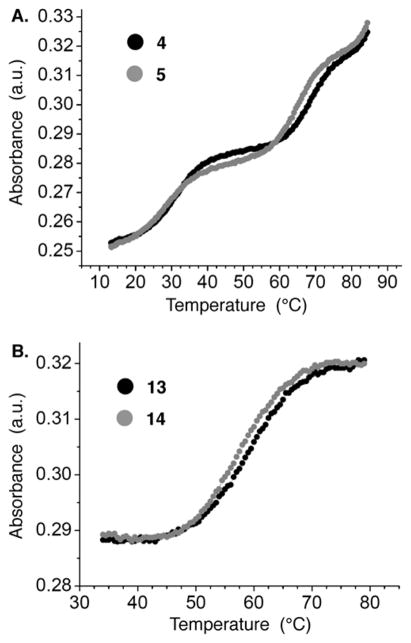
UV melt of (A) DOB ICL analogues (4 and 5) and (B) C4-AP ICL analogues (13 and 14).
Figure 13
Figure 13
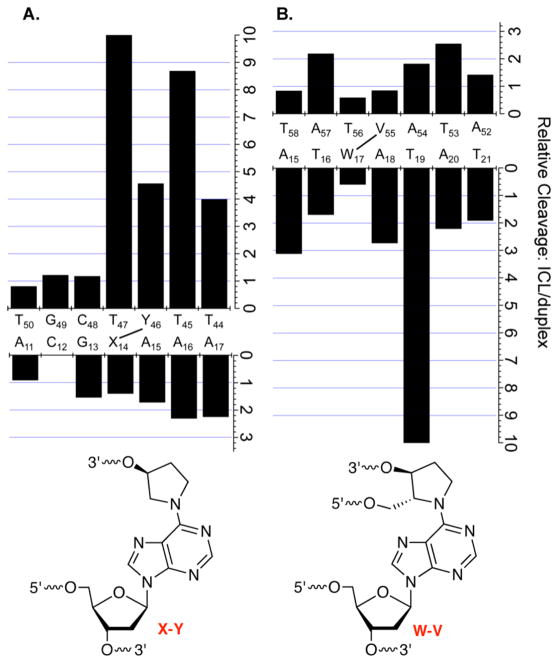
Nucleotide by nucleotide comparison of ICL reactivity relative to analogous duplex: (A) DOB-containing ICL and (B) C4-AP-containing ICL.
Scheme 1
Scheme 1
ICLs and Stabilized ICLs from C4-AP and DOB
Scheme 2
Scheme 2
ICL Positioning from C4-AP and DOB

References

    1. Räschle M, Knipscheer P, Enoiu M, Angelov T, Sun J, Griffith JD, Ellenberger TE, Schärer OD, Walter JC. Mechanism of replication-coupled DNA interstrand crosslink repair. Cell. 2008;134:969–980. - PMC - PubMed
    1. Noll DM, Mason TM, Miller PS. Formation and repair of interstrand cross-links in DNA. Chem Rev. 2006;106:277–301. - PMC - PubMed
    1. Kozekov ID, Turesky RJ, Alas GR, Harris CM, Harris TM, Rizzo CJ. Formation of deoxyguanosine cross-links from calf thymus DNA treated with acrolein and 4-hydroxy-2-nonenal. Chem Res Toxicol. 2010;23:1701–1713. - PMC - PubMed
    1. Stone MP, Cho Y-J, Huang H, Kim H-Y, Kozekov ID, Kozekova A, Wang H, Minko IG, Lloyd RS, Harris TM, Rizzo CJ. Interstrand DNA cross-links induced by α,β-unsaturated aldehydes derived from lipid peroxidation and environmental sources. Acc Chem Res. 2008;41:793–804. - PMC - PubMed
    1. Schärer OD. DNA interstrand crosslinks: Natural and drug-induced DNA adducts that induce unique cellular responses. ChemBioChem. 2005;6:27–32. - PubMed

Publication types

LinkOut - more resources