


Connect for Health: Design of a clinical-community childhood obesity intervention testing best practices of positive outliers
- PMID: 26427562
- PMCID: PMC4753774
- DOI: 10.1016/j.cct.2015.09.022
Connect for Health: Design of a clinical-community childhood obesity intervention testing best practices of positive outliers
Abstract
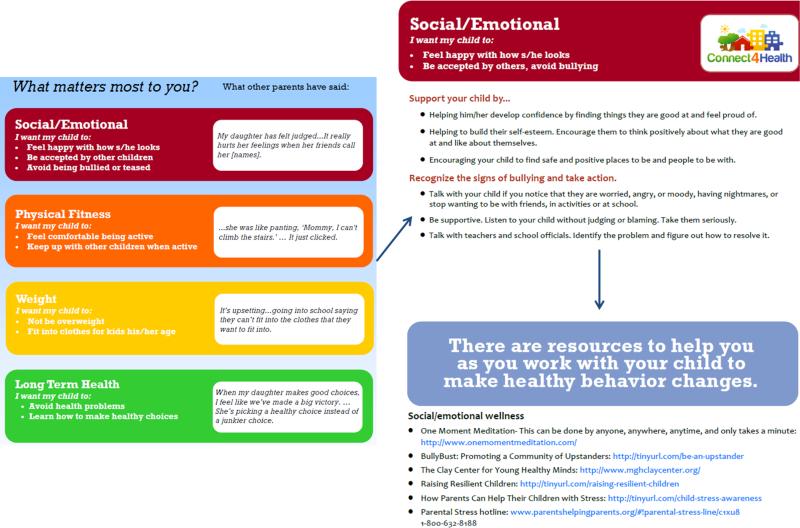
Background: The Connect for Health study is designed to assess whether a novel approach to care delivery that leverages clinical and community resources and addresses socio-contextual factors will improve body mass index (BMI) and family-centered, obesity-related outcomes of interest to parents and children. The intervention is informed by clinical, community, parent, and youth stakeholders and incorporates successful strategies and best practices learned from 'positive outlier' families, i.e., those who have succeeded in changing their health behaviors and improve their BMI in the context of adverse built and social environments.
Design: Two-arm, randomized controlled trial with measures at baseline and 12 months after randomization.
Participants: 2-12 year old children with overweight or obesity (BMI ≥ 85th percentile) and their parents/guardians recruited from 6 pediatric practices in eastern Massachusetts.
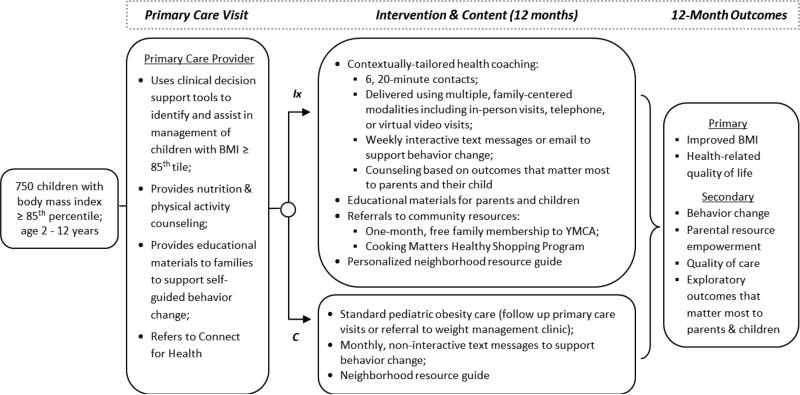
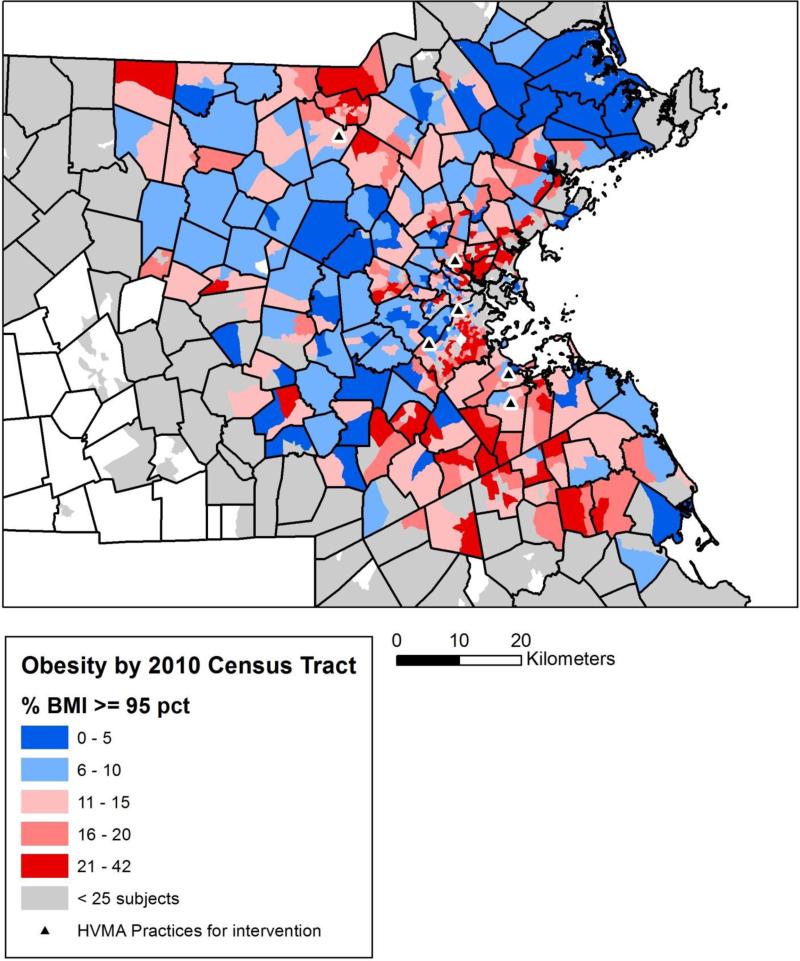
Intervention: Children randomized to the intervention arm receive a contextually-tailored intervention delivered by trained health coaches who use advanced geographic information system tools to characterize children's environments and neighborhood resources. Health coaches link families to community-level resources and use multiple support modalities including text messages and virtual visits to support families over a one-year intervention period. The control group receives enhanced pediatric care plus non-tailored health coaching.
Main outcome measures: Lower age-associated increase in BMI over a 1-year period. The main parent- and child-reported outcome is improved health-related quality of life.
Conclusions: The Connect for Health study seeks to support families in leveraging clinical and community resources to improve obesity-related outcomes that are most important to parents and children.
Trial registration: ClinicalTrials.gov NCT02124460.
Keywords: Children; Clinical; Community; Health coaching; Mobile technology; Obesity; Randomized controlled trial.
Copyright © 2015 Elsevier Inc. All rights reserved.
Figures
References
-
- Olds T, Maher C, Zumin S, et al. Evidence that the prevalence of childhood overweight is plateauing: data from nine countries. International journal of pediatric obesity : IJPO : an official journal of the International Association for the Study of Obesity. 2011 Oct;6(5-6):342–360. - PubMed
-
- Dietz WH, Baur LA, Hall K, et al. Management of obesity: improvement of health-care training and systems for prevention and care. Lancet. 2015 Feb 18; - PubMed
-
- Smedley B, Syme S, Institute of Medicine . Promoting health: intervention strategies from social and behavioral research. National Academies Press; Washington, DC: 2000. Committee on capitalizing on social science and behavioral research to improve the public's health. - PubMed
-
- Papas MA, Alberg AJ, Ewing R, Helzlsouer KJ, Gary TL, Klassen AC. The built environment and obesity. Epidemiol Rev. 2007;29:129–143. - PubMed
Publication types
MeSH terms
Associated data
Grants and funding
LinkOut - more resources
Full Text Sources
Other Literature Sources
Medical
