Review
. 2016 May:53:85-93.
doi: 10.1016/j.semcdb.2015.09.021. Epub 2015 Sep 30.

Metabolic fibroblast growth factors (FGFs): Mediators of energy homeostasis

Affiliations
Review

Metabolic fibroblast growth factors (FGFs): Mediators of energy homeostasis

Kathleen R Markan et al. Semin Cell Dev Biol. 2016 May.

Abstract

The metabolic fibroblast growth factors (FGFs), FGF1, FGF15/19, and FGF21 differ from classic FGFs in that they modulate energy homeostasis in response to fluctuating nutrient availability. These unique mediators of metabolism regulate a number of physiological processes which contribute to their potent pharmacological properties. Administration of pharmacological doses of these FGFs causes weight loss, increases energy expenditure, and improves carbohydrate and lipid metabolism in obese animal models. However, many questions remain regarding the precise molecular and physiological mechanisms governing the effects of individual metabolic FGFs. Here we review the metabolic actions of FGF1, FGF15/19, and FGF21 while providing insights into their pharmacological effects by examining known biological functions.

Keywords: FGF1; FGF15; FGF19; FGF21; Metabolism; Obesity.


Figures

Fig. 1
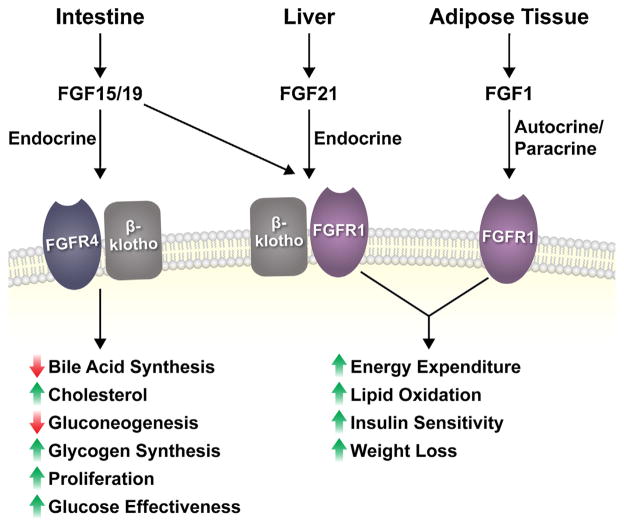
Fig. 1
Summary of metabolic FGFs. The metabolic FGFs are produced by specific tissues and signal in either an endocrine or autocrine/paracrine fashion to target cells through FGFR4 or FGFR1, complexed with or without β-klotho, to regulate metabolism. FGF15/19 signaling through hepatic FGFR4/β-klotho regulates the indicated hepatic processes (except glucose effectiveness which occurs through central effects), while the direct cellular targets of FGF21 through FGFR1/β-klotho signaling remain unclear. Endogenous FGF1 acts in an autocrine/paracrine manner to signal through FGFR1 independent of β-klotho. Although the metabolic FGFs possess different physiological functions, they produce similar pharmacological actions in models of metabolic disease through a common FGFR1-mediated pathway.
Fig. 2
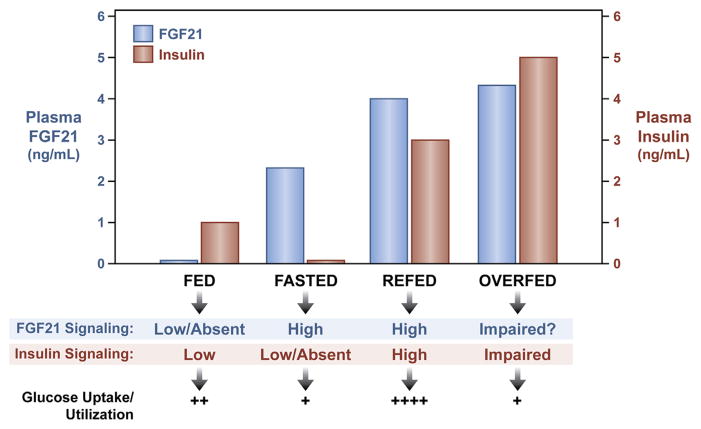
Fig. 2
FGF21 function is altered by nutritional status. FGF21 expression is regulated by nutritional status and it may mediate its functions through signaling crosstalk with other endocrine factors like insulin. Endogenous plasma FGF21 and insulin levels under various physiological conditions are presented relative to their respective level of signaling and functional effect on glucose uptake and utilization.
Fig. 3
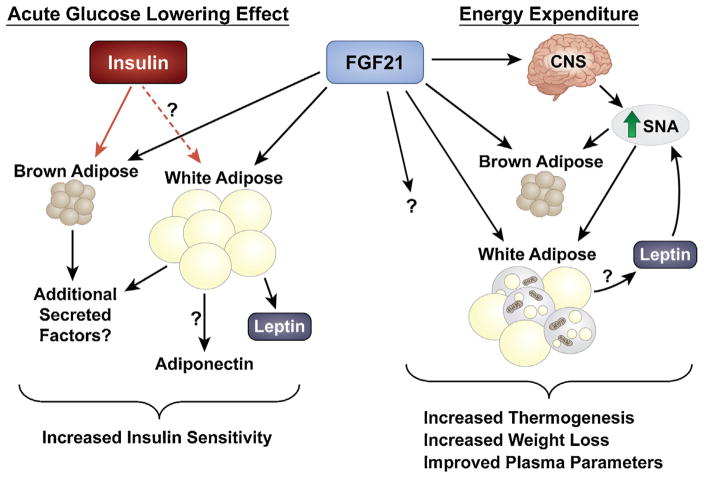
Fig. 3
Model for the pharmacological effects of FGF21. Acute pharmacological administration of FGF21 to models of metabolic disease increases insulin sensitivity whereas chronic administration increases energy expenditure, weight loss and insulin sensitivity. The acute insulin sensitizing effects of FGF21 requires functional adipose tissue(s). FGF21 enhances insulin action to increase peripheral glucose disposal, and functions to promote the secretion of adipokines including adiponectin and leptin. Extended administration of FGF21 increases energy expenditure through actions on the central nervous system (CNS) and adipose tissues. FGF21 increases sympathetic nerve activity (SNA) which stimulates brown adipose tissue thermogenesis and “browning” of white adipose tissue. Leptin also increases sympathetic nerve activity and leptin may be important for the effects of FGF21 on energy expenditure. FGF21 may also affect energy expenditure through a yet unidentified pathway. FGF21-mediated increases in energy expenditure increases weight loss and disposes of excess nutrients to improve metabolic profiles.
Fig. 4
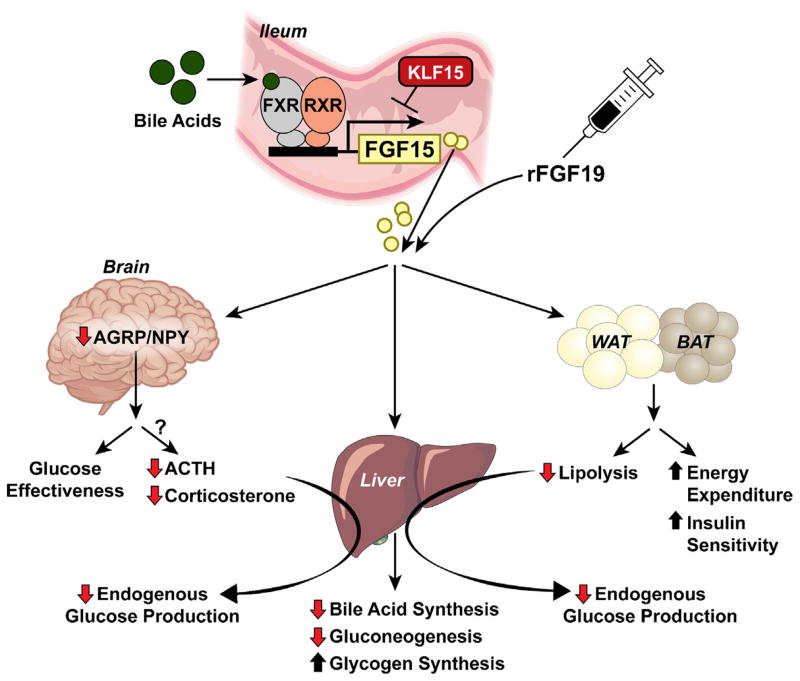
Fig. 4
Model for the physiological and pharmacological actions of FGF15/19. FGF15 is produced from the ileum of the small intestine in response to bile acid mediated activation of FXR, whereas FGF15 expression is repressed by KLF15. Once released into circulation, or administered pharmacologically, FGF15/19 acts on multiple tissues including the liver, adipose tissues and central nervous system to elicit specific metabolic effects. FGF15/19 can act directly on the liver to decrease bile acid synthesis, decrease hepatic gluconeogenesis and increase glycogen synthesis. FGF15/19 also signals to the brain to decrease AGRP/NPY neuron activity which increases glucose effectiveness. In addition, FGF15/19 signaling in the CNS suppresses the HPA axis (decreases ACTH and corticosterone), which reduces hepatic glucose production through decreased corticosterone levels and whole body lipolysis. FGF15/19 action on white and brown adipose tissues (WAT and BAT, respectively) increases energy expenditure and insulin sensitivity.

References

    1. Beenken A, Mohammadi M. The FGF family: biology, pathophysiology and therapy. Nat Rev Drug Discov. 2009;8(3):235–53. - PMC - PubMed
    1. Goetz R, et al. Molecular insights into the klotho-dependent, endocrine mode of action of fibroblast growth factor 19 subfamily members. Mol Cell Biol. 2007;27(9):3417–28. - PMC - PubMed
    1. Goetz R, Mohammadi M. Exploring mechanisms of FGF signalling through the lens of structural biology. Nat Rev Mol Cell Biol. 2013;14(3):166–80. - PMC - PubMed
    1. Kurosu H, et al. Tissue-specific expression of betaKlotho and fibroblast growth factor (FGF) receptor isoforms determines metabolic activity of FGF19 and FGF21. J Biol Chem. 2007;282(37):26687–95. - PMC - PubMed
    1. Ogawa Y, et al. BetaKlotho is required for metabolic activity of fibroblast growth factor 21. Proc Natl Acad Sci U S A. 2007;104(18):7432–7. - PMC - PubMed

Publication types

Substances