


TAS-102, a novel antitumor agent: a review of the mechanism of action
- PMID: 26428513
- PMCID: PMC4624296
- DOI: 10.1016/j.ctrv.2015.06.001
TAS-102, a novel antitumor agent: a review of the mechanism of action
Abstract
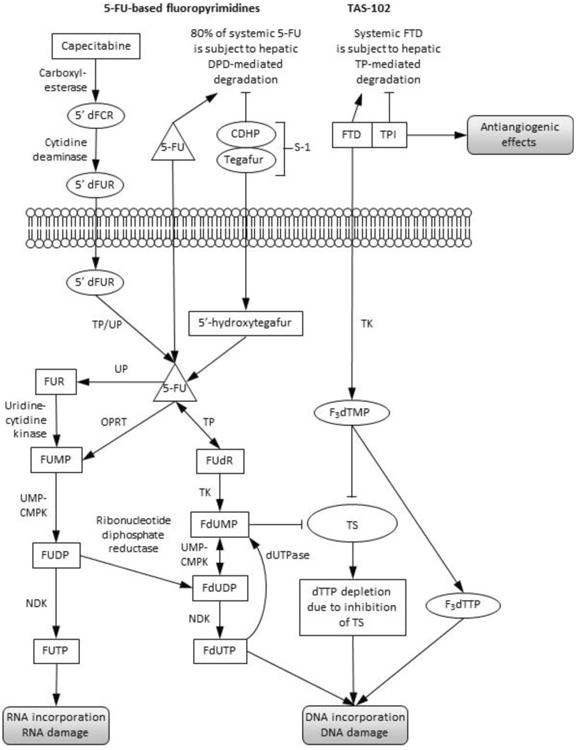
Inhibition of nucleoside metabolism is an important principle in cancer therapy as evidenced by the role of fluoropyrimidines, such as 5-fluorouracil (5-FU), and antifolates in the treatment of many cancers. TAS-102 is an oral combination therapy consisting of trifluridine (FTD), a thymidine-based nucleoside analog, plus tipiracil hydrochloride (TPI), a novel thymidine phosphorylase inhibitor that improves the bioavailability of FTD. TAS-102 has demonstrated efficacy in 5-FU-refractory patients based on a different mechanism of action and has been approved for the treatment of metastatic colorectal cancer in Japan. This review describes the mechanism of action of TAS-102, highlighting key differences between TAS-102 and 5-FU-based therapies. While both FTD and 5-FU inhibit thymidylate synthase (TS), a central enzyme in DNA synthesis, sufficient TS inhibition by FTD requires continuous infusion; therefore, it is not considered a clinically relevant mechanism with oral dosing. Instead, the primary cytotoxic mechanism with twice-daily oral dosing, the schedule used in TAS-102 clinical development, is DNA incorporation. FTD incorporation into DNA induces DNA dysfunction, including DNA strand breaks. Uracil-based analogs such as 5-FU may also be incorporated into DNA; however, they are immediately cleaved off by uracil-DNA glycosylases, reducing their ability to damage DNA. Moreover, the TPI component may enhance the durability of response to FTD. With its distinct mechanism of action and metabolism, TAS-102 is a promising treatment option for patients resistant to or intolerant of 5-FU-based fluoropyrimidines.
Keywords: 5-Fluorouracil; Fluoropyrimidines; Mechanism of action; Metastatic colorectal cancer; TAS-102; Thymidylate synthase.
Copyright © 2015. Published by Elsevier Ltd.
Conflict of interest statement
Sebastian Stintzing and Fotios Loupakis have reported no conflicts of interest.
Figures
References
-
- Heidelberger C. On the rational development of a new drug: the example of the fluorinated pyrimidines. Cancer Treat Rep. 1981;65(Suppl 3):3–9. - PubMed
-
- Wilson PM, Danenberg PV, Johnston PG, Lenz HJ, Ladner RD. Standing the test of time: targeting thymidylate biosynthesis in cancer therapy. Nat Rev Clin Oncol. 2014;11:282–98. - PubMed
-
- Jackman AL, Taylor GA, Gibson W, Kimbell R, Brown M, Calvert AH, et al. ICI D1694, a quinazoline antifolate thymidylate synthase inhibitor that is a potent inhibitor of L1210 tumor cell growth in vitro and in vivo: a new agent for clinical study. Cancer Res. 1991;51:5579–86. - PubMed
-
- Shih C, Chen VJ, Gossett LS, Gates SB, MacKellar WC, Habeck LL, et al. LY231514, a pyrrolo[2,3-d]pyrimidine-based antifolate that inhibits multiple folate-requiring enzymes. Cancer Res. 1997;57:1116–23. - PubMed
-
- Longley DB, Harkin DP, Johnston PG. 5-fluorouracil: mechanisms of action and clinical strategies. Nat Rev Cancer. 2003;3:330–8. - PubMed
Publication types
MeSH terms
Substances
Grants and funding
LinkOut - more resources
Full Text Sources
Other Literature Sources
Miscellaneous
