


Six-month quality-of-life and functional status of acute respiratory distress syndrome survivors compared to patients at risk: a population-based study
- PMID: 26428615
- PMCID: PMC4591714
- DOI: 10.1186/s13054-015-1062-y
Six-month quality-of-life and functional status of acute respiratory distress syndrome survivors compared to patients at risk: a population-based study
Abstract
Introduction: The long-term attributable burden related to acute respiratory distress syndrome (ARDS) is not fully investigated. The aim of this study is to evaluate the quality of life (QOL) and functional status at 6 months after hospitalization in patients at risk for ARDS who did and did not develop the syndrome.
Method: This is a population-based prospective cohort study of adult patients from Olmsted County, Minnesota, with or at risk for ARDS hospitalized from October 2008 to July 2011. The primary outcomes were changes in QOL and functional status, measured through 12-Item Short Form Survey (SF-12) and Barthel Index (BI) respectively, from baseline to 6 months, compared between survivors who did and did not develop ARDS.
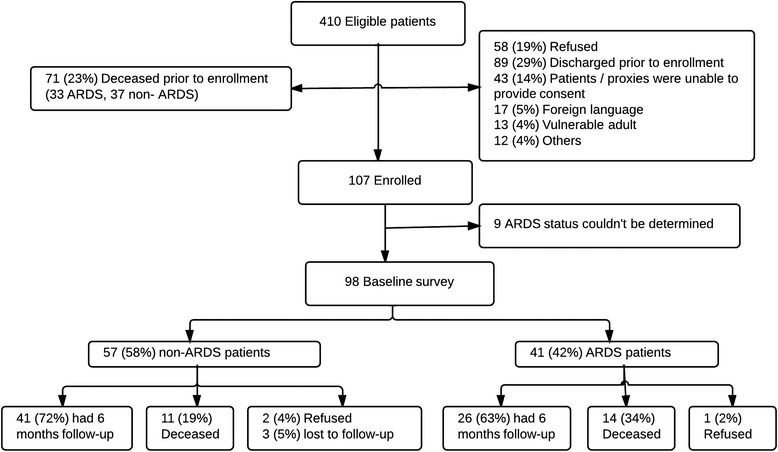
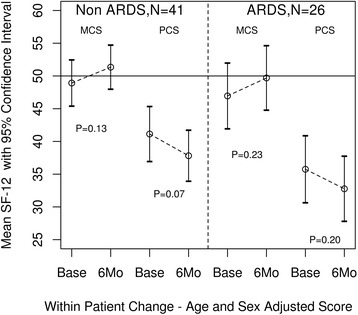
Results: Of 410 patients with or at risk for ARDS, 98 had baseline surveys collected and 67 responded to a 6-month survey (26 ARDS, 41 non-ARDS). Both ARDS and non-ARDS groups had lower physical component of SF-12 at baseline compared to general population (P < 0.001 for both). ARDS patients had poorer baseline functional status compared to non-ARDS (mean BI 80 ± 25 vs. 88 ± 22, P = 0.03). No significant differences were observed for the change between 6 months and baseline BI (delta 2.3 for ARDS vs. 2.0 for non-ARDS, P = 0.5), or mental (delta 2.7 vs. 2.4, P = 0.9) or physical (delta -3 vs. -3.3, P = 0.9) component of SF-12 between survivors with and without ARDS.
Conclusion: In this population-based study, decreased QOL and functional status 6 months after hospitalization were largely explained by baseline condition, with similar recovery in survivors who did and did not develop ARDS.
Figures
References
-
- Ventilation with lower tidal volumes as compared with traditional tidal volumes for acute lung injury and the acute respiratory distress syndrome. The Acute Respiratory Distress Syndrome Network. N Engl J Med. 2000;342(18):1301-1308. - PubMed
Publication types
MeSH terms
Grants and funding
LinkOut - more resources
Full Text Sources
Other Literature Sources
