


Competition and collaboration between different actin assembly pathways allows for homeostatic control of the actin cytoskeleton
- PMID: 26430713
- PMCID: PMC4832443
- DOI: 10.1080/19490992.2015.1090670
Competition and collaboration between different actin assembly pathways allows for homeostatic control of the actin cytoskeleton
Abstract
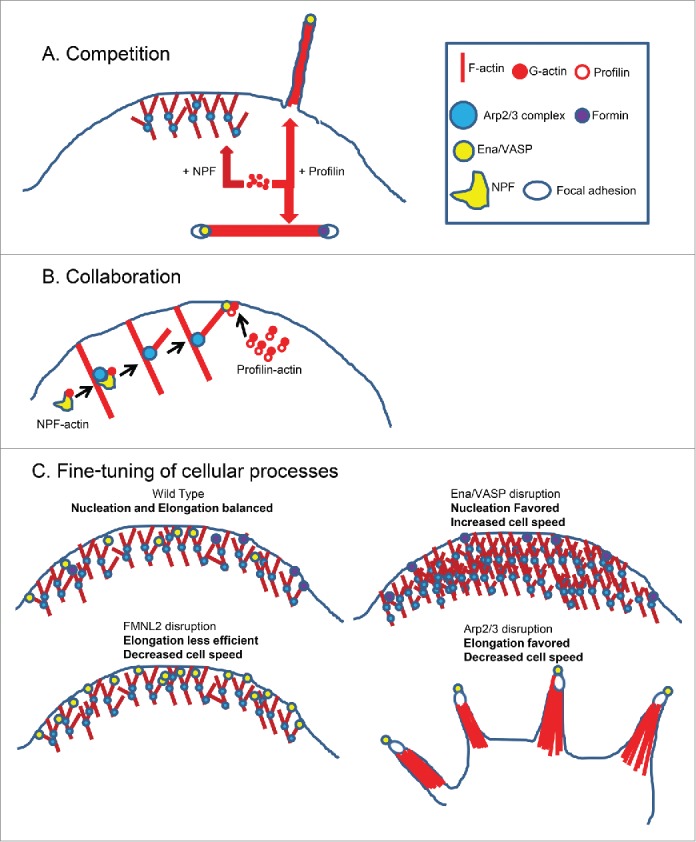
Tremendous insight into actin-associated proteins has come from careful biochemical and cell biological characterization of their activities and regulation. However, many studies of their cellular behavior have only considered each in isolation. Recent efforts reveal that assembly factors compete for polymerization-competent actin monomers, suggesting that actin is homeostatically regulated. It seems that a major regulatory component is competition between Arp2/3-activating nucleation promoting factors and profilin for actin monomers. The result is differential delivery of actin to different pathways, allowing for simultaneous assembly of competing F-actin structures and collaborative building of higher order cellular structures. Although there are likely to be additional factors that regulate actin homeostasis, especially in a cell type-dependent fashion, we advance the notion that competition between actin assembly factors results in a tunable system that can be adjusted according to extracellular and intracellular cues.
Keywords: Arp2/3 complex; Ena/VASP; actin; formin; motility; profilin.
Figures
Comment on
-
Profilin regulates F-actin network homeostasis by favoring formin over Arp2/3 complex.Dev Cell. 2015 Jan 12;32(1):43-53. doi: 10.1016/j.devcel.2014.10.027. Epub 2014 Dec 24. Dev Cell. 2015. PMID: 25543282 Free PMC article.
References
-
- Campellone KG, Welch MD. A nucleator arms race: cellular control of actin assembly. Nat Rev Mol Cell Biol 2010; 11:237-51; PMID:20237478; http://dx.doi.org/ 10.1038/nrm2867 - DOI - PMC - PubMed
-
- Rotty JD, Wu C, Bear JE. New insights into the regulation and cellular functions of the ARP2/3 complex. Nat Rev Mol Cell Biol 2013; 14:7-12; PMID:23212475; http://dx.doi.org/ 10.1038/nrm3492 - DOI - PubMed
-
- Krause M, Dent EW, Bear JE, Loureiro JJ, Gertler FB. Ena/VASP proteins: regulators of the actin cytoskeleton and cell migration. Annu Rev Cell Dev Biol 2003; 19:541-64; PMID:14570581; http://dx.doi.org/ 10.1146/annurev.cellbio.19.050103.103356 - DOI - PubMed
-
- Breitsprecher D, Goode BL. Formins at a glance. J Cell Sci 2013; 126:1-7; PMID:23516326; http://dx.doi.org/ 10.1242/jcs.107250 - DOI - PMC - PubMed
-
- Renault L, Bugyi B, Carlier M-F. Spire and Cordon-bleu: multifunctional regulators of actin dynamics. Trends Cell Biol 2008; 18:494-504; PMID:18774717; http://dx.doi.org/ 10.1016/j.tcb.2008.07.008 - DOI - PubMed
Publication types
MeSH terms
Substances
Grants and funding
LinkOut - more resources
Full Text Sources
Other Literature Sources
