


Nicotine delivery, retention and pharmacokinetics from various electronic cigarettes
- PMID: 26430813
- PMCID: PMC4749433
- DOI: 10.1111/add.13183
Nicotine delivery, retention and pharmacokinetics from various electronic cigarettes
Abstract
Aims: To measure the systemic retention of nicotine, propylene glycol (PG) and vegetable glycerin (VG) in electronic cigarette (e-cigarette) users, and assess the abuse liability of e-cigarettes by characterizing nicotine pharmacokinetics.
Design: E-cigarette users recruited over the internet participated in a 1-day research ward study. Subjects took 15 puffs from their usual brand of e-cigarette. Exhaled breath was trapped in gas-washing bottles and blood was sampled before and several times after use.
Setting: San Francisco, California, USA.
Participants: Thirteen healthy, experienced adult e-cigarette users (six females and seven males).
Measurements: Plasma nicotine was analyzed by gas chromatography-mass spectrometry (GC-MS/MS) and nicotine, VG and PG in e-liquids and gas traps were analyzed by LC-MS/MS. Heart rate changes and subjective effects were assessed.
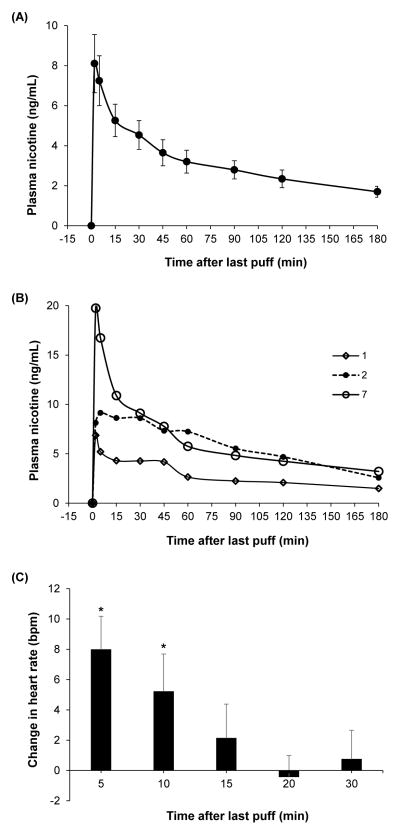
Findings: E-cigarettes delivered an average of 1.33 (0.87-1.79) mg [mean and 95% confidence interval (CI)] of nicotine, and 93.8% of the inhaled dose, 1.22 (0.80-1.66) was systemically retained. Average maximum plasma nicotine concentration (Cmax ) was 8.4 (5.4-11.5) ng/ml and time of maximal concentration (Tmax ) was 2-5 minutes. One participant had Tmax of 30 minutes. 84.4% and 91.7% of VG and PG, respectively, was systemically retained. Heart rate increased by an average of 8.0 beats per minute after 5 minutes. Withdrawal and urge to smoke decreased and the e-cigarettes were described as satisfying.
Conclusions: E-cigarettes can deliver levels of nicotine that are comparable to or higher than typical tobacco cigarettes, with similar systemic retention. Although the average maximum plasma nicotine concentration in experienced e-cigarette users appears to be generally lower than what has been reported from tobacco cigarette use, the shape of the pharmacokinetic curve is similar, suggesting addictive potential.
Keywords: Abuse liability; addiction; e-cigarette; nicotine pharmacokinetics; nicotine retention; propylene glycol; vegetable glycerin.
© 2015 Society for the Study of Addiction.
Conflict of interest statement
Figures
References
-
- Government Printing Office (GPO) Family Smoking Prevention and Tobacco Control Act. Public Law. :111–31.
-
- Food and Drug Administration. Deeming tobacco products to be subject to the Federal Food, Drug, and Cosmetic Act, as amended by the Family Smoking Prevention and Tobacco Control Act; regulations on the sale and distribution of tobacco products and required warning statements for tobacco products. Fed Regist. 2014;79(80):23141–207. - PubMed
Publication types
MeSH terms
Substances
Grants and funding
LinkOut - more resources
Full Text Sources
Other Literature Sources
Medical
Miscellaneous
