


Laparoscopic sleeve gastrectomy in children and adolescents with Prader-Willi syndrome: a matched-control study
- PMID: 26431633
- PMCID: PMC6866231
- DOI: 10.1016/j.soard.2015.07.014
Laparoscopic sleeve gastrectomy in children and adolescents with Prader-Willi syndrome: a matched-control study
Abstract
Background: Obesity is a leading cause of mortality and morbidity in Prader-Willi syndrome (PWS).
Objectives: To study weight loss and growth after laparoscopic sleeve gastrectomy (LSG) in pediatric patients with PWS compared with those without the syndrome.
Setting: Academic center with a standardized care pathway for pediatric bariatric surgery as a part of a prospective clinical outcome study on children and adolescents undergoing weight loss surgery.
Methods: Clinical data of all PWS patients who underwent LSG were abstracted from our prospective database, which included all pediatric patients who underwent bariatric surgery. These data were then compared with a 1:3 non-PWS group matched for age, gender, and body mass index (BMI). Data for up to 5 years follow-up were analyzed.
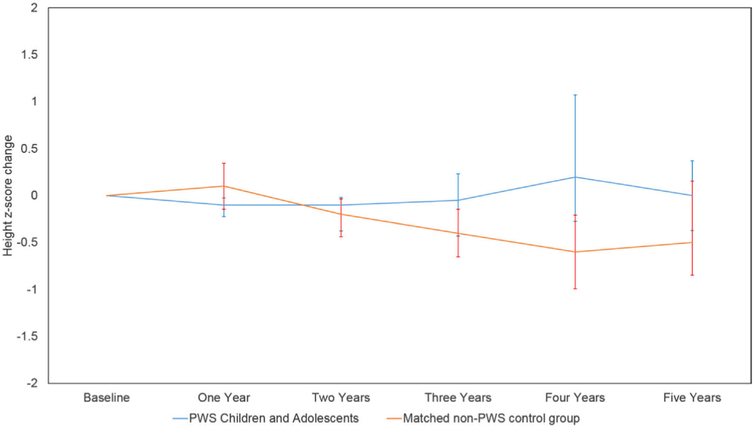
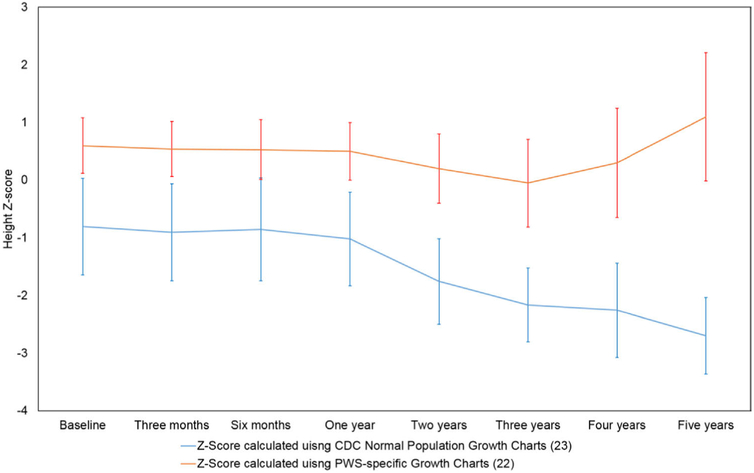
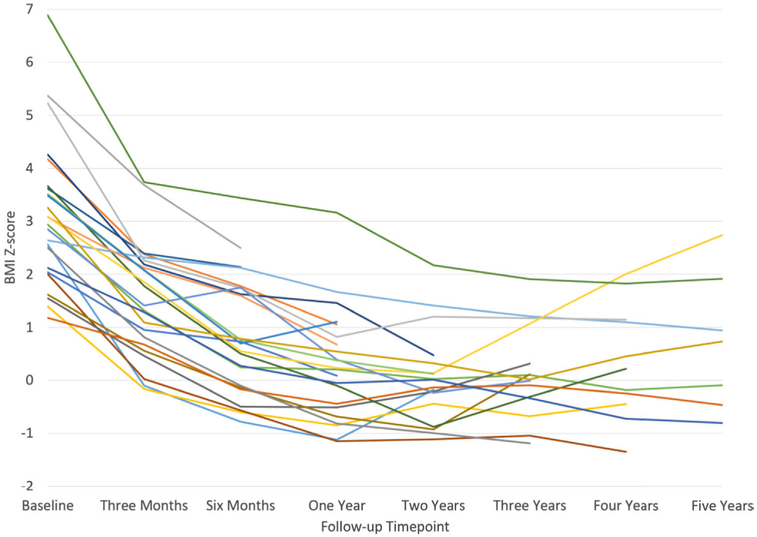
Results: The 24 PWS patients (mean age 10.7; 6<8 yr old, range 4.9-18) had a preoperative BMI of 46.2 ± 12.2 kg/m(2). All PWS patients had obstructive sleep apnea (OSA), 62% had dyslipidemia, 43% had hypertension, and 29% had diabetes mellitus. BMI change at the first, second, third, fourth, and fifth annual visits was -14.7 (n = 22 patients), -15.0 (n = 18), 12.2 (n = 13), -12.7 (n = 11), and -10.7 (n = 7), respectively, in the PWS group, whereas the non-PWS group had a BMI change of -15.9 (n = 67), -18.0 (n = 50), -18.4 (n = 47), -18.9 (n = 26), and -19.0 (n = 20), respectively. No significant difference was observed in postoperative BMI change (P = .2-.7) or growth (postoperative height z-score P value at each annual visit = .2-.8); 95% of co-morbidities in both groups were in remission or improved, with no significant difference in the rate of co-morbidity resolution after surgery (P = .73). One PWS patient was readmitted 5 years after surgery with recurrence of OSA and heart failure. No other readmissions occurred, and there were no reoperations, postoperative leaks, or other complications. No mortality or major morbidity was observed during the 5 years of follow-up. Among the PWS patients who reached their follow-up visit time points the total follow-up rate was 94.1%, whereas in the non-PWS group it was 97%. All patients who missed a follow-up visit were subsequently seen in future follow-ups, and no patient was lost to follow-up in either group.
Conclusions: PWS children and adolescents underwent effective weight loss and resolution of co-morbidities after LSG, without mortality, significant morbidity, or slowing of growth. LSG should be offered to obese PWS patients with heightened mortality particularly because no other effective alternative therapy is available.
Keywords: Bariatric surgery; Children and adolescents; Prader-Willi syndrome; Sleeve gastrectomy; Weight loss.
Copyright © 2016 American Society for Bariatric Surgery. Published by Elsevier Inc. All rights reserved.
Conflict of interest statement
Disclosures
The authors declare no conflicts of interests or relevant financial relationships to disclose.
Figures
Comment in
-
Response to the Letter to the Editor: laparoscopic sleeve gastrectomy in children and adolescents with Prader-Willi Syndrome: a matched control study.Surg Obes Relat Dis. 2016 Jan;12(1):215-6. doi: 10.1016/j.soard.2015.10.060. Epub 2015 Nov 6. Surg Obes Relat Dis. 2016. PMID: 26575355 No abstract available.
-
Laparoscopic sleeve gastrectomy in children and adolescents with Prader-Willi Syndrome: a matched control study.Surg Obes Relat Dis. 2016 Jan;12(1):213-4. doi: 10.1016/j.soard.2015.09.015. Epub 2015 Sep 26. Surg Obes Relat Dis. 2016. PMID: 26802226 No abstract available.
-
Laparoscopic sleeve gastrectomy in children and adolescents with Prader-Willi syndrome: a matched control study.Surg Obes Relat Dis. 2017 Feb;13(2):366. doi: 10.1016/j.soard.2016.08.013. Epub 2016 Aug 17. Surg Obes Relat Dis. 2017. PMID: 27692916 No abstract available.
References
-
- Butler MG, Lee PDK, Whitman BY, editors. Management of Prader-Willi syndrome. 3rd ed. New York: Springer-Verlag; 2006. p. 1–550.
-
- Chen C, Visootsak J, Dills S, Graham JM Jr. Prader-Willi syndrome: an update and review for the primary pediatrician. Clin Pediatr (Phila) 2007;46(7):580–91. - PubMed
-
- Tauber M, Diene G, Molinas C, Hebert M. Review of 64 cases of death in children with Prader-Willi syndrome (PWS). Am J Med Genet A 2008;146 A(7):881–7. - PubMed
Publication types
MeSH terms
Grants and funding
LinkOut - more resources
Full Text Sources
Other Literature Sources
Medical
