. 2015 Nov 15;75(22):4688-96.
doi: 10.1158/0008-5472.CAN-15-0892. Epub 2015 Oct 2.

Androgen Receptor Upregulation Mediates Radioresistance after Ionizing Radiation

Affiliations

Androgen Receptor Upregulation Mediates Radioresistance after Ionizing Radiation

Daniel E Spratt et al. Cancer Res. .

Abstract

Clinical trials have established the benefit of androgen deprivation therapy (ADT) combined with radiotherapy in prostate cancer. ADT sensitizes prostate cancer to radiotherapy-induced death at least in part through inhibition of DNA repair machinery, but for unknown reasons, adjuvant ADT provides further survival benefits. Here, we show that androgen receptor (AR) expression and activity are durably upregulated following radiotherapy in multiple human prostate cancer models in vitro and in vivo. Moreover, the degree of AR upregulation correlates with survival in vitro and time to tumor progression in animal models. We also provide evidence of AR pathway upregulation, measured by a rise in serum levels of AR-regulated hK2 protein, in nearly 20% of patients after radiotherapy. Furthermore, these men were three-fold more likely to experience subsequent biochemical failure. Collectively, these data demonstrate that radiotherapy can upregulate AR signaling after therapy to an extent that negatively affects disease progression and/or survival.


Conflict of interest statement

Conflicts of interest: CLS and JW are co-inventors of MDV3100. DJT and GGK hold patents for the immunoassay of hK2.

Figures
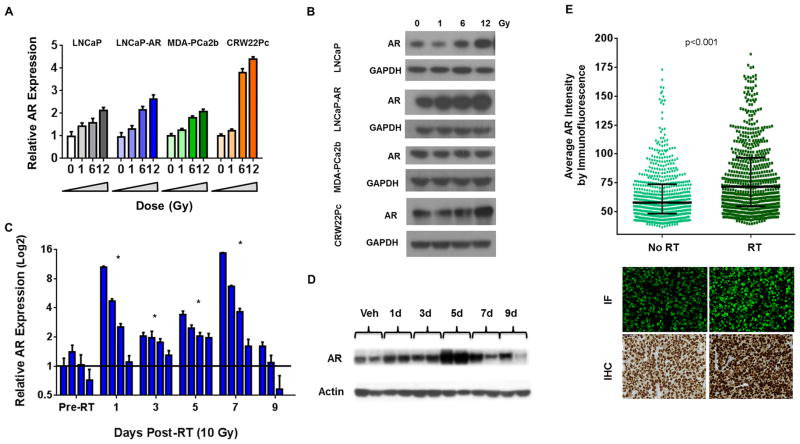
Figure 1
Figure 1. RT induces increased expression of the androgen receptor
(A) LNCaP, LNCaP-AR, MDA-PCa2b, and CWR22Pc cell lines were treated with either 0, 1, 6, or 12 Gy or EBRT and the cells harvested for mRNA measured by qPCR, and (B) protein by western blot. (C) LNCaP-AR derived xenografts were treated with 10 Gy of conformal EBRT and compared to non-irradiated controls, and mRNA for AR was measured by qPCR, and (D) protein by western blot. (E) LNCaP-AR xenografts were treated with 10 Gy of EBRT and harvested 5 days after treatment, fixed and formalin and paraffin embedded and stained by IHC and immunofluorescence for AR. Significance level indicated by * (p<0.05) or p-value listed in figure.
Figure 2
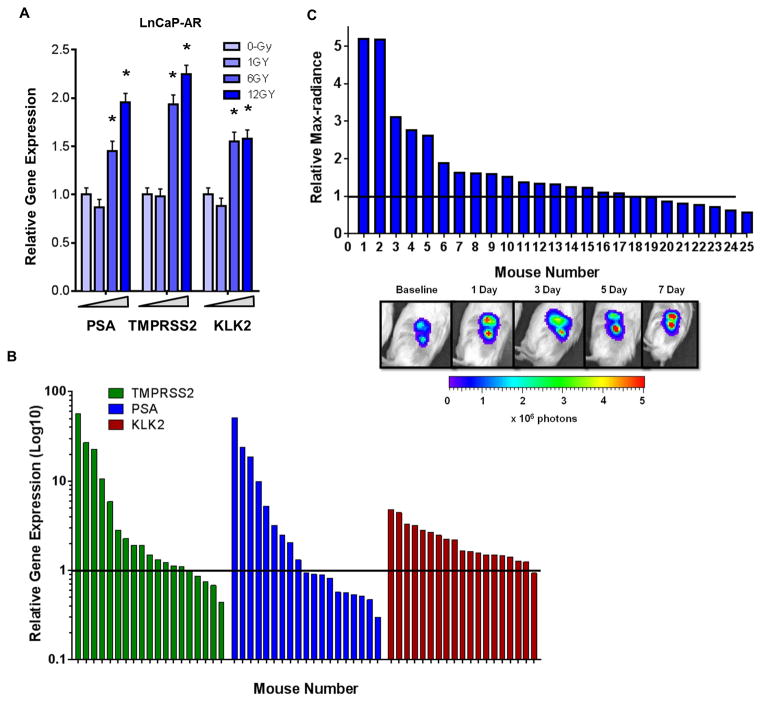
Figure 2. AR transcriptional output is increased following RT
(A) LNCaP-AR in vitro qPCR assessment of AR target genes PSA, TMPRSS2, and KLK2 mRNA expression post-EBRT (0, 1, 6, 12 Gy). (B) LNCaP-AR xenografts irradiated with 10 Gy and harvested over the first week post-RT and mRNA by qPCR was analyzed for the AR target genes TMPRSS2, PSA, and KLK2. (C) Bioluminescence assay of 25 SCID mice with LNCaP-AR xenografts imaged at baseline and then treated with 10 Gy of conformal EBRT. Subsequent imaging performed during the first week post-RT and the max increase in bioluminescence was recorded. The bottom panel demonstrates the acute and persistent increase in AR-output measured by bioluminescence from mouse #1 in the companion graph. Significance level indicated by * (p<0.05) or p-value listed in figure.
Figure 3
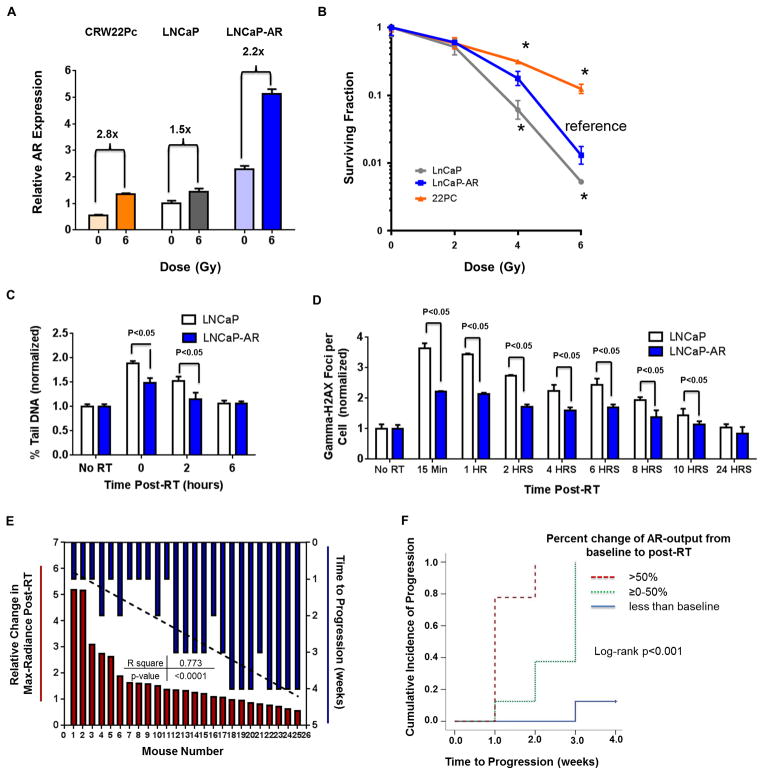
Figure 3. Increased AR signaling post-RT correlates with increased DNA repair and cancer cell survival
(A) Relative upregulation of AR mRNA after 6 Gy of EBRT in CWR22Pc, LNCaP, and LNCaP-AR cell lines. 22Pc cells had the greatest AR induction despite having the lowest baseline AR expression level. (B) Long-term clonogenic survival assay comparing cell lines with different baseline AR expression and different magnitudes of AR induction. (C) Neutral comet assay and (D) gamma-H2AX immunofluorescence were performed to compare LNCaP and LNCaP-AR cells after 6 Gy of EBRT. (E) Waterfall plot of AR-output upregulation post-RT measured by max-radiance from in vivo bioluminescence of LNCaP-AR tumors (red) co-plotted with time to tumor progression (blue) (R2 0.77, p<0.001). (F) Cumulative incidence of mice categorically subgrouped into three groups from panel D (>50%, 0–50%, <0% increase in bioluminescence). Significance level indicated by * (p<0.05) or p-value listed in figure.
Figure 4
Figure 4. Serum hK2 up-regulation post-RT is associated with biochemical failure in 227 men treated with definitive EBRT for localized prostate cancer
A. Waterfall plot of percent change in hK2 post-RT compared to baseline. B. Comparison of biochemical relapse outcomes in men who had an hK2 gain post-RT (n=40) versus those who did not (n=187); (odds ratio 3.39 [95%CI 1.23–9.39], p=0.019). C. Kaplan-Meier curves for Freedom of PSA progression by Hk2 gain status. Estimates at 72 months for Hk2 gain were 83.5% compared to 94.2% for those without an Hk2 gain (p=0.027).

References

    1. Horwitz EM, Bae K, Hanks GE, Porter A, Grignon DJ, Brereton HD, et al. Ten-year follow-up of radiation therapy oncology group protocol 92–02: a phase III trial of the duration of elective androgen deprivation in locally advanced prostate cancer. J Clin Oncol. 2008;26:2497–504. - PubMed
    1. Bolla M, De Reijke TM, Van Tienhoven G, Van den Bergh AC, Oddens J, Poortmans PM, et al. Duration of androgen suppression in the treatment of prostate cancer. N Engl J Med. 2009;360:2516–27. - PubMed
    1. Pisansky TM, Hunt D, Gomella LG, Amin MB, Balogh AG, Chinn DM, et al. Duration of androgen suppression before radiotherapy for localized prostate cancer: Radiation Therapy Oncology Group randomized clinical trial 9910. J Clin Oncol. 2014;58:0662. - PMC - PubMed
    1. Alibhai SM, Gogov S, Allibhai Z. Long-term side effects of androgen deprivation therapy in men with non-metastatic prostate cancer: a systematic literature review. Critical reviews in oncology/hematology. 2006;60:201–15. - PubMed
    1. Polkinghorn WR, Parker JS, Lee MX, Kass EM, Spratt DE, Iaquinta PJ, et al. Androgen receptor signaling regulates DNA repair in prostate cancers. Cancer discovery. 2013;3:1245–53. - PMC - PubMed

Publication types