. 2015 Nov 15;407(2):232-45.
doi: 10.1016/j.ydbio.2015.09.012. Epub 2015 Oct 1.

Loss of the Drosophila melanogaster DEAD box protein Ddx1 leads to reduced size and aberrant gametogenesis

Affiliations

Loss of the Drosophila melanogaster DEAD box protein Ddx1 leads to reduced size and aberrant gametogenesis

Devon R Germain et al. Dev Biol. .

Abstract

Mammalian DDX1 has been implicated in RNA trafficking, DNA double-strand break repair and RNA processing; however, little is known about its role during animal development. Here, we report phenotypes associated with a null Ddx1 (Ddx1(AX)) mutation generated in Drosophila melanogaster. Ddx1 null flies are viable but significantly smaller than control and Ddx1 heterozygous flies. Female Ddx1 null flies have reduced fertility with egg chambers undergoing autophagy, whereas males are sterile due to disrupted spermatogenesis. Comparative RNA sequencing of control and Ddx1 null third instars identified several transcripts affected by Ddx1 inactivation. One of these, Sirup mRNA, was previously shown to be overexpressed under starvation conditions and implicated in mitochondrial function. We demonstrate that Sirup is a direct binding target of Ddx1 and that Sirup mRNA is differentially spliced in the presence or absence of Ddx1. Combining Ddx1 null mutation with Sirup dsRNA-mediated knock-down causes epistatic lethality not observed in either single mutant. Our data suggest a role for Drosophila Ddx1 in stress-induced regulation of splicing.

Keywords: DDX1; DEAD box helicase; Gametogenesis; Metabolism; Sirup.


Figures

None
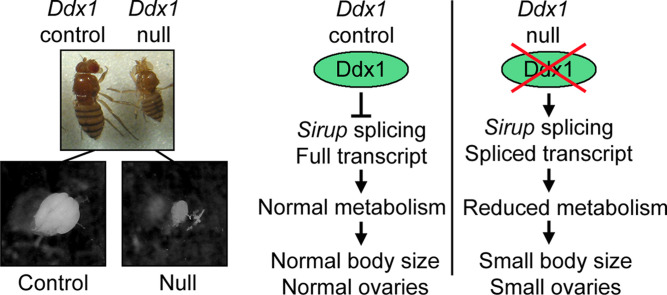
Graphical abstract
Fig. 1
Fig. 1
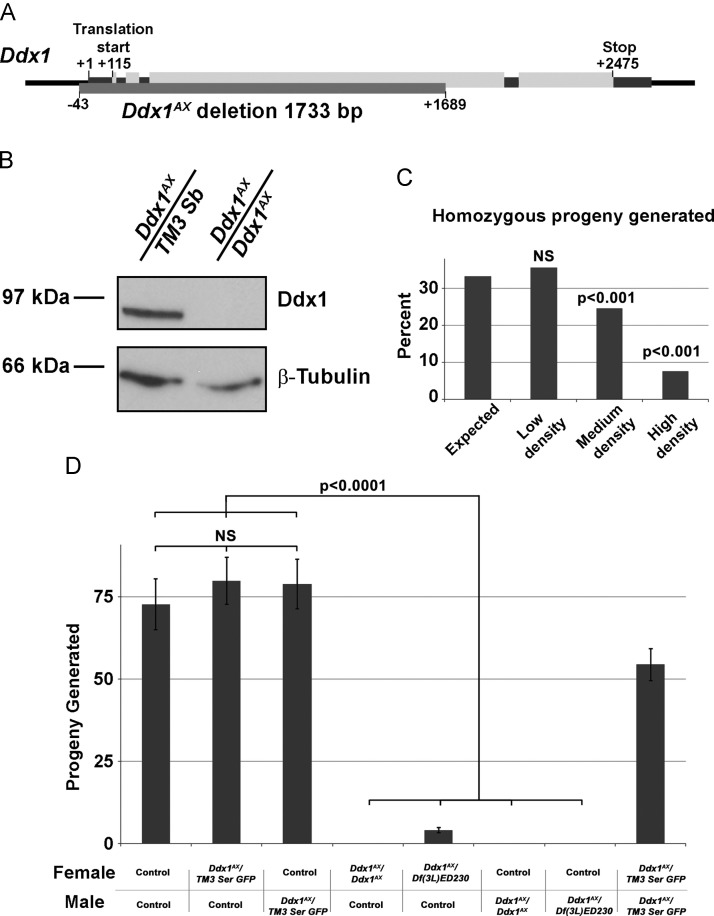
Ddx1null flies are viable but show reduced fertility. (A) The location of the Ddx1AX deletion. (B) Western blot analysis shows no detectable signal for Ddx1 protein in Ddx1AX/AXadult flies. (C) Survival of homozygous adult flies generated from Ddx1 heterozygote crosses. As the Ddx1AX mutation is carried over a recessive lethal balancer chromosome, the expected percentage of homozygous progeny is 33%. At low density, homozygous flies were generated at the expected rate. At medium density and high density, a significant reduction in the number of homozygous flies was observed; n=45 adults (low density), 1165 adults (medium density) and 499 adults (high density). (D) Progeny generated from single virgin females mated with two males (genotypes are indicated) and allowed to lay eggs for 10 days. Pupae were removed and counted daily. Homozygous mutant flies generated very low or no progeny. Heterozygous flies generated progeny at the expected rate. n≥20 crosses for all samples. Error bars indicate s.e.m.
Fig. 2
Fig. 2
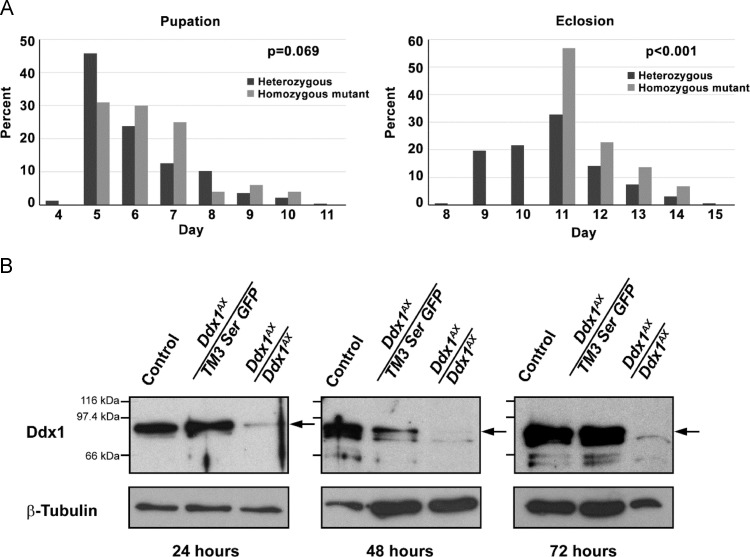
Ddx1null flies show delayed development (A) and maternally contributed Ddx1 protein in larvae (B). (A) Ddx1 heterozygote crosses were allowed to lay eggs for 24 hours. Pupae were removed at 24 hour intervals and scored for Ddx1 genotype (left, n=233 for heterozygous pupae and n=104 for homozygous mutant pupae). Adults were also counted at 24 hour intervals (right, n=162 for heterozygous adults and n=44 for homozygous mutant adults). A non-significant trend was observed for pupation time, and a significant difference was observed for eclosion time. (B) Control and Ddx1AX heterozygote crosses were allowed to lay eggs on apple juice plates for a period of two hours. Protein lysates were prepared from GFP sorted (for Ddx1AX/+ and Ddx1AX/AX progeny) and control larvae collected at 24, 48 or 72 hours post-egg laying. Western blot analysis was carried out using anti-Ddx1 (GenScript) and anti-β-tubulin antibodies (E7, DSHB). A faint Ddx1 signal was observed at both 24 and 48 hours post-egg laying, indicating that maternally loaded Ddx1 is still present at these times. Ddx1 was no longer detected at 72 hours.
Fig. 3
Fig. 3
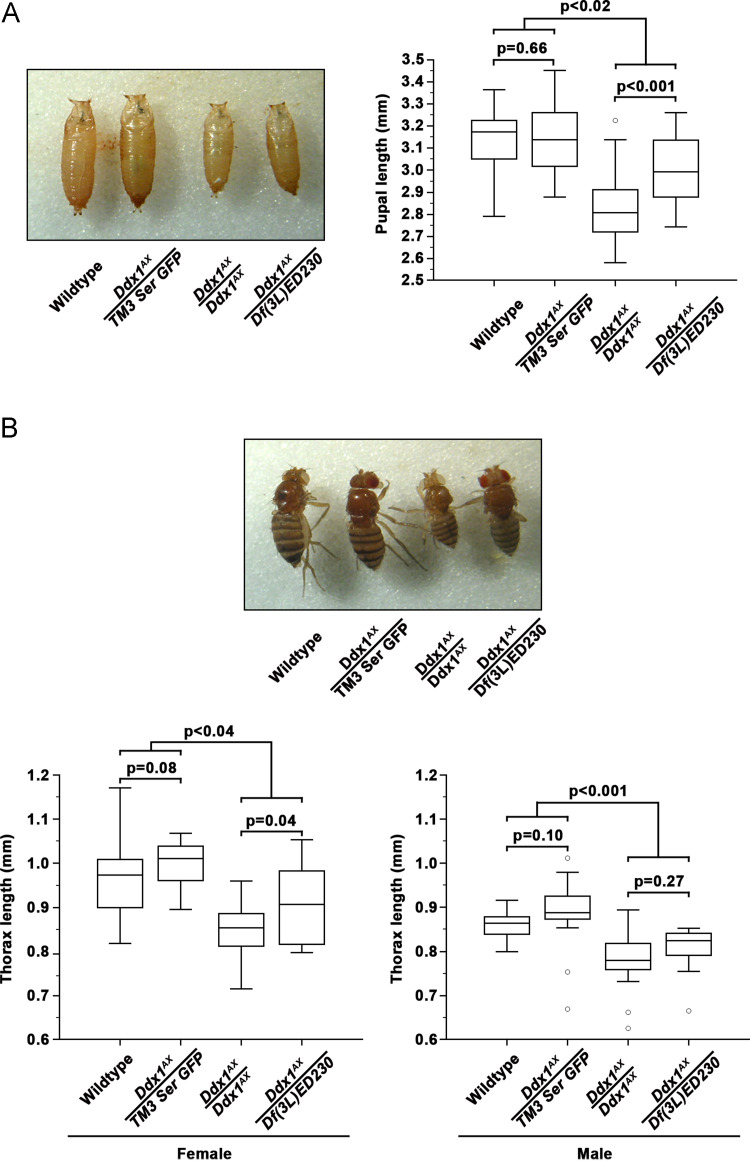
Ddx1null flies are smaller than control. (A) Control, Ddx1 heterozygous and Ddx1 homozygous mutant pupae were collected and total pupal length was measured, n≥20 pupae for each sample. (B) Control, Ddx1 heterozygous and Ddx1 homozygous mutant one day old adults were collected and thorax length was measured, n≥19 adults for each sample. At both pupal and adult stages, Ddx1 null animals were significantly smaller than control animals, and Ddx1AX/Df(3L)ED230 animals were slightly larger than Ddx1AX/AX.
Fig. 4
Fig. 4
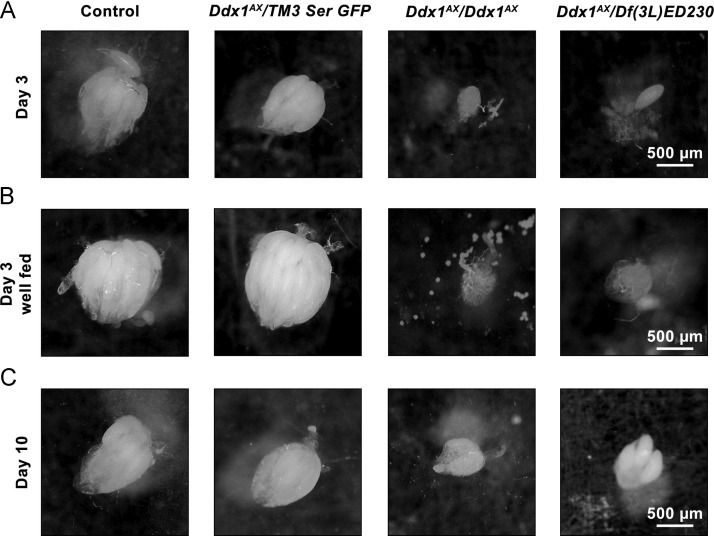
Gross ovary phenotypes inDdx1null flies. Ovaries collected from virgin females held in isolation for 3 days (A) or 10 days (C), or held with males for 3 days and supplemented with wet yeast paste (B). Under both conditions at day 3, Ddx1 null flies have much smaller ovaries, with few (Ddx1AX/Df(3L)ED230) or no (Ddx1AX/AX) mature eggs present (A and B). By day 10, a small number of full size mature eggs lacking dorsal appendages are present in Ddx1AX/AXovaries.
Fig. 5
Fig. 5
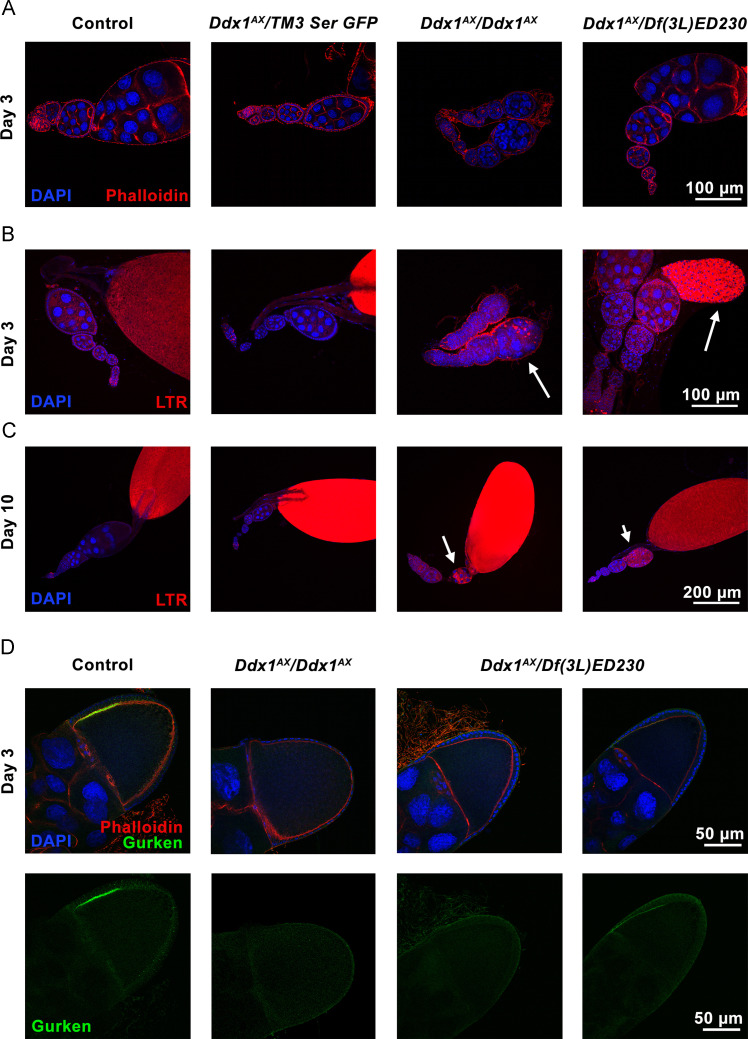
Aberrant development ofDdx1null egg chambers. Immunofluorescence imaging of ovaries with DAPI and Alexa 546-conjugated phalloidin (A), DAPI and LysoTracker Red (B and C), and DAPI, Alexa 546-conjugated phalloidin and anti-Gurken antibody (D). Developing egg chambers in Ddx1 null ovaries appear normal at early stages (A); however, LysoTracker Red staining reveals egg chambers undergoing autophagy (B and C, white arrows). (D) Immunostaining of stage 8-9 egg chambers with anti-Gurken antibody shows a normal Gurken pattern in control and some Ddx1AX/Df(3L)ED230 egg chambers, with absent Gurken signal in the remaining Ddx1AX/Df(3L)ED230 and all Ddx1AX/AX egg chambers.
Fig. 6
Fig. 6
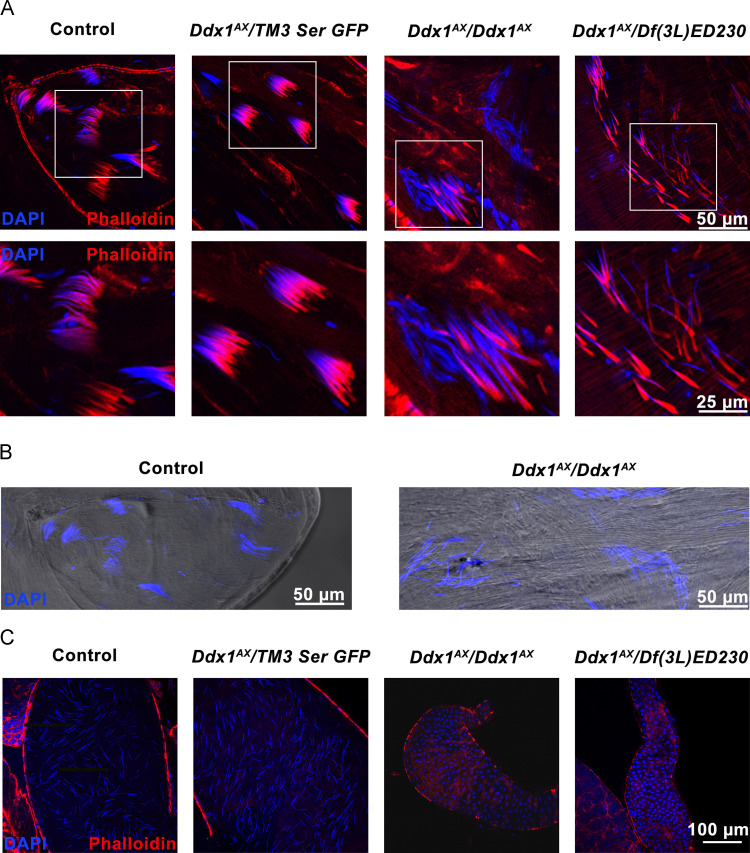
Aberrant spermiogenesis inDdx1null testes. Analysis of testes and seminal vesicles collected from male flies held in isolation for 3 days. (A) Confocal microscopy analysis of testes from control, Ddx1 heterozygous and Ddx1 null adult male flies stained with Alexa 546-conjugated phalloidin and DAPI. The area outlined in the top diagram is magnified in the bottom diagram. (B) DIC imaging of testes from control and Ddx1 null adult male flies. (C) Confocal microscopy analysis of seminal vesicles from control, Ddx1 heterozygous and Ddx1 null adult male flies stained with Alex 546-conjugated phalloidin and DAPI. Ddx1 null testes show disordered spermatid cysts with elongated spermatid tails. No mature sperm are observed in Ddx1 null seminal vesicles.
Fig. 7
Fig. 7
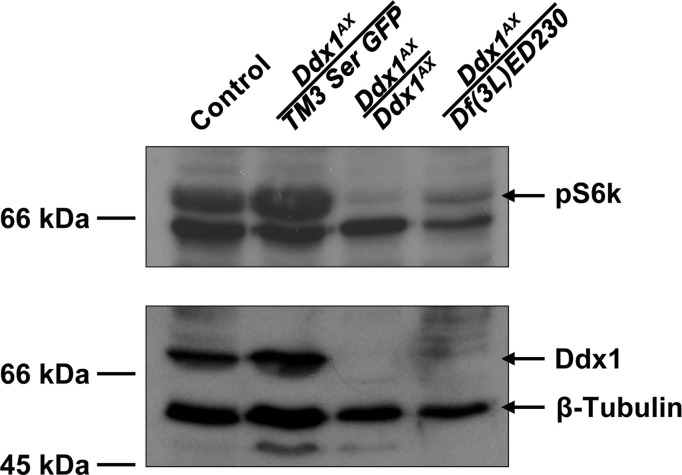
Reduced pS6k levels inDdx1null flies. Western blot analysis of cell lysates prepared from control, Ddx1 heterozygous and Ddx1 null 3rd instars. pS6k levels are reduced in the Ddx1 null lines, but slightly elevated in Ddx1AX/Df(3L)ED230 larvae as compared to Ddx1AX/AX.
Fig. 8
Fig. 8
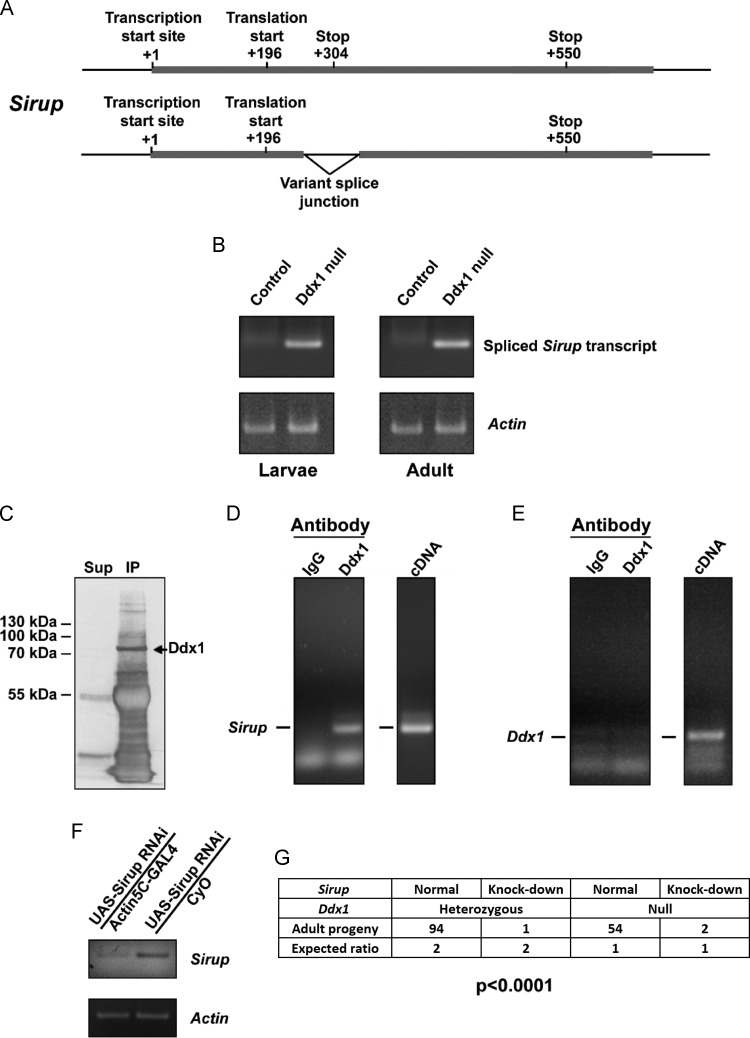
Interactions between Ddx1andSirup. (A) Pictograph showing the structure of Sirup and the variable splice junction site (top – transcript expressed in control flies; bottom – transcript expressed in Ddx1AX/AX flies). (B) RT-PCR analysis of control and null larvae and adult flies. A spliced Sirup product is only observed in Ddx1 null animals. (C) IP using anti-Ddx1 antibody demonstrating that almost all Ddx1 protein is retained in the immunoprecipitate. (D, E) Left panels – RT-PCR analysis of RNA co-immunoprecipitated with Ddx1 or IgG. Right panels – RT-PCR of cDNA generated from control flies used as a positive control for the PCR reaction. Sirup mRNA results indicate that Sirup RNA, but not Ddx1 RNA, is pulled down with Ddx1 protein. (F) RT-PCR analysis shows reduced Sirup RNA levels in Sirup knock-down adult flies. (G) Progeny generated from y1w*; Actin5C-Gal4/CyO; Ddx1AX/TM3, Sb x y1w*; UAS-Sirup-RNAi; Ddx1AX/TM3, Ser GFP crosses. Expected ratios of 2:1 for heterozygous to homozygous mutant Ddx1 and 1:1 for Sirup knock-down to CyO. A significant reduction in the number of Sirup knock-down flies was observed. Chi square analysis comparing observed distribution to expected distribution was used to determine significance.

References

    1. Activities at the Universal Protein Resource (UniProt) Nucleic Acids Res. 2014;42:D191–D198. - PMC - PubMed
    1. Balko J.M., Arteaga C.L. Dead-box or black-box: is DDX1 a potential biomarker in breast cancer? Breast Cancer Res Treat. 2011;127:65–67. - PubMed
    1. Barth J.M., Szabad J., Hafen E., Kohler K. Autophagy in Drosophila ovaries is induced by starvation and is required for oogenesis. Cell Death Differ. 2011;18:915–924. - PMC - PubMed
    1. Berg C.A. The Drosophila shell game: patterning genes and morphological change. Trends Genet. 2005;21:346–355. - PubMed
    1. Bleoo S., Sun X., Hendzel M.J., Rowe J.M., Packer M., Godbout R. Association of human DEAD box protein DDX1 with a cleavage stimulation factor involved in 3’-end processing of pre-MRNA. Mol Biol Cell. 2001;12:3046–3059. - PMC - PubMed

Publication types

MeSH terms

LinkOut - more resources