


GCKR and PPP1R3B identified as genome-wide significant loci for plasma lactate: the Atherosclerosis Risk in Communities (ARIC) study
- PMID: 26433129
- PMCID: PMC4819009
- DOI: 10.1111/dme.12971
GCKR and PPP1R3B identified as genome-wide significant loci for plasma lactate: the Atherosclerosis Risk in Communities (ARIC) study
Abstract
Aim: To investigate the genetic influence of circulating lactate level, a marker of oxidative capacity associated with diabetes.
Methods: We conducted a genome-wide association study of log-transformed plasma lactate levels in 6901 European-American participants in the Atherosclerosis Risk in Communities study. For regions that achieved genome-wide significance in European-American participants, we conducted candidate region analysis in African-American subjects and tested for interaction between metformin use and the index single nucleotide polymorphisms for plasma lactate in European-American subjects.
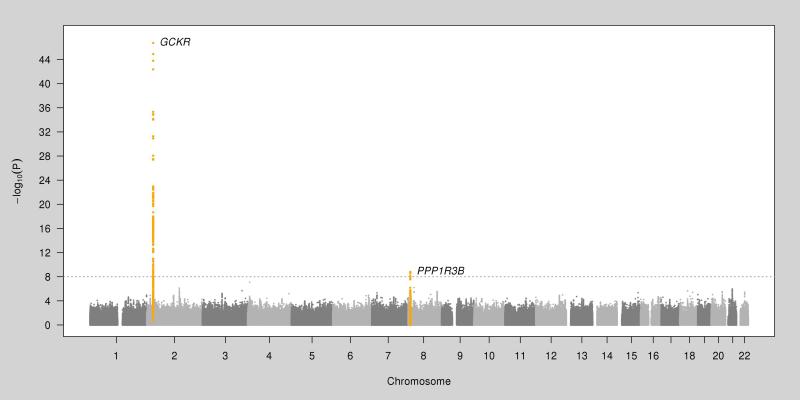
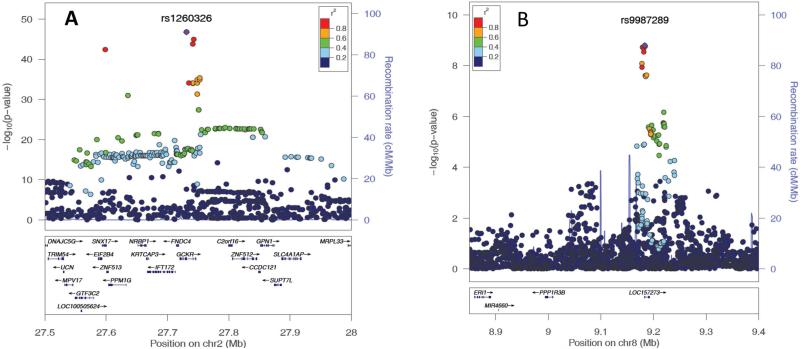
Results: The genome-wide association study in European-American subjects identified two genome-wide significant loci, GCKR (rs1260326, T allele β=0.08; P=1.8×10(-47) ) and PPP1R3B/LOC157273 (rs9987289, A allele β=0.06; P=1.6×10(-9) ). The index single nucleotide polymorphisms in these two loci explain 3.3% of the variance in log-transformed plasma lactate levels among the European-American subjects. In the African-American subjects, based on a region-significant threshold, the index single nucleotide polymorphism at GCKR was associated with plasma lactate but that at PPP1R3B/LOC157273 was not. Metformin use appeared to strengthen the association between the index single nucleotide polymorphism at PPP1R3B/LOC157273 and plasma lactate in European-American subjects (P for interaction=0.01).
Conclusions: We identified GCKR and PPP1R3B/LOC157273 as two genome-wide significant loci of plasma lactate. Both loci are associated with other diabetes-related phenotypes. These findings increase our understanding of the genetic control of lactate metabolism.
© 2015 Diabetes UK.
Figures
References
-
- van Hall G. Lactate kinetics in human tissues at rest and during exercise. Acta Physiol. 2010;199:499–508. - PubMed
MeSH terms
Substances
Grants and funding
- HHSN268201100012C/HL/NHLBI NIH HHS/United States
- HHSN268201100009I/HL/NHLBI NIH HHS/United States
- HHSN268201100010C/HL/NHLBI NIH HHS/United States
- UL1 RR025005/RR/NCRR NIH HHS/United States
- HHSN268201100008C/HL/NHLBI NIH HHS/United States
- HHSN268201100005G/HL/NHLBI NIH HHS/United States
- HHSN268201100008I/HL/NHLBI NIH HHS/United States
- R01 HL059367/HL/NHLBI NIH HHS/United States
- HHSN268201100007C/HL/NHLBI NIH HHS/United States
- T32 DK007732/DK/NIDDK NIH HHS/United States
- HHSN268201100011I/HL/NHLBI NIH HHS/United States
- HHSN268201100011C/HL/NHLBI NIH HHS/United States
- R01 HL086694/HL/NHLBI NIH HHS/United States
- U01 HG004402/HG/NHGRI NIH HHS/United States
- HHSN268201100006C/HL/NHLBI NIH HHS/United States
- R01 DK085458/DK/NIDDK NIH HHS/United States
- HHSN268201100005I/HL/NHLBI NIH HHS/United States
- HHSN268201100009C/HL/NHLBI NIH HHS/United States
- HHSN268201100005C/HL/NHLBI NIH HHS/United States
- HHSN268201100007I/HL/NHLBI NIH HHS/United States
- R01 HL087641/HL/NHLBI NIH HHS/United States
LinkOut - more resources
Full Text Sources
Other Literature Sources
