


Dietary diversity, meal frequency and associated factors among infant and young children in Northwest Ethiopia: a cross- sectional study
- PMID: 26433689
- PMCID: PMC4592571
- DOI: 10.1186/s12889-015-2333-x
Dietary diversity, meal frequency and associated factors among infant and young children in Northwest Ethiopia: a cross- sectional study
Abstract
Background: Inappropriate feeding practice increases risk of under nutrition, illness, and mortality amongst children less than 2 years of age. The objective of this study is to assess minimum dietary diversity, meal frequency and its associated factors among infant and young children aged 6-23 months in Dangila Town, Northwest Ethiopia.
Methods: A community based cross sectional study was conducted. Simple random sampling technique was used to select study participants. Interviewer administered questionnaire were used. Bivariate and multivariable logistic regression analyses was employed to identify factors associated with minimum dietary diversity and meal frequency.
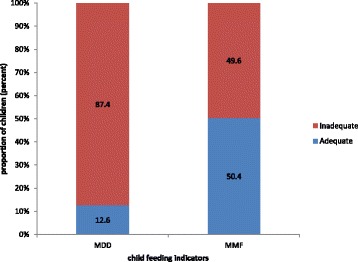
Results: A total of 920 children 6-23 months were included. Proportion of children who met the minimum dietary diversity and meal frequency was 12.6 and 50.4 %, respectively. Mothers education [AOR =2.52], age of a child [AOR = 2.05], birth order of index child [AOR = 2.08], living in urban area [AOR = 2.09], having home gardening [AOR = 2.03], and media exposure [AOR = 2.74] were positively associated with dietary diversity. Moreover, age of the child [AOR = 3.03], birth order of index child [AOR = 1.58], mothers involvement in decision making [AOR = 1.51], media exposure [AOR = 2.62], and having postnatal visit [AOR = 2.30] were positively associated with meal frequency.
Conclusion: The proportion of children who received minimum dietary diversity and meal frequency was low. Being at younger age, first birth order, and lack of media exposure affect both dietary diversity and meal frequency. Increasing mother's education, home gardening, mass media promotion and empowering women in decision making are highly recommended to increase dietary diversity and meal frequency.
Figures
References
-
- Federal Democratic Republic of Ethiopia Ministry of Health. Complimentary feeding practices for children aged 6 up to 24 months. Addiss Ababa, Ethiopia, 2012.
-
- World Health Organization. Guiding principles for feeding non-breastfed children 6–24 months of age. 2005.
-
- Infant and Young Child Feeding Practices. Collecting and Using Data: A Step-by- Step Guide. Cooperative for Assistance and Relief Everywhere, Inc. (CARE). 2010.
-
- World Health Organization. Indicators for assessing infant and young child feeding practices: part 1: definitions: conclusions of a consensus meeting held 6–8 November 2007 in Washington DC, USA. 2008.
-
- World Health Organization. Infant and young child feeding Model Chapter for textbooks for medical students and allied health professionals. Vol. II. Geneva Switzerland; 2009. - PubMed
MeSH terms
LinkOut - more resources
Full Text Sources
Other Literature Sources
Miscellaneous
