


Ponatinib as first-line treatment for patients with chronic myeloid leukaemia in chronic phase: a phase 2 study
- PMID: 26436130
- PMCID: PMC4587395
- DOI: 10.1016/S2352-3026(15)00127-1
Ponatinib as first-line treatment for patients with chronic myeloid leukaemia in chronic phase: a phase 2 study
Abstract
Background: Ponatinib has shown efficacy in patients with refractory chronic myeloid leukaemia (CML) and in those with CML with a Thr315Ile mutation. We aimed to investigate the activity and safety of ponatinib as first-line treatment for patients with chronic-phase CML.
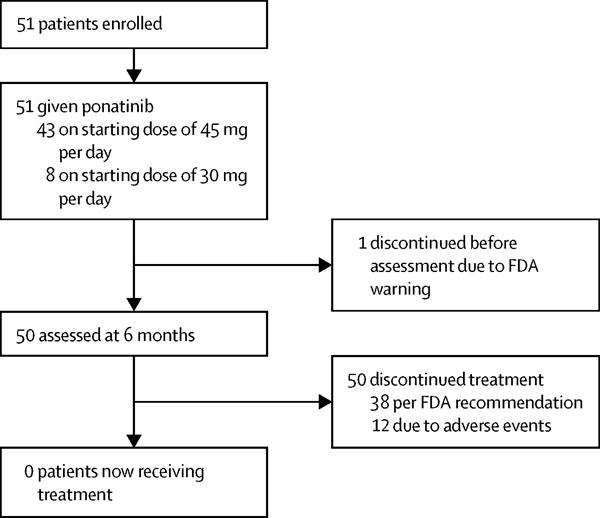
Methods: We did a single-arm, phase 2 trial at MD Anderson Cancer Center in Houston, TX, USA. Between May 3, 2012, and Sept 24, 2013, we enrolled patients with early (<6 months) chronic-phase CML and treated them with oral ponatinib once a day. Patients enrolled before July 25, 2013, were given a starting dose of 45 mg per day; we lowered this due to tolerability issues and patients enrolled after this date were given a starting dose of 30 mg per day. After a warning by the US Food and Drug Administration (FDA) in Oct 6, 2013, for vascular complications with ponatinib, we started all patients on aspirin 81 mg daily and reduced the dose of ponatinib to 30 mg or 15 mg per day for all patients. The primary endpoint was the proportion of patients who achieved complete cytogenetic response by 6 months in the per-protocol population. This trial is registered with ClinicalTrials.gov, number NCT01570868.
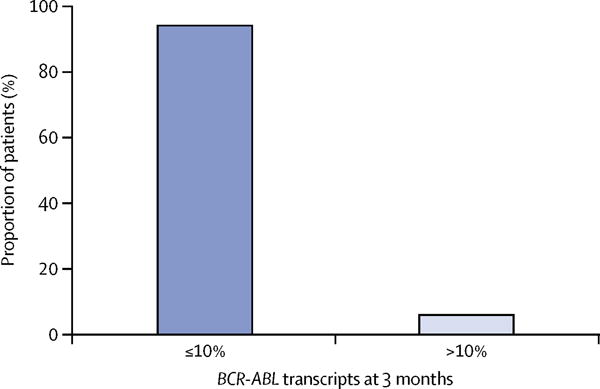
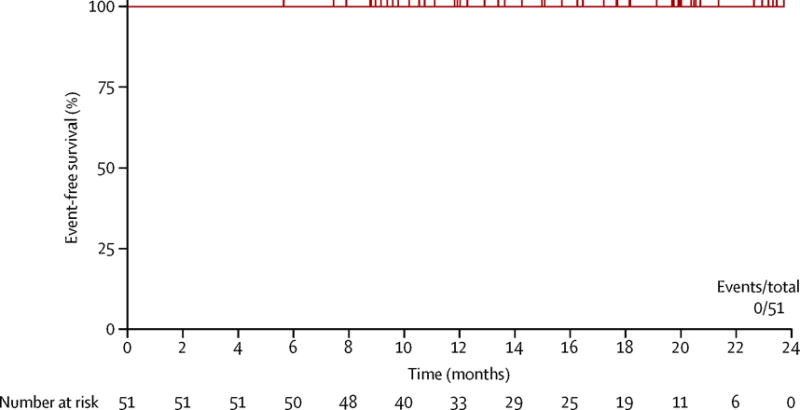
Findings: We enrolled 51 patients. Median follow-up was 20·9 months (IQR 14·9–25·2). 43 patients were started on 45 mg ponatinib every day; eight patients were started on 30 mg per day. 43 (94%) of 46 evaluable patients achieved complete cytogenetic response at 6 months. Most frequent toxicities included skin-related effects (n=35; 69%) and elevated lipase (n=32; 63%). Cardiovascular events (mainly hypertension) occurred in 25 (49%) patients. Grade 3–4 myelosuppression occurred in 15 (29%) patients. Five (10%) patients developed cerebrovascular or vaso-occlusive disease. 43 (85%) patients needed treatment interruptions at some time and 45 (88%) needed dose reductions. The study was terminated June 18, 2014, at the recommendation of the FDA due to concern about the increased risk of thromboembolism with ponatinib.
Interpretation: Patients with newly diagnosed CML in chronic phase respond well to treatment with ponatinib, with most achieving a complete cytogenetic response. Dose adjustment, extensive monitoring, and counselling of the patients for thromboembolic events is needed for patients on ponatinib therapy. However, due to the risk of vascular thrombotic events and the availability of alternative options for these patients, other drugs should be considered first in the frontline setting.
Funding: MD Anderson Cancer Center, National Cancer Institute, ARIAD Pharmaceutical.
Conflict of interest statement
HK declares research grants from Novartis, ARIAD Pharmaceuticals, Bristol-Myers Squibb (BMS), and Pfizer. EJ declares consultancy for BMS, Pfizer, and ARIAD, and research grants from Teva. JC declares research support from ARIAD, BMS, Novartis, Pfizer, and Teva and was a consultant for ARIAD, BMS, Pfizer, and Teva. All other authors declare no competing interests.
Figures
Comment in
-
Ponatinib in chronic myeloid leukaemia: ready for first-line?Lancet Haematol. 2015 Sep;2(9):e352-3. doi: 10.1016/S2352-3026(15)00130-1. Epub 2015 Jul 30. Lancet Haematol. 2015. PMID: 26685767 No abstract available.
References
-
- Deininger M, O’Brien SG, Guilhot F, et al. International randomized study of interferon vs STI571 (IRIS) 8-year follow up: sustained survival and low risk for progression or events in patients with newly diagnosed chronic myeloid leukemia in chronic phase (CML-CP) treated with Imatinib. Blood. 2009;114:1126.
-
- Baccarani M, Rosti G, Castagnetti F, et al. Comparison of imatinib 400 mg and 800 mg daily in the front-line treatment of high-risk, Philadelphia-positive chronic myeloid leukemia: a European LeukemiaNet Study. Blood. 2009;113:4497–504. - PubMed
-
- Cortes JE, Baccarani M, Guilhot F, et al. Phase III, randomized, open-label study of daily imatinib mesylate 400 mg versus 800 mg in patients with newly diagnosed, previously untreated chronic myeloid leukemia in chronic phase using molecular end points: tyrosine kinase inhibitor optimization and selectivity study. J Clin Oncol. 2010;28:424–30. - PMC - PubMed
Publication types
MeSH terms
Substances
Associated data
Grants and funding
LinkOut - more resources
Full Text Sources
Other Literature Sources
Medical
