


Epidemiology of infections by HIV, Syphilis, Gonorrhea and Lymphogranuloma Venereum in Barcelona City: a population-based incidence study
- PMID: 26438040
- PMCID: PMC4594901
- DOI: 10.1186/s12889-015-2344-7
Epidemiology of infections by HIV, Syphilis, Gonorrhea and Lymphogranuloma Venereum in Barcelona City: a population-based incidence study
Abstract
Background: The aim of this study was to determine the evolution of HIV infection, gonorrhea, syphilis and lymphogranuloma venereum (LGV), and their epidemiological characteristics in Barcelona city.
Methods: Population-based incidence study of all newly occurring diagnoses of HIV infection, syphilis, gonorrhea and LGV detected in Barcelona between January 2007 and December 2011. A descriptive analysis was performed. The annual incidence rates per 100,000 inhabitants were calculated by sex, sexual conduct and educational level. To estimate global sex-specific rates we used the Barcelona city census; for the calculation of rates by sexual conduct and educational level we used estimates of the Barcelona Health Interview Survey. Trends were analysed using the chi-squared test for linear trend.
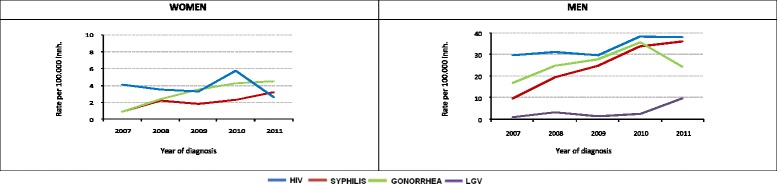
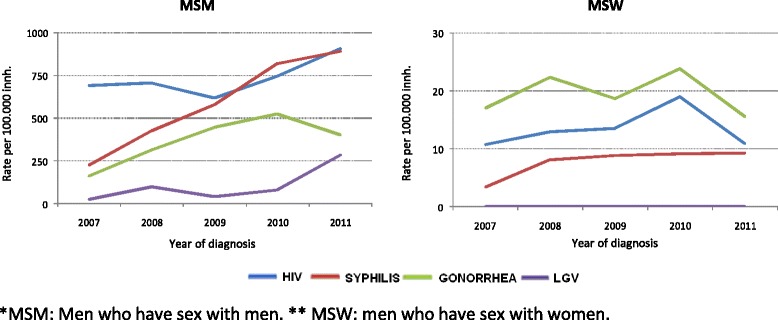
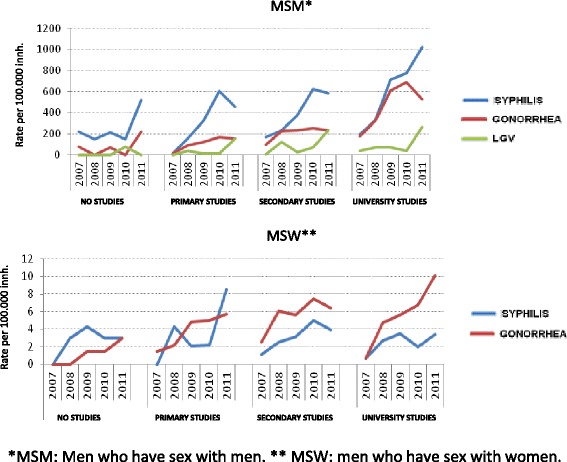
Results: HIV. 66.8 % of the HIV cases were men who had sex with men (MSM). The incidence rates in MSM over the study period were from 692.67/100,000 to 909.88/100,000 inh. Syphilis. 74.2 % of the syphilis cases were MSM. The incidence rates in MSM were from 224.9/100,000 to 891.97/100,000 inh. and the MSM with a university education ranged from 196.3/100,000 to 1020.8/100,000. Gonorrhea. 45.5 % of the gonorrhea cases were MSM. The incidence rates in MSM were from 164.24/100,000 to 404.79/100,000 inh. and the MSM with university education ranged from 176.7/100,000 to 530.1/100,000 inh.. Lymphogranuloma venereum (LGV). 95.3 % of the LGV cases are MSM. The incidence rates in MSM were from 24.99/100,000 to 282.99/100,000 inh. and the MSM with university education ranged from 9.3/100,000 to 265/100,000 inh.
Conclusion: An increase in cases of STI was observed. These STI mainly affected MSM with a university education. Continuing to monitor changes in the epidemiology of STI, and identifying the most affected groups should permit redesigning preventive programs, with the goal of finding the most efficient way to reach these population groups.
Figures
References
-
- European Centre for Disease Prevention and Control. Annual Epide miological Report 2013. Reporting on 2011 surveillance data and 2012 epidemic intelligence data. Stockholm: ECDC; 2013. Available at: http://www.ecdc.europa.eu/en/publications/Publications/annual-epidemiolo....
-
- Elford J, Jeannin A, Spencer B, Gervasoni JP, van de Laar MJ, Dubois-Arber F. HIV and STI Behavioural Surveillance Mapping Group. HIV and STI behavioural surveillance among men who have sex with men in Europe. Euro Surveill. 2009;14(47). Available online: http://www.eurosurveillance.org/ViewArticle.aspx?ArticleId=19414. European Centre for Disease Prevention and Control/WHO Regional Office for Europe: HIV/SIDA Surveillance in Europe 2012. Stockholm: European Centre for Disease Prevention and Control; 2013. Available at: http://www.ecdc.europa.eu/en/publications/Publications/hiv-aids-surveill.... - PubMed
-
- UNAIDS. Global report: UNAIDS report on the global AIDS epidemic 2013; 2013. Available at: http://www.unaids.org/sites/default/files/en/media/unaids/contentassets/...
-
- European Centre for Disease Prevention and Control . Thematic report: Men who have sex with men. Monitoring implementation of the Dublin Declaration on Partnership to Fight HIV/AIDS in Europe and Central Asia: 2012 Progress Report. Stockholm: ECDC; 2013.
-
- European Center for Disease Prevention and Control . Sexually Transmitted Infections in Europe, 1990–2009. Stockholm: ECDC; 2011.
Publication types
MeSH terms
LinkOut - more resources
Full Text Sources
Other Literature Sources
Medical
