. 2015 Dec;59(12):7723-34.
doi: 10.1128/AAC.01291-15. Epub 2015 Oct 5.

Clonal Dissemination of Enterobacter cloacae Harboring blaKPC-3 in the Upper Midwestern United States

Affiliations

Clonal Dissemination of Enterobacter cloacae Harboring blaKPC-3 in the Upper Midwestern United States

Melissa L Hargreaves et al. Antimicrob Agents Chemother. 2015 Dec.

Abstract

Carbapenemase-producing, carbapenem-resistant Enterobacteriaceae, or CP-CRE, are an emerging threat to human and animal health, because they are resistant to many of the last-line antimicrobials available for disease treatment. Carbapenemase-producing Enterobacter cloacae harboring blaKPC-3 recently was reported in the upper midwestern United States and implicated in a hospital outbreak in Fargo, North Dakota (L. M. Kiedrowski, D. M. Guerrero, F. Perez, R. A. Viau, L. J. Rojas, M. F. Mojica, S. D. Rudin, A. M. Hujer, S. H. Marshall, and R. A. Bonomo, Emerg Infect Dis 20:1583-1585, 2014, http://dx.doi.org/10.3201/eid2009.140344). In early 2009, the Minnesota Department of Health began collecting and screening CP-CRE from patients throughout Minnesota. Here, we analyzed a retrospective group of CP-E. cloacae isolates (n = 34) collected between 2009 and 2013. Whole-genome sequencing and analysis revealed that 32 of the strains were clonal, belonging to the ST171 clonal complex and differing collectively by 211 single-nucleotide polymorphisms, and it revealed a dynamic clone under positive selection. The phylogeography of these strains suggests that this clone existed in eastern North Dakota and western Minnesota prior to 2009 and subsequently was identified in the Minneapolis and St. Paul metropolitan area. All strains harbored identical IncFIA-like plasmids conferring a CP-CRE phenotype and an additional IncX3 plasmid. In a single patient with multiple isolates submitted over several months, we found evidence that these plasmids had transferred from the E. cloacae clone to an Escherichia coli ST131 bacterium, rendering it as a CP-CRE. The spread of this clone throughout the upper midwestern United States is unprecedented for E. cloacae and highlights the importance of continued surveillance to identify such threats to human health.


Figures

FIG 1
FIG 1
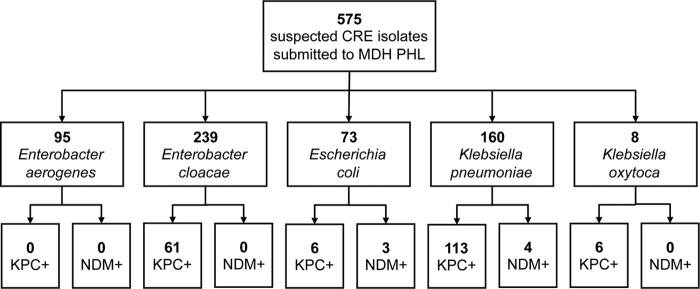
Carbapenem-resistant Enterobacteriaceae (CRE) isolates submitted to the MDH-PHL for further characterization according to the MDH CRE definition. Isolates were collected between February 2009 and December 2013. Other species of CRE (e.g., Citrobacter spp.) submitted for additional testing were excluded. Whole-genome sequencing (WGS) was performed subsequently on a subset of CRE isolates (40 E. cloacae and 4 E. coli isolates) for this study.
FIG 2
FIG 2
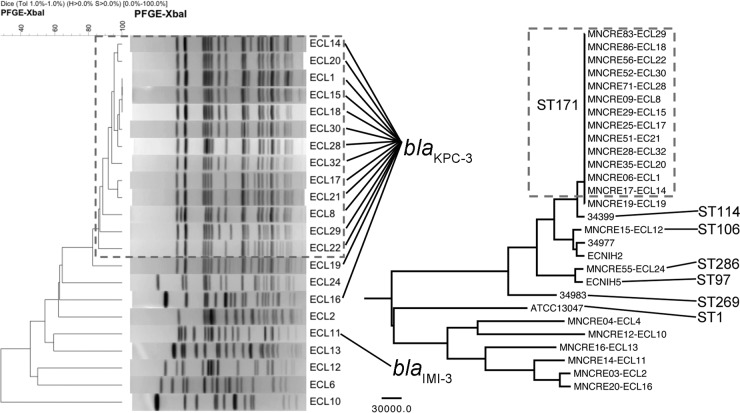
Genetic relationships between E. cloacae isolates from Minnesota and North Dakota. (Left) Dendrogram of the pulsed-field gel electrophoresis XbaI banding patterns. The dendrogram was generated using the Dice coefficient with a band position tolerance of 1%. Patterns within the hashed box are ≥85% similar and are representative PFGE subtypes of the isolates belonging to the KPC-3-positive circulating lineage. ECL numbers are PFGE subtype designations determined by the MDH-PHL. Strains corresponding to ECL numbers are the following: ECL1, MNCRE06; ECL2, MNCRE03; ECL6, MNCRE04; ECL8, MNCRE09; ECL10, MNCRE12; ECL11, MNCRE14; ECL12, MNCRE15; ECL13, MNCRE16; ECL14, MNCRE17; ECL15, MNCRE29; ECL16, MNCRE20; ECL17, MNCRE25; ECL18, MNCRE86; ECL19, MNCRE19; ECL20, MNCRE35; ECL21, MNCRE51; ECL22, MNCRE56; ECL24, MNCRE55; ECL28, MNCRE71; ECL29, MNCRE83; ECL30, MNCRE52; and ECL32, MNCRE28. Isolates harboring blaKPC-3 or blaIMI-3 are noted. (Right) Phylogenetic relationships between the same isolates based upon whole-genome sequencing, also including existing genome sequences form the NCBI database (see Materials and Methods for a description). Evolutionary history was inferred using the maximum parsimony method on SNPs identified by multiple-genome alignment in MAUVE. Branches corresponding to partitions reproduced in fewer than 50% of bootstrap replicates are collapsed following 1,000 bootstrap replications. All branches were supported with >90% bootstrap confidence. Branches are displayed to scale, and the scale bar represents the number of substitutions. A total of 818,547 SNPs were included in the final data set, and analyses were conducted in MEGA6. The boxed isolates represent KPC-3-positive isolates belonging to the circulating lineage.
FIG 3
FIG 3
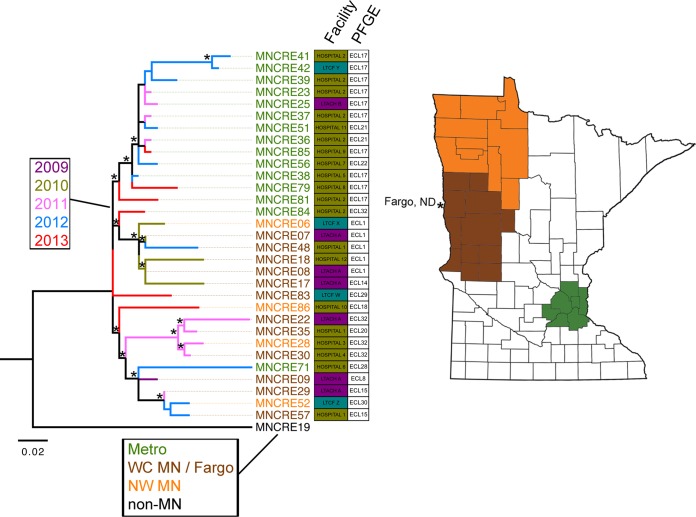
Phylogenetic relationships between CP-E. cloacae isolates within the circulating lineage. (Left) Evolutionary history was inferred using the maximum likelihood method based on the general time-reversible model, using SNPs identified by mapping to strain MNCRE09 as a reference. Branches corresponding to partitions reproduced in fewer than 50% of bootstrap replicates are collapsed following 10,000 bootstrap replications. Branches are displayed to scale and represent nucleotide changes over the entire sequence assessed. A total of 234 SNPs were included in the final data set, and analyses were conducted in MEGA6. Branches with >60% bootstrap confidence are noted with an asterisk. Branches are colored by year of isolation, and isolate labels are colored by the geographical location of the facility (WC MN, west central MN; NW MN, northwest MN). Facility type (LTACH, long-term acute-care hospital; LTCF, long-term-care facility) and isolate PFGE subtype are included. (Right) Isolate label colors correspond to colored locations on the map of Minnesota (Fargo, ND, isolates were included with WC MN isolates because the city borders WC MN).
FIG 4
FIG 4
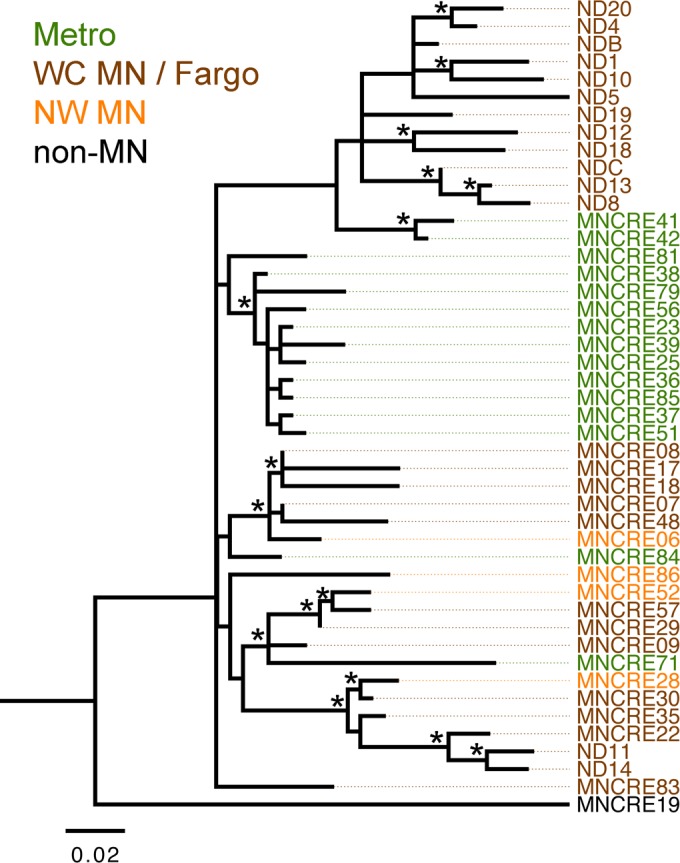
Phylogenetic relationships between CP-E. cloacae isolates in the upper midwestern United States. MNCRE isolates from the Minnesota Department of Health were compared with database isolates from an apparent outbreak in a hospital system in North Dakota (ND) during 2010 to 2012 (BioProject PRJNA259658). Evolutionary history was inferred using the maximum likelihood method based on the general time-reversible model, using SNPs identified by mapping to strain MNCRE09 as a reference. A total of 234 SNPs were included in the final data set, and analyses were conducted in MEGA6. Branches with >60% bootstrap confidence are noted with an asterisk. Branches are displayed to scale and represent nucleotide changes over the entire sequence. A total of 234 SNPs were included in the final data set, and analyses were conducted in MEGA6. Isolate label colors correspond to those in Fig. 3.
FIG 5
FIG 5
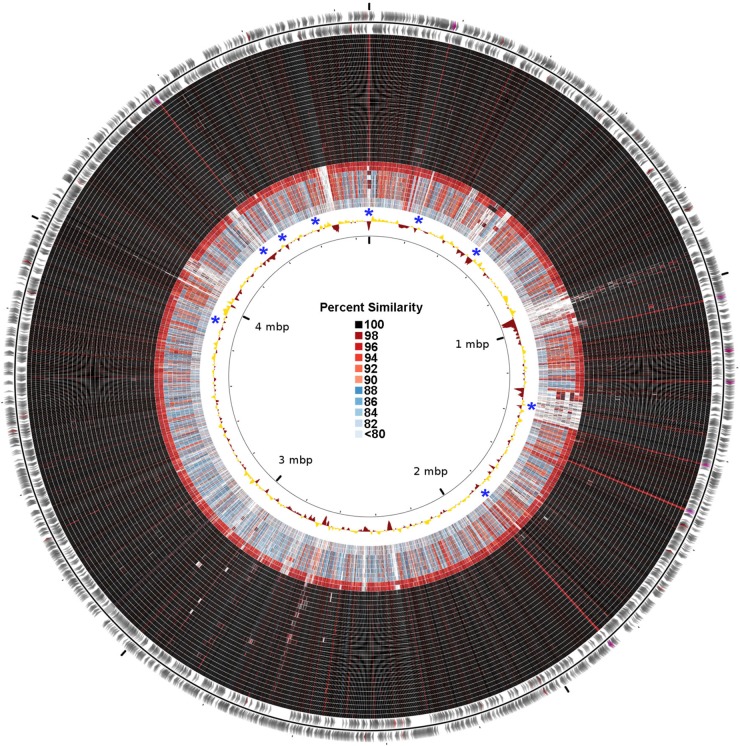
Circular map visualizing chromosomal nucleotide similarities between strains of the circulating lineage and unrelated reference/KPC-negative E. cloacae genomes. The outer two rings represent the genome of strain NDA, with coding regions in forward and reverse orientations and tRNA genes colored purple. The next 28 rings depict nucleotide similarities between strain NDA and other sequenced E. cloacae isolates belonging to the circulating lineage (some strains were excluded to eliminate redundancy). Similarities were calculated using nucleotide BLAST in 1,000-bp increments across the chromosome. The remaining rings are unrelated E. cloacae reference/KPC-negative strains in the following order: MNCRE15, MNCRE55, ATCC 13047, MNCRE04, MNCRE16, MNCRE03, MNCRE20, MNCRE14, MNCRE46, and MNCRE47. The innermost ring depicts deviation from the average G+C content for the chromosome, with gold representing higher G+C content and maroon representing lower G+C content. Asterisks depict regions of interest, as defined in Table 3. The legend for BLAST similarity colors is in the center of the circle.
FIG 6
FIG 6
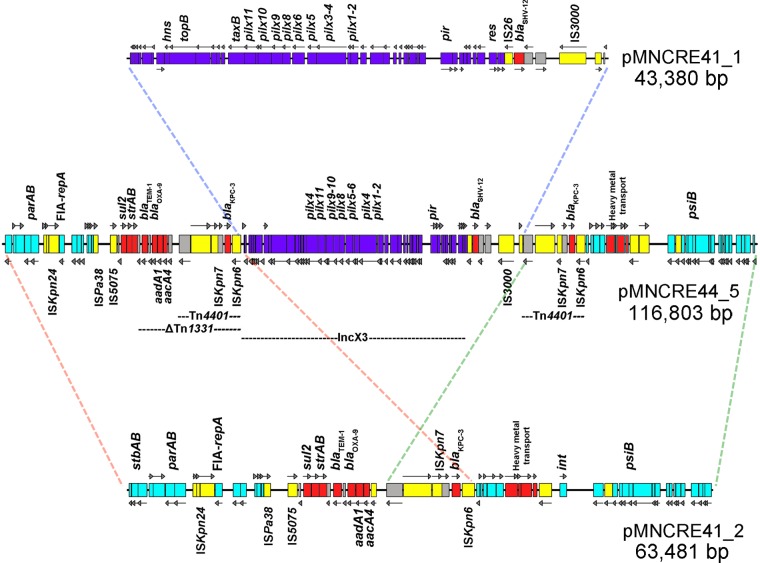
Linear map of plasmids pMNCRE41_1 and pMNCRE41_2 from E. cloacae strain MNCRE41 and pMNCRE44_5 from E. coli ST131 strain MNCRE44. IncX3-associated genes are colored purple, and IncFIA-associated genes are colored light blue. Resistance-associated genes are colored red, and transposase-associated genes are colored yellow. Regions of similarity between plasmids are outlined by colored dashed lines.
FIG 7
FIG 7
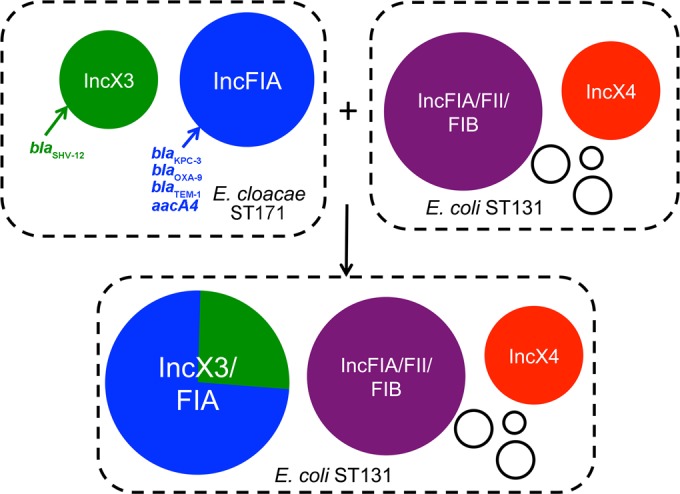
Diagram of proposed plasmid transfer between E. cloacae and E. coli within the same patient.

References

    1. Mezzatesta ML, Gona F, Stefani S. 2012. Enterobacter cloacae complex: clinical impact and emerging antibiotic resistance. Future Microbiol 7:887–902. doi: 10.2217/fmb.12.61. - DOI - PubMed
    1. Dalben M, Varkulja G, Basso M, Krebs VL, Gibelli MA, van der Heijden I, Rossi F, Duboc G, Levin AS, Costa SF. 2008. Investigation of an outbreak of Enterobacter cloacae in a neonatal unit and review of the literature. J Hosp Infect 70:7–14. doi: 10.1016/j.jhin.2008.05.003. - DOI - PubMed
    1. Conlan S, Thomas PJ, Deming C, Park M, Lau AF, Dekker JP, Snitkin ES, Clark TA, Luong K, Song Y, Tsai YC, Boitano M, Dayal J, Brooks SY, Schmidt B, Young AC, Thomas JW, Bouffard GG, Blakesley RW, Mullikin JC, Korlach J, Henderson DK, Frank KM, Palmore TN, Segre JA. 2014. Single-molecule sequencing to track plasmid diversity of hospital-associated carbapenemase-producing Enterobacteriaceae. Sci Transl Med 6:254ra126. doi: 10.1126/scitranslmed.3009845. - DOI - PMC - PubMed
    1. Luo Y, Yang J, Ye L, Guo L, Zhao Q, Chen R, Chen Y, Han X, Zhao J, Tian S, Han L. 2014. Characterization of KPC-2-producing Escherichia coli, Citrobacter freundii, Enterobacter cloacae, Enterobacter aerogenes, and Klebsiella oxytoca isolates from a Chinese hospital. Microb Drug Resist 20:264–269. doi: 10.1089/mdr.2013.0150. - DOI - PubMed
    1. Tijet N, Richardson D, MacMullin G, Patel SN, Melano RG. 2015. Characterization of multiple NDM-1-producing Enterobacteriaceae isolated from the same patient. Antimicrob Agents Chemother doi: 10.1128/AAC.04862-14. - DOI - PMC - PubMed

Publication types

Substances

LinkOut - more resources