


Percutaneous central venous catheters versus peripheral cannulae for delivery of parenteral nutrition in neonates
- PMID: 26439610
- PMCID: PMC9250057
- DOI: 10.1002/14651858.CD004219.pub4
Percutaneous central venous catheters versus peripheral cannulae for delivery of parenteral nutrition in neonates
Abstract
Background: Neonatal parenteral nutrition may be delivered via peripheral cannulas or central venous catheters (umbilical or percutaneous). As the result of complications associated with umbilical catheters, many neonatal units prefer to use percutaneous catheters after initial stabilisation. Although they can be difficult to place, these catheters may be more stable than peripheral cannulae and require less frequent replacement. These delivery methods may be associated with different risks of adverse events, including acquired invasive infection and extravasation injury.
Objectives: To determine the effects of infusion of parenteral nutrition via percutaneous central venous catheters versus peripheral cannulae on nutrient input, growth and development and complications among hospitalised neonates receiving parenteral nutrition in terms of adverse consequences such as bacteraemia or invasive fungal infection, cardiac tamponade or other extravasation injuries.
Search methods: We searched the Cochrane Central Register of Controlled Trials (CENTRAL; 2015, Issue 5), MEDLINE (1966 to June 2015) and EMBASE (1980 to June 2015), as well as conference proceedings and previous reviews.
Selection criteria: Randomised controlled trials that compared delivery of intravenous fluids (primarily parenteral nutrition) via percutaneous central venous catheters versus peripheral cannulae in hospitalised neonates.
Data collection and analysis: We extracted data using standard methods of the Cochrane Neonatal Group, with separate evaluation of trial quality and data extraction by two review authors.
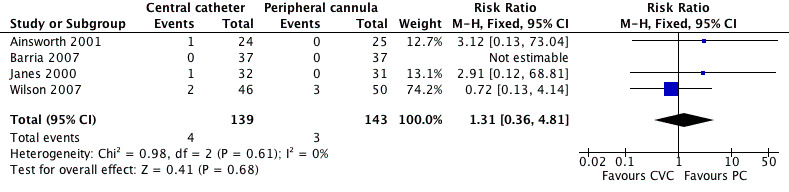
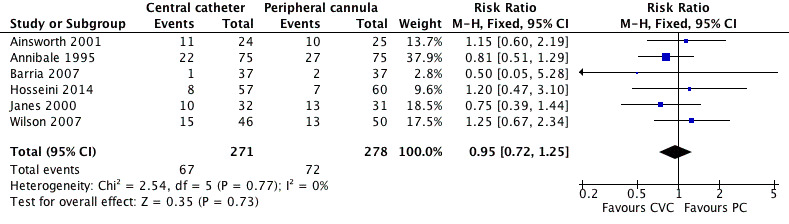
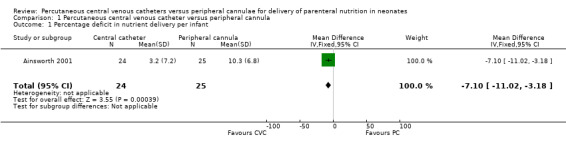
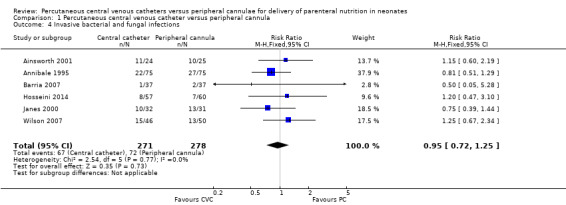
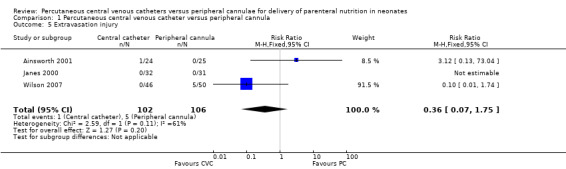
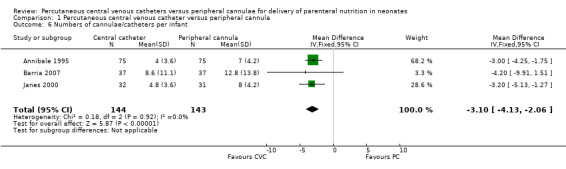
Main results: We found six trials recruiting a total of 549 infants. One trial showed that use of a percutaneous central venous catheter was associated with a smaller deficit between prescribed and actual nutrient intake during the trial period (mean difference (MD) -7.1%, 95% confidence interval (CI) -11.02 to -3.2). Infants in the percutaneous central venous catheter group needed significantly fewer catheters/cannulae (MD -4.3, 95% CI -5.24, -3.43). Meta-analysis of data from all trials revealed no evidence of an effect on the incidence of invasive infection (typical risk ratio (RR) 0.95, 95% CI 0.72 to 1.25; typical risk difference (RD) -0.01, 95% CI -0.08 to 0.06).
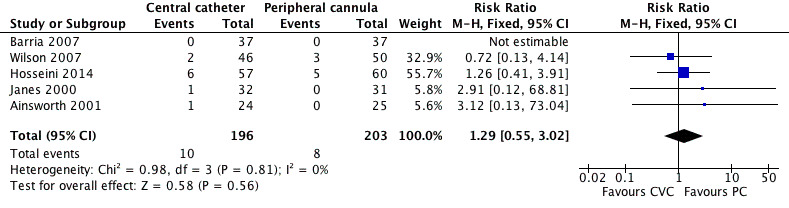
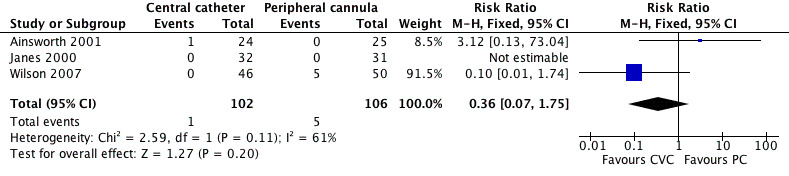
Authors' conclusions: Data from one small trial suggest that use of percutaneous central venous catheters to deliver parenteral nutrition increases nutrient input. The significance of this in relation to long-term growth and developmental outcomes is unclear. Three trials suggest that use of percutaneous central venous catheters decreases the number of catheters/cannulae needed to deliver nutrition. No evidence suggests that percutaneous central venous catheter use increases risks of adverse events, particularly invasive infection, although none of the included trials was large enough to rule out an effect on uncommon severe adverse events such as pericardial effusion.
Conflict of interest statement
Sean Ainsworth is the lead investigator for one of the included trials (Ainsworth 2001).
Figures


Update of
-
Percutaneous central venous catheters versus peripheral cannulae for delivery of parenteral nutrition in neonates.Cochrane Database Syst Rev. 2007 Jul 18;(3):CD004219. doi: 10.1002/14651858.CD004219.pub3. Cochrane Database Syst Rev. 2007. Update in: Cochrane Database Syst Rev. 2015 Oct 06;(10):CD004219. doi: 10.1002/14651858.CD004219.pub4. PMID: 17636749 Updated.
Comment in
-
Peripherally Inserted Central Catheters vs Peripheral Cannulas for Delivering Parenteral Nutrition in Neonates.JAMA. 2016 Jun 21;315(23):2612-3. doi: 10.1001/jama.2016.7020. JAMA. 2016. PMID: 27327804
References
References to studies included in this review
Ainsworth 2001 {published and unpublished data}
-
- Ainsworth SB, Furness J, Fenton AC. Randomized comparative trial between percutaneous longlines and peripheral cannulae in the delivery of neonatal parenteral nutrition. Acta Paediatrica 2001;90(9):1016‐20. - PubMed
Annibale 1995 {published data only}
-
- Annibale DJ, Bissinger RL, Husley TC, Headdon P, Ohning BL. Early percutaneous central venous catheterization (PCVC) in neonates. Pediatric Research 1995;37:1148.
Barria 2007 {published and unpublished data}
-
- Barría RM, Lorca P, Muñoz S. Randomized controlled trial of vascular access in newborns in the neonatal intensive care unit. Journal of Obstetric, Gynecologic and Neonatal Nursing 2007;36(5):450‐6. - PubMed
Hosseini 2014 {published data only}
-
- Hosseini MB, Jodeiri B, Mahallei M, Abdoli‐Oskooi SH, Safari A, Salimi Z. Early outcome of peripherally inserted central catheter versus peripheral IV line in very low birth weight neonates. Feyz, Journal of Kashan University of Medical Sciences 2014;17(6):561‐7.
Janes 2000 {published and unpublished data}
-
- Janes M, Kalyn A, Pinelli J, Paes B. A randomized trial comparing peripherally inserted central venous catheters and peripheral intravenous catheters in infants with very low birth weight. Journal of Pediatric Surgery 2000;35(7):1040‐4. - PubMed
Wilson 2007 {published data only}
-
- Wilson D, Verklan MT, Kennedy KA. Randomized trial of percutaneous central venous lines versus peripheral intravenous lines. Journal of Perinatology 2007;27(2):92‐6. - PubMed
References to studies excluded from this review
Arnts 2014 {published data only}
-
- Arnts IJ, Bullens LM, Groenewoud JM, Liem KD. Comparison of complication rates between umbilical and peripherally inserted central venous catheters in newborns. Journal of Obstetric Gynecologic and Neonatal Nursing 2014;43(2):205‐15. - PubMed
Cairns 1995 {published data only}
-
- Cairns PA, Wilson DC, McClure BG, Halliday HL, McReid M. Percutaneous central venous catheter use in the very low birth weight neonate. European Journal of Pediatrics 1995;154:145‐7. - PubMed
Childs 1995 {published data only}
-
- Childs AM, Murdoch Eaton DG, Standring P, Puntis JW. A prospective comparison of central and peripheral vein access for parenteral nutrition in the newborn. Clinical Nutrition 1995;14:303‐5. - PubMed
Geffers 2010 {published data only}
-
- Geffers C, Gastmeier A, Schwab F, Groneberg K, Rüden H, Gastmeier P. Use of central venous catheter and peripheral venous catheter as risk factors for nosocomial bloodstream infection in very‐low‐birth‐weight infants. Infection Control and Hospital Epidemiology 2010;31(4):395‐401. - PubMed
Liossis 2003 {published data only}
-
- Liossis G, Bardin C, Papageorgiou A. Comparison of risks from percutaneous central venous catheters and peripheral lines in infants of extremely low birth weight: a cohort controlled study of infants < 1000 g. Journal of Maternal‐Fetal & Neonatal Medicine 2003;13:171‐4. - PubMed
Parellada 1999 {published data only}
-
- Parellada JA, Moise AA, Hegemier S, Gest AL. Percutaneous central catheters and peripheral intravenous catheters have similar infection rates in very low birth weight infants. Journal of Perinatology 1999;19:251‐4. - PubMed
Schwengel 2004 {published data only}
-
- Schwengel DA, McGready J, Berenholtz SM, Kozlowski LJ, Nichols DG, Yaster M. Peripherally inserted central catheters: a randomized, controlled, prospective trial in pediatric surgical patients. Anesthesia & Analgesia 2004;99:1038‐43. - PubMed
Additional references
Adams‐Chapman 2006
-
- Adams‐Chapman I, Stoll BJ. Neonatal infection and long‐term neurodevelopmental outcome in the preterm infant. Current Opinion in Infectious Diseases 2006;19(3):290‐7. [PUBMED: 16645492] - PubMed
Bassler 2009
Cartwright 2004
Chapman 2003
-
- Chapman RL, Faix RG. Persistent bacteremia and outcome in late onset infection among infants in a neonatal intensive care unit. The Pediatric Infectious Disease Journal 2003;22(1):17‐21. [PUBMED: 12544403] - PubMed
Darling 2001
-
- Darling JC, Newell SJ, Mohamdee O, Uzun O, Cullinane CJ, Dear PR. Central venous catheter tip in the right atrium: a risk factor for neonatal cardiac tamponade. Journal of Perinatology 2001;21:461‐4. - PubMed
Embleton 2001
-
- Embleton NE, Pang N, Cooke RJ. Postnatal malnutrition and growth retardation: an inevitable consequence of current recommendations in preterm infants?. Pediatrics 2001;107:270‐3. - PubMed
Garland 2008
-
- Garland JS, Alex CP, Sevallius JM, Murphy DM, Good MJ, Volberding AM, et al. Cohort study of the pathogenesis and molecular epidemiology of catheter‐related bloodstream infection in neonates with peripherally inserted central venous catheters. Infection Control and Hospital Epidemiology 2008;29(3):243‐9. [PUBMED: 18220483] - PubMed
Hermans 2007
-
- Hermans D, Talbotec C, Lacaille F, Goulet O, Ricour C, Colomb V. Early central catheter infections may contribute to hepatic fibrosis in children receiving long‐term parenteral nutrition. Journal of Pediatric Gastroenterology and Nutrition 2007;44(4):459‐63. [PUBMED: 17414144] - PubMed
Higgins 2011
-
- Higgins JPT, Green S (editors). Cochrane Handbook for Systematic Reviews of Interventions Version 5.1.0 [updated March 2011]. The Cochrane Collaboration, 2011. www.cochrane‐handbook.org.
Hruszkewycz 1991
-
- Hruszkewycz V, Holtrop PC, Batton DG, Morden RS, Gibson P, Band JD. Complications associated with central venous catheters inserted in critically ill neonates. Infection Control and Hospital Epidemiology 1991;12:544‐8. - PubMed
Johnson 2013
Karlowicz 2002
-
- Karlowicz MG, Furigay PJ, Croitoru DP, Buescher ES. Central venous catheter removal versus in situ treatment in neonates with coagulase‐negative staphylococcal bacteremia. The Pediatric Infectious Disease Journal 2002;21:22‐7. - PubMed
Lahra 2009
-
- Lahra MM, Beeby PJ, Jeffery HE. Intrauterine inflammation, neonatal sepsis, and chronic lung disease: a 13‐year hospital cohort study. Pediatrics 2009;123(5):1314‐9. [PUBMED: 19403497] - PubMed
Mahieu 2001
-
- Mahieu LM, Muynck AO, Ieven MM, Dooy JJ, Goossens HJ, Reempts PJ. Risk factors for central vascular catheter‐associated bloodstream infections among patients in a neonatal intensive care unit. The Journal of Hospital Infection 2001;48:108‐16. - PubMed
Neubauer 1995
-
- Neubauer AP. Percutaneous central i.v. access in the neonate: experience with 535 silastic catheters. Acta Paediatrica 1995;84:756‐60. - PubMed
Ohki 2008
-
- Ohki Y, Yoshizawa Y, Watanabe M, Kuwashima M, Morikawa A. Complications of percutaneously inserted central venous catheters in Japanese neonates. Pediatrics International 2008;50(5):636‐9. [PUBMED: 19261110] - PubMed
Olsen 2009
-
- Olsen AL, Reinholdt J, Jensen AM, Andersen LP, Jensen ET. Nosocomial infection in a Danish Neonatal Intensive Care Unit: a prospective study. Acta Paediatrica 2009;98(8):1294‐9. [PUBMED: 19438843] - PubMed
Payne 2004
-
- Payne NR, Carpenter JH, Badger GJ, Horbar JD, Rogowski J. Marginal increase in cost and excess length of stay associated with nosocomial bloodstream infections in surviving very low birth weight infants. Pediatrics 2004;114(2):348‐55. [PUBMED: 15286215] - PubMed
Saint 2000
-
- Saint S, Veenstra DL, Lipsky BA. The clinical and economic consequences of nosocomial central venous catheter‐related infection: are antimicrobial catheters useful?. Infection Control and Hospital Epidemiology 2000;21(6):375‐80. [PUBMED: 10879567] - PubMed
Salzman 1993
-
- Salzman MB, Isenberg HD, Shapiro JF, Lipsitz PJ, Rubin LG. A prospective study of the catheter hub as the portal of entry for microorganisms causing catheter‐related sepsis in neonates. The Journal of Infectious Diseases 1993;167:487‐90. - PubMed
Salzman 1995
-
- Salzman MB, Rubin LG. Intravenous catheter‐related infections. Advances in Pediatric Infectious Diseases 1995;10:337‐68. - PubMed
Shah 2008
-
- Shah DK, Doyle LW, Anderson PJ, Bear M, Daley AJ, Hunt RW, et al. Adverse neurodevelopment in preterm infants with postnatal sepsis or necrotizing enterocolitis is mediated by white matter abnormalities on magnetic resonance imaging at term. The Journal of Pediatrics 2008;153(2):170‐5. [PUBMED: 18534228] - PubMed
Shaw 1973
-
- Shaw JCL. Parenteral nutrition in the management of sick low birth weight infants. Pediatric Clinics of North America 1973;20:333‐58.
Sohn 2001
-
- Sohn AH, Garrett DO, Sinkowitz‐Cochran RL, Grohskopf LA, Levine GL, Stover BH, et al. The Pediatric Prevention Network. Prevalence of nosocomial infections in neonatal intensive care unit patients: results from the first national point‐prevalence survey. Journal of Pediatrics 2001;139:821‐7. - PubMed
Stoll 2004
-
- Stoll BJ, Hansen NI, Adams‐Chapman I, Fanaroff AA, Hintz SR, Vohr B, et al. Neurodevelopmental and growth impairment among extremely low‐birth‐weight infants with neonatal infection. JAMA 2004;292(19):2357‐65. [PUBMED: 15547163] - PubMed
Thornburg 2008
-
- Thornburg CD, Smith PB, Smithwick ML, Cotten CM, Benjamin DK Jr. Association between thrombosis and bloodstream infection in neonates with peripherally inserted catheters. Thrombosis Research 2008;122(6):782‐5. [PUBMED: 17997477] - PubMed
Thureen 2001
-
- Thureen PJ, Hay WW Jr. Early aggressive nutrition in preterm infants. Seminars in Neonatology 2001;6:403‐15. - PubMed
Trotter 1996
-
- Trotter CW. Percutaneous central venous catheter‐related sepsis in the neonate: an analysis of the literature from 1990 to 1994. Neonatal Network 1996;15:15‐28. - PubMed
References to other published versions of this review
Ainsworth 2004
Publication types
MeSH terms
LinkOut - more resources
Full Text Sources
Research Materials
Miscellaneous
