. 2015 Oct 6:5:14612.
doi: 10.1038/srep14612.

Time-scales of hydrological forcing on the geochemistry and bacterial community structure of temperate peat soils

Affiliations

Time-scales of hydrological forcing on the geochemistry and bacterial community structure of temperate peat soils

Flavia L D Nunes et al. Sci Rep. .

Abstract

Peatlands are an important global carbon reservoir. The continued accumulation of carbon in peatlands depends on the persistence of anoxic conditions, in part induced by water saturation, which prevents oxidation of organic matter, and slows down decomposition. Here we investigate how and over what time scales the hydrological regime impacts the geochemistry and the bacterial community structure of temperate peat soils. Peat cores from two sites having contrasting groundwater budgets were subjected to four controlled drought-rewetting cycles. Pore water geochemistry and metagenomic profiling of bacterial communities showed that frequent water table drawdown induced lower concentrations of dissolved carbon, higher concentrations of sulfate and iron and reduced bacterial richness and diversity in the peat soil and water. Short-term drought cycles (3-9 day frequency) resulted in different communities from continuously saturated environments. Furthermore, the site that has more frequently experienced water table drawdown during the last two decades presented the most striking shifts in bacterial community structure, altering biogeochemical functioning of peat soils. Our results suggest that the increase in frequency and duration of drought conditions under changing climatic conditions or water resource use can induce profound changes in bacterial communities, with potentially severe consequences for carbon storage in temperate peatlands.


Figures
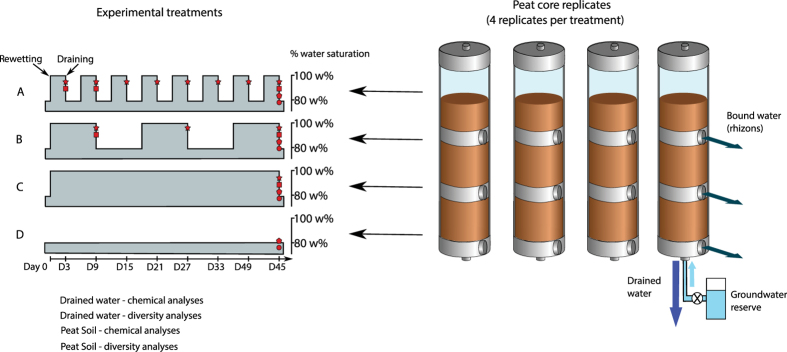
Figure 1
Figure 1. Sketch of the experimental set-up for the dry-rewetting experiment.
(A) 3-day cycle; (B) 9-day cycle; (C) continuously saturated; (D) continuously unsaturated.
Figure 2
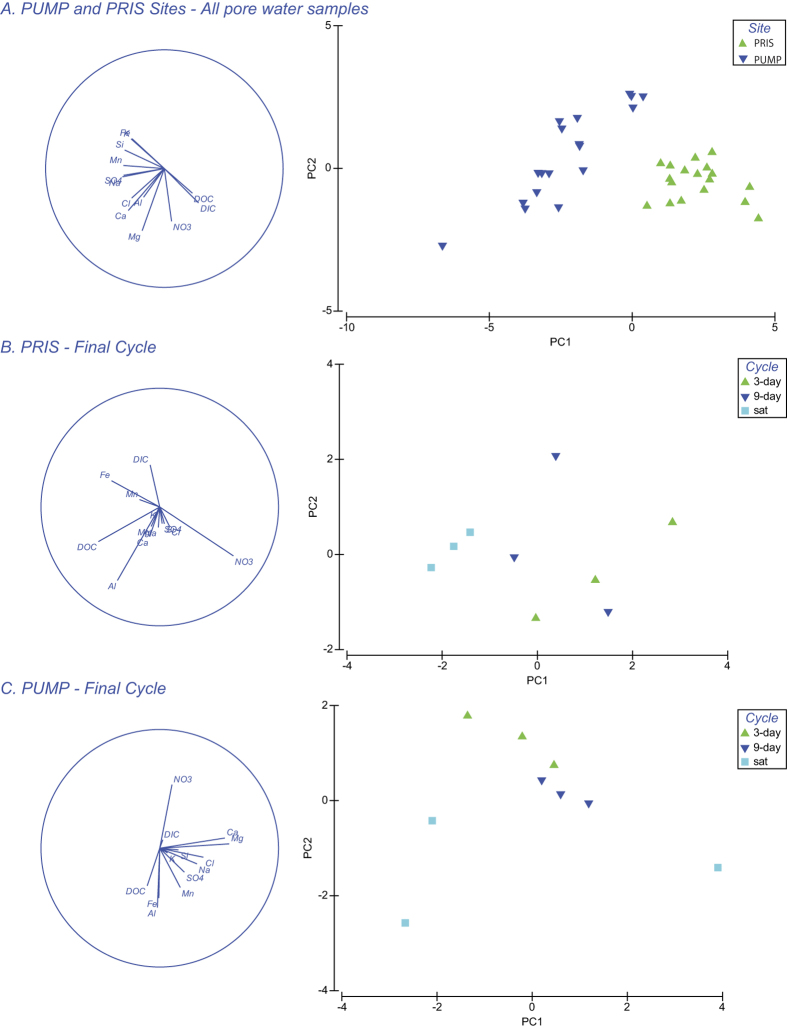
Figure 2. Principal Component Analysis of pore water geochemistry, showing eigenvector plots (left column) and PCA scatter plot (right column) for comparison between (A).
All pore water samples collected in the pumping station site (PUMP) and pristine site (PRIS) over the course of the experiment; (B) Pore water samples collected in the pristine site (PRIS) at the end of the experiment (Final Cycle); (C) Pore water samples collected in the pumping station site (PUMP) at the end of the experiment (Final Cycle).
Figure 3
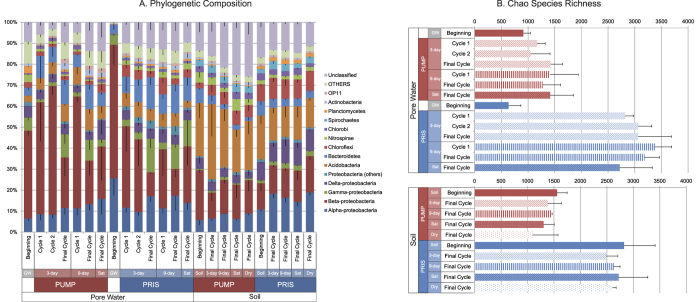
Figure 3. Bacterial community composition and diversity in water and soil samples collected from the pumping station site (PUMP), pristine site (PRIS) and groundwater (GW) used to saturate the experimental cores.
(A) Phylogenetic composition, shown as the percentage of the ten most abundant phyla, with the remaining 27 phyla grouped under “Others”. Proteobacteria have been further subdivided into α-, β-, γ-, δ-Proteobacteria and others (ε-, TA18 and unclassified). Unclassified OTUs had no match with the Silva Bacterial Database. (B) Chao species richness. In both panels, each bar represents the average of 3 replicate samples with the standard error shown as line inside or above each bar.
Figure 4
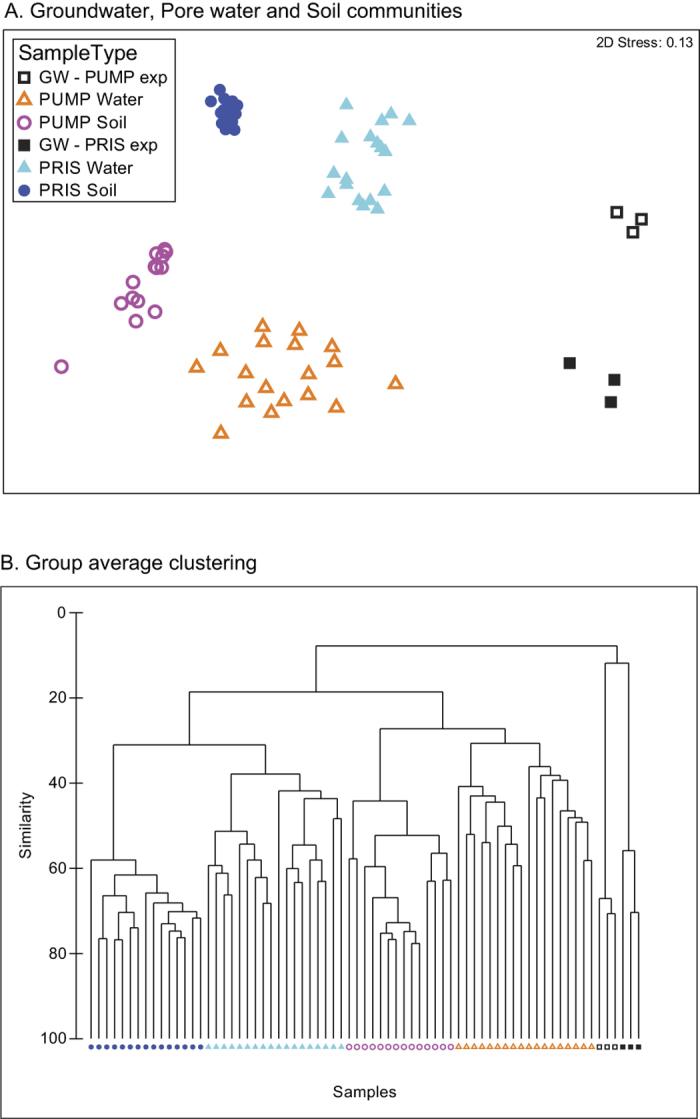
Figure 4
(A) NMDS of bacterial communities based on Bray-Curtis similarities. Bacteria collected from the pristine (PRIS) and pumping station (PUMP) sites were sequenced from water extracted from cores (Water), from soil collected from the field site and from cores at the end of the experiment (Soil), and from groundwater (GW) used to saturate cores during the PRIS and PUMP experiments. Groundwater, pore water and soil community are clearly distinguished from one another, as well as by sampling site. (B) Group-average clustering dendrogram based on Bray-Curtis similarities.
Figure 5
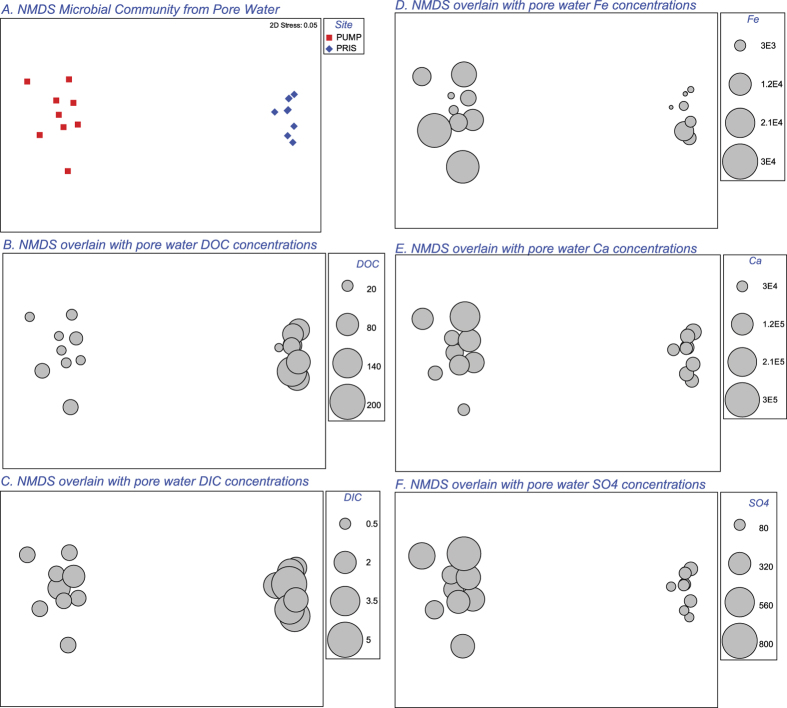
Figure 5
(A) NMDS based on Bray-Curtis similarity of bacterial communities in core-collected waters of the pristine (PRIS) and pumping station (PUMP) sites, collected at the end of the experiment. Panels (BF) show the NMDS overlain with circles proportional to the concentration of dissolved organic carbon (DOC), dissolved inorganic carbon (DIC), total iron (Fe), calcium (Ca2+) and sulfate (SO42−) measured in the pore waters at the time of sampling. The PRIS site has high levels of DOC and DIC relative to the PUMP site, while the PUMP site is characterized by high levels of Fe, Ca2+ and SO42−.
Figure 6
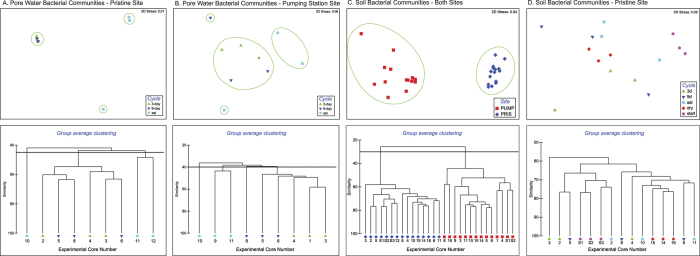
Figure 6. NMDS of bacterial communities in pore water and soil based on Bray-Curtis similarity.
Green ellipses indicate group average clustering of samples for the similarity threshold shown in the dendrogram below. Panels (A,B) show samples subjected to three experimental dry-rewetting cycles (3-day, 9-day and saturated) taken at the end of the experiment (Final Cycle). Most communities subjected to 3-day and 9-day dry-rewetting cycles fall within a cluster, while bacterial communities in continuously saturated cores are distinct from the 3-day and 9-day cycles, and at times distinct from other saturated cores, indicating high variance among communities in saturated cores. Panels (C,D) show soil bacterial communities. Soil communities in the pristine site (PRIS) are distinct from communities in the pumping station site (PUMP) (Panel (C)), while within the prisitne site, there is no clear evidence of an effect of dry-rewetting cycle (Panel (D)). A similar pattern is observed in the pumping station site (data not shown).
Figure 7
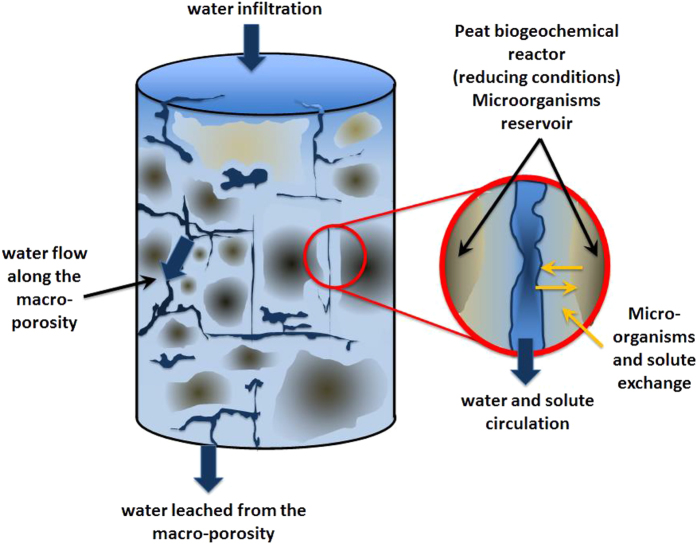
Figure 7. Sketch of the dual-porosity concept of the peat soil and associated biogeochemical reactor.
The peat soil is composed of interconnected pores that actively transmit water and dead-end and closed pores associated to the peat matrix which retard flow. The closed pores constitute the preferential habitat for microbes are therefore the core of the biogeochemical reactor.

References

    1. Alm J. et al. Reconstruction of the carbon balance for microsites in a boreal oligotrophic pine fen, Finland. Oecologia 110, 423–431 (1997). - PubMed
    1. Belyea L. R. & Malmer N. Carbon sequestration in peatland: patterns and mechanisms of response to climate change. Glob. Chang. Biol . 10, 1043–1052 (2004).
    1. Clark J. M., Chapman P. J., Adamson J. K. & Lane S. N. Influence of drought-induced acidification on the mobility of dissolved organic carbon in peat soils. Glob. Chang. Biol . 11, 791–809 (2005).
    1. Clark J. M., Chapman P. J., Heathwaite A. L. & Adamson J. K. Suppression of dissolved organic carbon by sulfate induced acidification during simulated droughts. Environ. Sci. Technol. 40, 1776–83 (2006). - PubMed
    1. Eimers M. C., Dillon P. J., Schiff S. L. & Jeffries D. S. The effects of drying and re-wetting and increased temperature on sulphate release from upland and wetland material. Soil Biol. Biochem. 35, 1663–1673 (2003).

Publication types

LinkOut - more resources