


Epigenetic marks: regulators of livestock phenotypes and conceivable sources of missing variation in livestock improvement programs
- PMID: 26442116
- PMCID: PMC4585011
- DOI: 10.3389/fgene.2015.00302
Epigenetic marks: regulators of livestock phenotypes and conceivable sources of missing variation in livestock improvement programs
Abstract
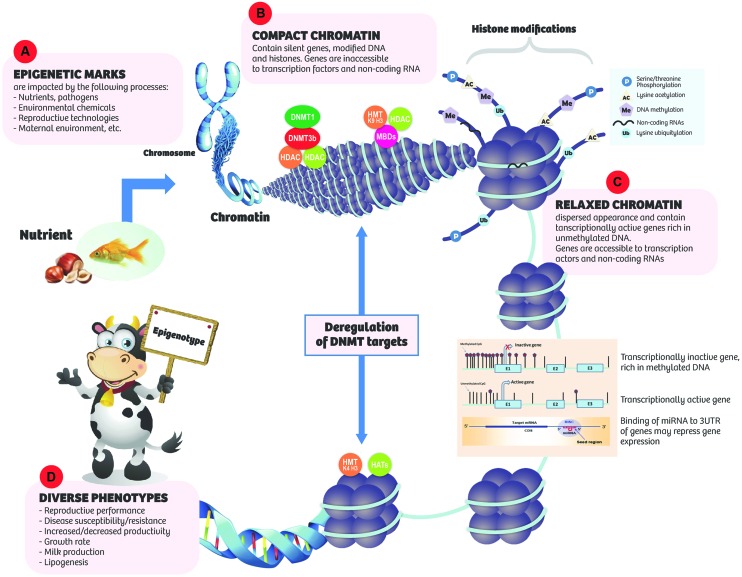
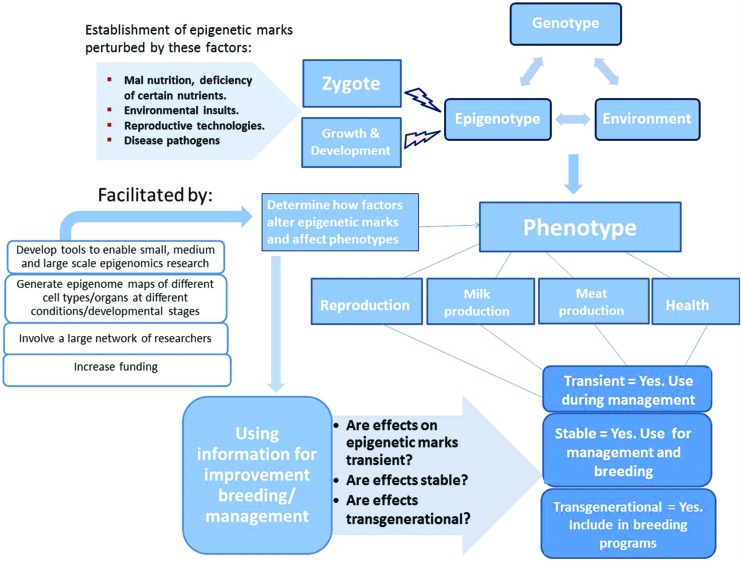
Improvement in animal productivity has been achieved over the years through careful breeding and selection programs. Today, variations in the genome are gaining increasing importance in livestock improvement strategies. Genomic information alone, however, explains only a part of the phenotypic variance in traits. It is likely that a portion of the unaccounted variance is embedded in the epigenome. The epigenome encompasses epigenetic marks such as DNA methylation, histone tail modifications, chromatin remodeling, and other molecules that can transmit epigenetic information such as non-coding RNA species. Epigenetic factors respond to external or internal environmental cues such as nutrition, pathogens, and climate, and have the ability to change gene expression leading to emergence of specific phenotypes. Accumulating evidence shows that epigenetic marks influence gene expression and phenotypic outcome in livestock species. This review examines available evidence of the influence of epigenetic marks on livestock (cattle, sheep, goat, and pig) traits and discusses the potential for consideration of epigenetic markers in livestock improvement programs. However, epigenetic research activities on farm animal species are currently limited partly due to lack of recognition, funding and a global network of researchers. Therefore, considerable less attention has been given to epigenetic research in livestock species in comparison to extensive work in humans and model organisms. Elucidating therefore the epigenetic determinants of animal diseases and complex traits may represent one of the principal challenges to use epigenetic markers for further improvement of animal productivity.
Keywords: cattle; epigenetics; genetic improvement; goat; livestock; pig; sheep.
Figures
References
-
- Altmann S., Murani E., Schwerin M., Metges C. C., Wimmers K., Ponsuksili S. (2012). Maternal dietary protein restriction and excess affects offspring gene expression and methylation of non-SMC subunits of condensin in liver and skeletal muscle. Epigenetics 7 239–252. 10.4161/epi.7.3.19183 - DOI - PubMed
-
- Altmann S., Murani E., Schwerin M., Metges C. C., Wimmers K., Ponsuksili S. (2013). Dietary protein restriction and excess of pregnant German Landrace sows induce changes in hepatic gene expression and promoter methylation of key metabolic genes in the offspring. J. Nutr. Biochem. 24 484–495. 10.1016/j.jnutbio.2012.01.011 - DOI - PubMed
Publication types
LinkOut - more resources
Full Text Sources
Other Literature Sources
