. 2015 Oct 5:10:73.
doi: 10.1186/s40793-015-0031-z. eCollection 2015.

Complete genome sequence of Geobacillus thermoglucosidasius C56-YS93, a novel biomass degrader isolated from obsidian hot spring in Yellowstone National Park

Affiliations

Complete genome sequence of Geobacillus thermoglucosidasius C56-YS93, a novel biomass degrader isolated from obsidian hot spring in Yellowstone National Park

Phillip J Brumm et al. Stand Genomic Sci. .

Abstract

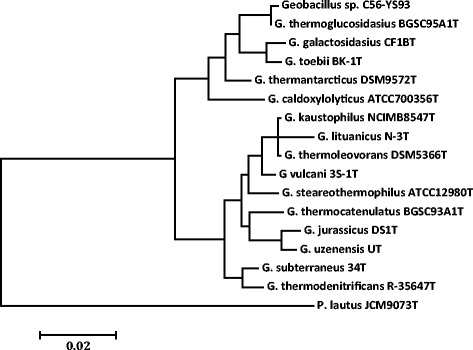
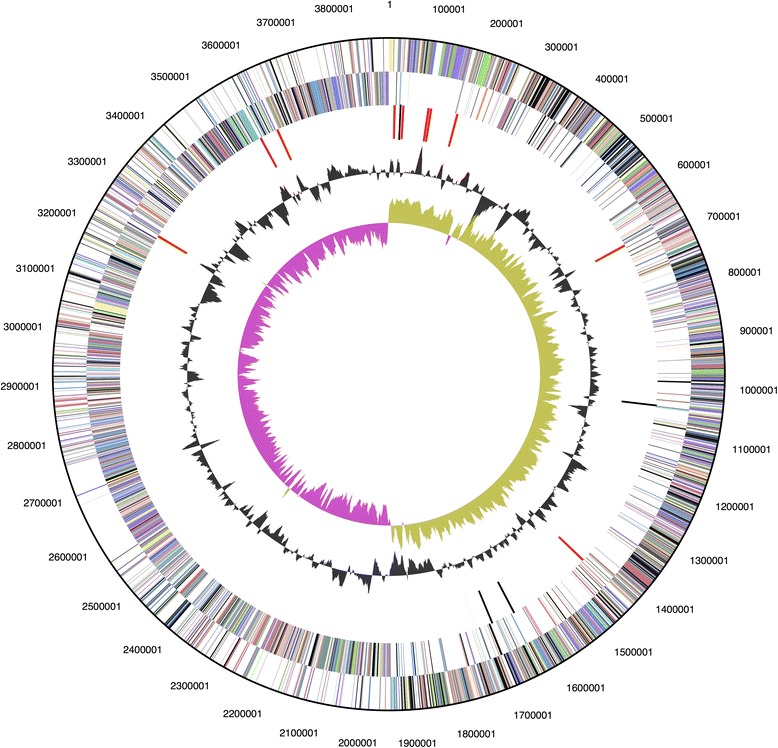
Geobacillus thermoglucosidasius C56-YS93 was one of several thermophilic organisms isolated from Obsidian Hot Spring, Yellowstone National Park, Montana, USA under permit from the National Park Service. Comparison of 16 S rRNA sequences confirmed the classification of the strain as a G. thermoglucosidasius species. The genome was sequenced, assembled, and annotated by the DOE Joint Genome Institute and deposited at the NCBI in December 2011 (CP002835). The genome of G. thermoglucosidasius C56-YS93 consists of one circular chromosome of 3,893,306 bp and two circular plasmids of 80,849 and 19,638 bp and an average G + C content of 43.93 %. G. thermoglucosidasius C56-YS93 possesses a xylan degradation cluster not found in the other G. thermoglucosidasius sequenced strains. This cluster appears to be related to the xylan degradation cluster found in G. stearothermophilus. G. thermoglucosidasius C56-YS93 possesses two plasmids not found in the other two strains. One plasmid contains a novel gene cluster coding for proteins involved in proline degradation and metabolism, the other contains a collection of mostly hypothetical proteins.

Keywords: Biomass; Geobacillus thermoglucosidasius C56-YS93; Hot springs; Prophage; Xylan.


Figures
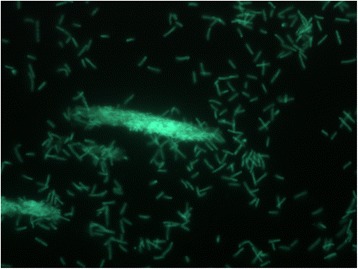
Fig. 1
Fig. 1
Micrograph of Geobacillus thermoglucosidasius C56-YS93 cells showing individual cells and clumps of cells. Cells were grown in TSB plus 0.4 % glucose for 18 h. at 70 °C. A 1.0 ml aliquot was removed, centrifuged, re-suspended in 0.2 ml of sterile water, and stained using a 50 μM solution of SYTO® 9 fluorescent stain in sterile water (Molecular Probes). Dark field fluorescence microscopy was performed using a Nikon Eclipse TE2000-S epifluorescence microscope at 2000× magnification using a high-pressure Hg light source and a 500 nm emission filter
Fig. 2
Fig. 2
Molecular phylogenetic analysis by Maximum Likelihood method as detailed in the Material and Methods section. The tree with the highest log likelihood (−3014.19) is shown. The tree is drawn to scale, with branch lengths measured in the number of substitutions per site. The novel sequenced Geobacillus strains are indicated in bold. The type strains of all validly described species are included (NCBI accession numbers): G. caldoxylolyticus ATCC700356T (AF067651), G. galactosidasius CF1BT (AM408559), G. jurassicus DS1T (FN428697), G. kaustophilus NCIMB8547T (X60618), G. lituanicus N-3T (AY044055), G. stearothermophilus R-35646T (FN428694), G. subterraneus 34 T (AF276306), G. thermantarcticus DSM9572T(FR749957), G. thermocatenulatus BGSC93A1T (AY608935), G. thermodenitrificans R-35647T (FN538993), G. thermoglucosidasius BGSC95A1T (FN428685), G. thermoleovoransDSM5366T (Z26923), G. toebii BK-1T (FN428690), G. uzenensis UT (AF276304) and G. vulcani 3S-1T (AJ293805). The 16S rRNA sequence of Paenibacillus lautusJCM9073T (AB073188) was used to root the tree
Fig. 3
Fig. 3
Graphical circular map of the chromosome. From outside to the center: Genes on forward strand (color by COG categories) Genes on reverse strand (color by COG categories) RNA genes (tRNAs green, rRNAs red, other RNAs black) GC content, GC skew
Fig. 4
Fig. 4
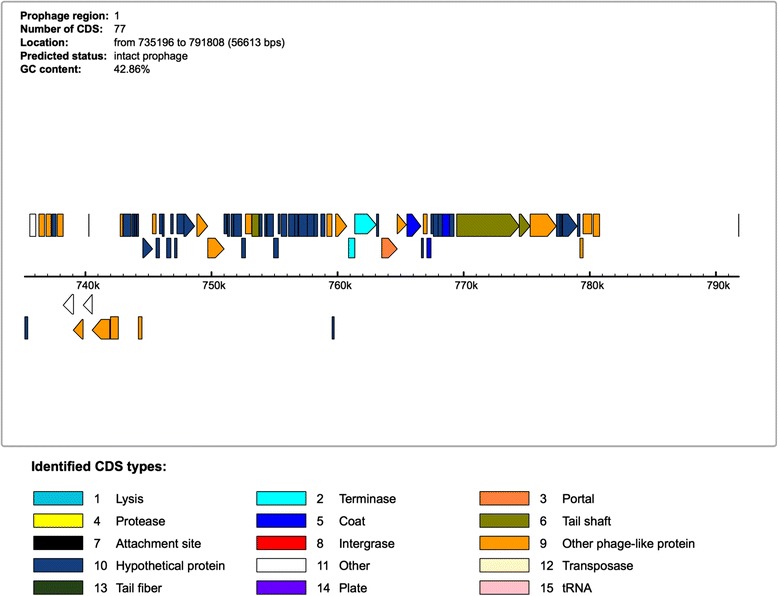
Prophage genes identified in G. thermoglucosidasius C56-YS93 using PHAST genome search software

References

    1. Valls C, Gallardo O, Vidal T, Pastor FI, Diaz P, Roncero MB. New xylanases to obtain modified eucalypt fibres with high-cellulose content. Bioresour Technol. 2010;101(19):7439–45. doi: 10.1016/j.biortech.2010.04.085. - DOI - PubMed
    1. Valls C, Roncero MB. Using both xylanase and laccase enzymes for pulp bleaching. Bioresour Technol. 2009;100(6):2032–9. doi: 10.1016/j.biortech.2008.10.009. - DOI - PubMed
    1. Tricarico JM, Dawson KA. Influence of supplemental endoglucanase or xylanase on volatile fatty acid production from ruminant feed by ruminal in vitro cultures. Arch Anim Nutr. 2005;59(5):325–34. doi: 10.1080/17450390500247865. - DOI - PubMed
    1. Brock TD, Freeze H. Thermus aquaticus gen. n. and sp. n., a nonsporulating extreme thermophile. J Bacteriol. 1969;98(1):289–97. - PMC - PubMed
    1. Brock TD, Edwards MR. Fine structure of Thermus aquaticus, an extreme thermophile. J Bacteriol. 1970;104(1):509–17. - PMC - PubMed