. 2007 Apr;2(2):10.1128/ecosalplus.3.6.3.4.
doi: 10.1128/ecosalplus.3.6.3.4.

Biosynthesis of Pantothenic Acid and Coenzyme A

Biosynthesis of Pantothenic Acid and Coenzyme A

Roberta Leonardi et al. EcoSal Plus. 2007 Apr.

Abstract

Pantothenate is vitamin B5 and is the key precursor for the biosynthesis of coenzyme A (CoA), a universal and essential cofactor involved in a myriad of metabolic reactions, including the synthesis of phospholipids, the synthesis and degradation of fatty acids, and the operation of the tricarboxylic acid cycle. CoA is also the only source of the phosphopantetheine prosthetic group for enzymes that shuttle intermediates between the active sites of enzymes involved in fatty acid, nonribosomal peptide, and polyketide synthesis. Pantothenate can be synthesized de novo and/or transported into the cell through a pantothenatepermease. Pantothenate uptake is essential for those organisms that lack the genes to synthesize this vitamin. The intracellular levels of CoA are controlled by the balance between synthesis and degradation. In particular, CoA is assembled in five enzymatic steps, starting from the phosphorylation of pantothenate to phosphopantothenatecatalyzed by pantothenate kinase, the product of the coaA gene. In some bacteria, the production of phosphopantothenate by pantothenate kinase is the rate limiting and most regulated step in the biosynthetic pathway. CoA synthesis additionally networks with other vitamin-associated pathways, such as thiamine and folic acid.


Figures
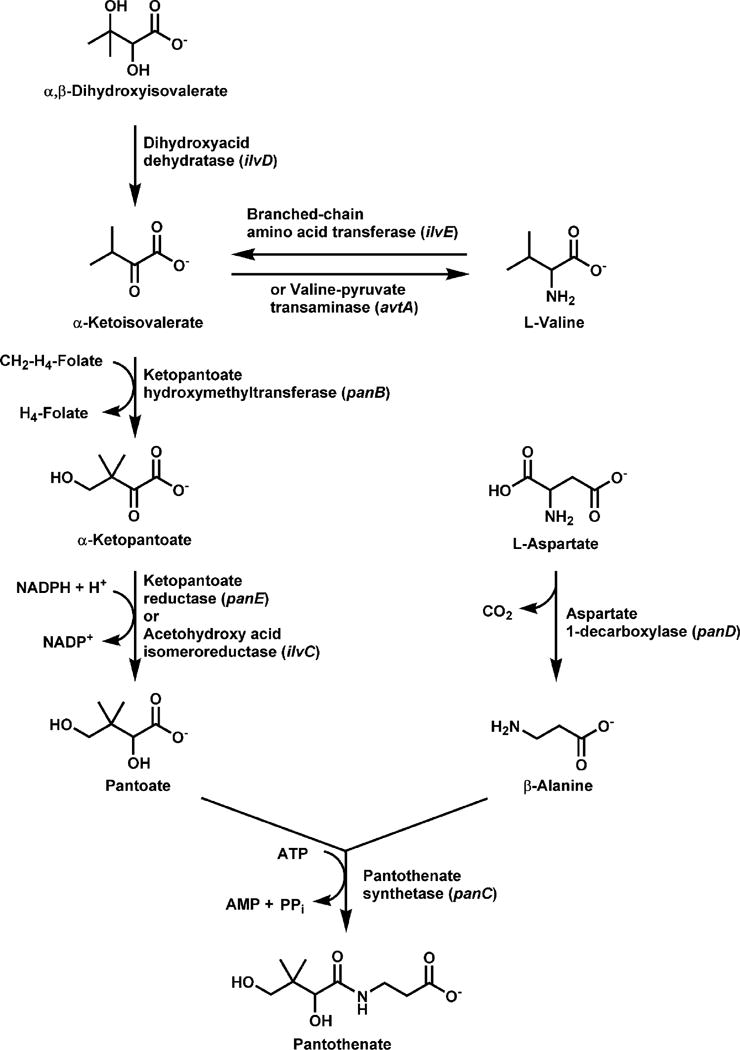
Figure 1
Figure 1
Pathway for the biosynthesis of pantothenic acid. Three enzymatic steps are required for the de novo formation of pantothenate. β-alanine is formed from aspartate by aspartate-1-decarboxylase, the product of the panD gene. Pantoate formation begins with the transfer of a methyl group to α-ketoisovalerate by ketopantoate hydroxymethyltransferase (the panB gene product) followed by reduction by ketopantoate reductase (the panE gene product). Pantothenate is then formed by the ATP-dependent condensation of β-alanine and pantoate by pantothenate synthetase (the panC gene product). Pantothenate is then either used for CoA biosynthesis or exported from the cell.
Figure 2
Figure 2
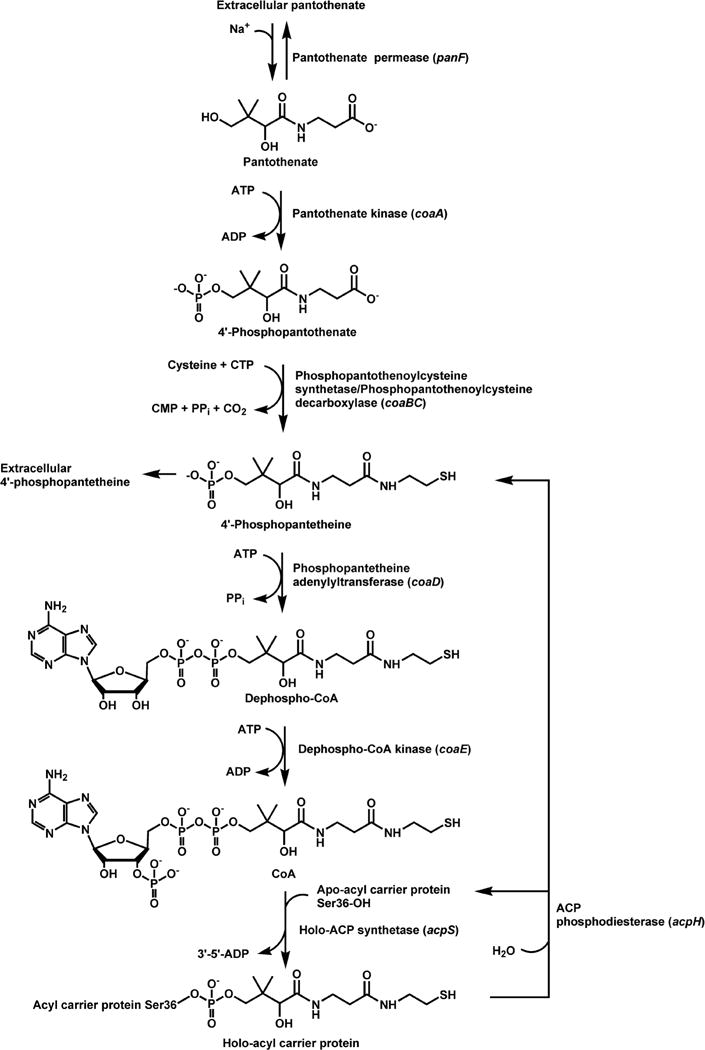
Pathway for CoA biosynthesis and the addition of the prosthetic group to ACP. Active uptake of pantothenate by a sodium-dependent permease (the panF gene product) is an alternate route to intracellular pantothenate, which is then either used for CoA biosynthesis or exported from the cells by a separate transport system. Pantothenate kinase (the coaA gene product) is the first, and most highly regulated, step in CoA biosynthesis and is regulated by feedback inhibition by CoA and its thioesters. Cysteine is then added to 4′-phosphopanthenate to generate 4′-phosphopantothenoylcysteine, which is then decarboxylated to yield 4′-phosphopantetheine. Both reactions are catalyzed by the bifunctional enzyme, phosphopantothenoylcysteine synthetase/phosphopantothenoylcyteine decarboxylase (the coaBC gene product). 4′-Phosphopantetheine adenylyltransferase (the coaD gene product) is a secondary regulatory point and is responsible for the formation of dephospho-CoA, which is then phosphorylated on the 3′-hydroxyl group to yield CoA by the dephospho-CoA kinase (the coaE gene product). CoA is then used as the 4′-phosphopantetheine donor in the synthesis of ACP from apo-ACP catalyzed by ACP synthase (the acpS gene product). The 4′-phosphopantetheine prosthetic group of ACP undergoes rapid metabolic turnover mediated by the ACP phosphodiesterase (the acpH gene product), generating apo-ACP and 4′-phosphopantetheine. The direct degradation of CoA to 4′-phosphopantetheine occurs during abrupt metabolic transitions. 4′-Phosphopantetheine is either reused for CoA synthesis or excreted from the cell. 4′-Phosphopantetheine accumulates in the growth medium since E. coli does not have an uptake system for this intermediate.

References

    1. Abiko Y, Suzuki T, Shimizu M. Investigations on pantothenic acid and its related compounds XI. Biochemical studies 6. A final stage in the biosynthesis of CoA. J Biochem (Tokyo) 1967;61:309–312. - PubMed
    1. Aghajanian S, Worrall DM. Identification and characterization of the gene encoding the human phosphopantetheine adenylyltransferase and dephospho-CoA kinase bifunctional enzyme (CoA synthase) Biochem J. 2002;365:13–18. - PMC - PubMed
    1. Albert A, Dhanaraj V, Genschel U, Khan G, Ramjee MK, Pulido R, Sibanda BL, von Delft F, Witty M, Blundell TL, Smith AG, Abell C. Crystal structure of aspartate decarboxylase at 2.2 A resolution provides evidence for an ester in protein self-processing. Nat Struct Biol. 1998;5:289–293. - PubMed
    1. Alberts AW, Vagelos PR. Acyl Carrier Protein VIII. Studies of acyl carrier protein and coenzyme A in Escherichia coli pantothenate or β-alanine auxotrophs. J Biol Chem. 1966;241:5201–5204. - PubMed
    1. Baigori M, Grau R, Morbidoni HR, de MD. Isolation and characterization of Bacillus subtilis mutants blocked in the synthesis of pantothenic acid. J Bacteriol. 1991;173:4240–4242. - PMC - PubMed