


Effects of 2-year calorie restriction on circulating levels of IGF-1, IGF-binding proteins and cortisol in nonobese men and women: a randomized clinical trial
- PMID: 26443692
- PMCID: PMC4717266
- DOI: 10.1111/acel.12400
Effects of 2-year calorie restriction on circulating levels of IGF-1, IGF-binding proteins and cortisol in nonobese men and women: a randomized clinical trial
Abstract
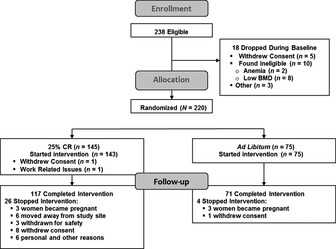
Young-onset calorie restriction (CR) in rodents decreases serum IGF-1 concentration and increases serum corticosterone levels, which have been hypothesized to play major roles in mediating its anticancer and anti-aging effects. However, little is known on the effects of CR on the IGF-1 system and cortisol in humans. To test the sustained effects of CR on these key hormonal adaptations, we performed a multicenter randomized trial of a 2-year 25% CR intervention in 218 nonobese (body mass index between 22 and 27.8 kg m(-2) ) young and middle-aged (20-50 years age range) men and women. Average CR during the first 6 months was 19.5 ± 0.8% and 9.1 ± 0.7% over the next 18 months of the study. Weight loss averaged 7.6 ± 0.3 kg over the 2-years period of which 71% was fat mass loss (P < 0.0001). Average CR during the CR caused a significant 21% increase in serum IGFBP-1 and a 42% reduction in IGF-1:IGFBP-1 ratio at 2 years (P < 0.008), but did not change IGF-1 and IGF-1:IGFBP-3 ratio levels. Serum cortisol concentrations were slightly but significantly increased by CR at 1 year only (P = 0.003). Calorie restriction had no effect on serum concentrations of PDGF-AB and TGFβ-1. We conclude, on the basis of the present and previous findings, that, in contrast to rodents, humans do not respond to CR with a decrease in serum IGF-1 concentration or with a sustained and biological relevant increase in serum cortisol. However, long-term CR in humans significantly and persistently increases serum IGFBP-1 concentration.
Keywords: IGF-1; IGFBP-1; calorie restriction; cancer; cortisol; weight loss.
© 2015 The Authors. Aging Cell published by the Anatomical Society and John Wiley & Sons Ltd.
References
-
- Albanes D (1987) Total calories, body weight, and tumor incidence in mice. Cancer Res. 47, 1987–1992. - PubMed
-
- Breese CR, Ingram RL, Sonntag WE (1991) Influence of age and long‐term dietary restriction on plasma insulin‐like growth factor‐1 (IGF‐1), IGF‐1 gene expression, and IGF‐1 binding proteins. J. Gerontol. 46, B180–B187. - PubMed
-
- Busby WH, Snyder DK, Clemmons DR (1988) Radioimmunoassay of a 26,000‐dalton plasma insulin‐like growth factor‐binding protein: control by nutritional variables. J. Clin. Endocrinol. Metab. 67, 1225–1230. - PubMed
-
- Clemmons DR, Klibanski A, Underwood LE, McArthur JW, Ridgway EC, Beitins IZ, Van Wyk JJ (1981) Reduction of plasma immunoreactive somatomedin C during fasting in humans. J. Clin. Endocrinol. Metab. 53, 1247–1250. - PubMed
Publication types
MeSH terms
Substances
Grants and funding
- U24 AG047121/AG/NIA NIH HHS/United States
- U01 AG020487/AG/NIA NIH HHS/United States
- U01-AG-022132/AG/NIA NIH HHS/United States
- U01 AG020478/AG/NIA NIH HHS/United States
- U01 AG022132/AG/NIA NIH HHS/United States
- M01 RR000036/RR/NCRR NIH HHS/United States
- P30 DK072476/DK/NIDDK NIH HHS/United States
- P30 DK056341/DK/NIDDK NIH HHS/United States
- UL1RR024992/RR/NCRR NIH HHS/United States
- U01-AG-020478/AG/NIA NIH HHS/United States
- P30-DK-056341/DK/NIDDK NIH HHS/United States
- M01-RR00036/RR/NCRR NIH HHS/United States
- UL1 TR000448/TR/NCATS NIH HHS/United States
- U01-AG-020480/AG/NIA NIH HHS/United States
- U01-AG-020487/AG/NIA NIH HHS/United States
LinkOut - more resources
Full Text Sources
Other Literature Sources
Medical
Miscellaneous
