


Neuropsychiatry and White Matter Microstructure in Huntington's Disease
- PMID: 26443926
- PMCID: PMC4684097
- DOI: 10.3233/JHD-150160
Neuropsychiatry and White Matter Microstructure in Huntington's Disease
Abstract
Background: Neuropsychiatric symptoms in Huntington's disease (HD) are often evident prior to clinical diagnosis. Apathy is highly correlated with disease progression, while depression and irritability occur at different stages of the disease, both before and after clinical onset. Little is understood about the neural bases of these neuropsychiatric symptoms and to what extent those neural bases are analogous to neuropsychiatric disorders in the general population.
Objective: We used Diffusion Tensor Imaging (DTI) to investigate structural connectivity between brain regions and any putative microstructural changes associated with depression, apathy and irritability in HD.
Methods: DTI data were collected from 39 premanifest and 45 early-HD participants in the Track-HD study and analysed using whole-brain Tract-Based Spatial Statistics. We used regression analyses to identify white matter tracts whose structural integrity (as measured by fractional anisotropy, FA) was correlated with HADS-depression, PBA-apathy or PBA-irritability scores in gene-carriers and related to cumulative probability to onset (CPO).
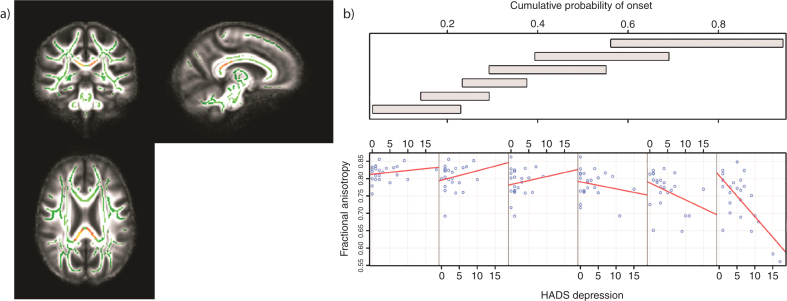
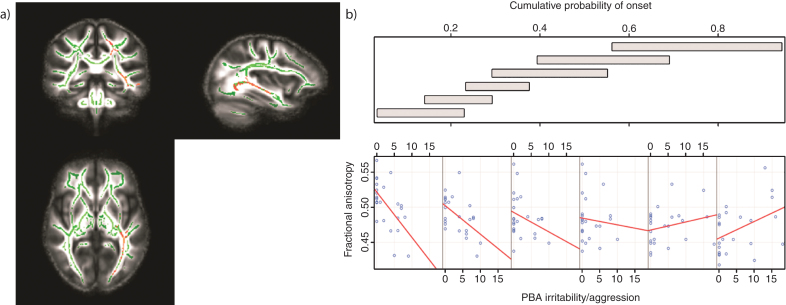
Results: For those with the highest CPO, we found significant correlations between depression scores and reduced FA in the splenium of the corpus callosum. In contrast, those with lowest CPO demonstrated significant correlations between irritability scores and widespread FA reductions. There was no significant relationship between apathy and FA throughout the whole brain.
Conclusions: We demonstrate that white matter changes associated with both depression and irritability in HD occur at different stages of disease progression concomitant with their clinical presentation.
Keywords: Huntington’s disease; apathy; depression; diffusion tensor imaging; irritability.
Figures
References
-
- Ross CA, Tabrizi SJ. Huntington’s disease: From molecular pathogenesis to clinical treatment. Lancet Neurol. 2011;10(1):83–98. - PubMed
-
- Unified Huntington’s Disease Rating Scale: Reliability and consistency. Huntington study group. Mov Disord. 1996;11(2):136–142. - PubMed
-
- Tabrizi SJ, Scahill RI, Owen G, Durr A, Leavitt BR, Roos RA, et al. Predictors of phenotypic progression and disease onset in premanifest and early-stage Huntington’s disease in the TRACK-HD study: Analysis of 36-month observational data. Lancet Neurol. 2013;12(7):637–649. - PubMed
Publication types
MeSH terms
Grants and funding
LinkOut - more resources
Full Text Sources
Medical
