


Repeat HIV-testing is associated with an increase in behavioral risk among men who have sex with men: a cohort study
- PMID: 26444673
- PMCID: PMC4596465
- DOI: 10.1186/s12916-015-0458-5
Repeat HIV-testing is associated with an increase in behavioral risk among men who have sex with men: a cohort study
Abstract
Background: The Center for Disease Control and Prevention recommends that high-risk groups, like sexually active men who have sex with men (MSM), receive HIV testing and counseling at least annually. The objective of this study was to investigate the relationship between voluntary repeat HIV testing and sexual risk behavior in MSM receiving rapid serologic and nucleic acid amplification testing.
Methods: We performed a cohort study to analyze reported risk behavior among MSM receiving the "Early Test", a community-based, confidential acute and early HIV infection screening program in San Diego, California, between April 2008 and July 2014. The study included 8,935 MSM receiving 17,333 "Early Tests". A previously published risk behavior score for HIV acquisition in MSM (i.e. Menza score) was chosen as an outcome to assess associations between risk behaviors and number of repeated tests.
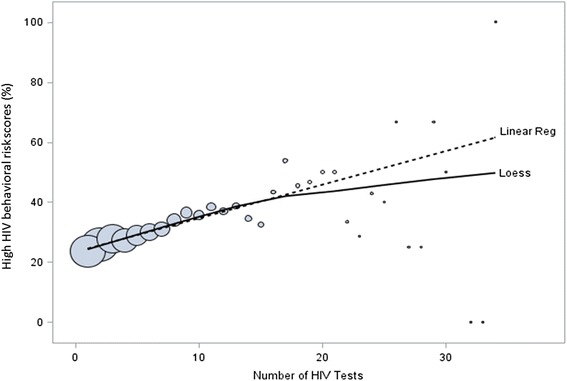
Results: At baseline, repeat-testers (n = 3,202) reported more male partners and more condomless receptive anal intercourse (CRAI) when compared to single-testers (n = 5,405, all P <0.001). In 2,457 repeat testers there was a strong association observed between repeated HIV tests obtained and increased risk behavior, with number of male partners, CRAI with high risk persons, non-injection stimulant drug use, and sexually transmitted infections all increasing between the first and last test. There was also a linear increase of risk (i.e. high Menza scores) with number of tests up to the 17th test. In the multivariable mixed effects model, more HIV tests (OR = 1.18 for each doubling of the number of tests, P <0.001) and younger age (OR = 0.95 per 5-year increase, P = 0.006) had significant associations with high Menza scores.
Conclusions: This study found that the highest risk individuals for acquiring HIV (e.g. candidates for antiretroviral pre-exposure prophylaxis) can be identified by their testing patterns. Future studies should delineate causation versus association to improve prevention messages delivered to repeat testers during HIV testing and counseling sessions.
Figures

References
-
- Xia Q, Osmond DH, Tholandi M, Pollack LM, Zhou W, Ruiz JD, et al. HIV prevalence and sexual risk behaviors among men who have sex with men: results from a statewide population-based survey in California. J Acquir Immune Defic Syndr. 2006;41:238–45. doi: 10.1097/01.qai.0000185574.98472.36. - DOI - PubMed
-
- Scott HM, Vittinghoff E, Irvin R, Sachdev D, Liu A, Gurwith M, et al. Age, race/ethnicity, and behavioral risk factors associated with per contact risk of HIV infection among men who have sex with men in the United States. J Acquir Immune Defic Syndr. 2014;65:115–21. doi: 10.1097/QAI.0b013e3182a98bae. - DOI - PMC - PubMed
-
- Mannheimer SB, Wang L, Wilton L, Van Tieu H, Del Rio C, Buchbinder S, et al. Infrequent HIV testing and late HIV diagnosis are common among a cohort of black men who have sex with men in 6 US cities. J Acquir Immune Defic Syndr. 2014;67:438–45. doi: 10.1097/QAI.0000000000000334. - DOI - PMC - PubMed
Publication types
MeSH terms
Grants and funding
- K24 AI100665/AI/NIAID NIH HHS/United States
- AI074621/AI/NIAID NIH HHS/United States
- AI036214/AI/NIAID NIH HHS/United States
- R25 MH081482/MH/NIMH NIH HHS/United States
- K23 AI093163/AI/NIAID NIH HHS/United States
- U01 AI043638/AI/NIAID NIH HHS/United States
- AI43638/AI/NIAID NIH HHS/United States
- R24 AI106039/AI/NIAID NIH HHS/United States
- R25-MH081482/MH/NIMH NIH HHS/United States
- DP1 DA034978/DA/NIDA NIH HHS/United States
- DA034978/DA/NIDA NIH HHS/United States
- P30 MH062512/MH/NIMH NIH HHS/United States
- P30 AI036214/AI/NIAID NIH HHS/United States
- AI100665/AI/NIAID NIH HHS/United States
- AI106039/AI/NIAID NIH HHS/United States
- P01 AI074621/AI/NIAID NIH HHS/United States
- R01 MH100974/MH/NIMH NIH HHS/United States
- AI093163/AI/NIAID NIH HHS/United States
LinkOut - more resources
Full Text Sources
Other Literature Sources
Medical
Miscellaneous
