


Feasibility and Preliminary Efficacy of Visual Cue Training to Improve Adaptability of Walking after Stroke: Multi-Centre, Single-Blind Randomised Control Pilot Trial
- PMID: 26445137
- PMCID: PMC4596478
- DOI: 10.1371/journal.pone.0139261
Feasibility and Preliminary Efficacy of Visual Cue Training to Improve Adaptability of Walking after Stroke: Multi-Centre, Single-Blind Randomised Control Pilot Trial
Abstract
Objectives: Given the importance of vision in the control of walking and evidence indicating varied practice of walking improves mobility outcomes, this study sought to examine the feasibility and preliminary efficacy of varied walking practice in response to visual cues, for the rehabilitation of walking following stroke.
Design: This 3 arm parallel, multi-centre, assessor blind, randomised control trial was conducted within outpatient neurorehabilitation services.
Participants: Community dwelling stroke survivors with walking speed <0.8m/s, lower limb paresis and no severe visual impairments.
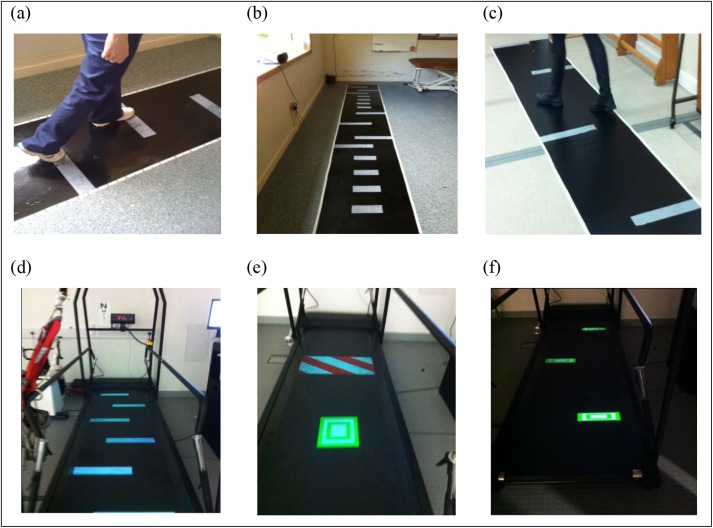
Intervention: Over-ground visual cue training (O-VCT), Treadmill based visual cue training (T-VCT), and Usual care (UC) delivered by physiotherapists twice weekly for 8 weeks.
Main outcome measures: Participants were randomised using computer generated random permutated balanced blocks of randomly varying size. Recruitment, retention, adherence, adverse events and mobility and balance were measured before randomisation, post-intervention and at four weeks follow-up.
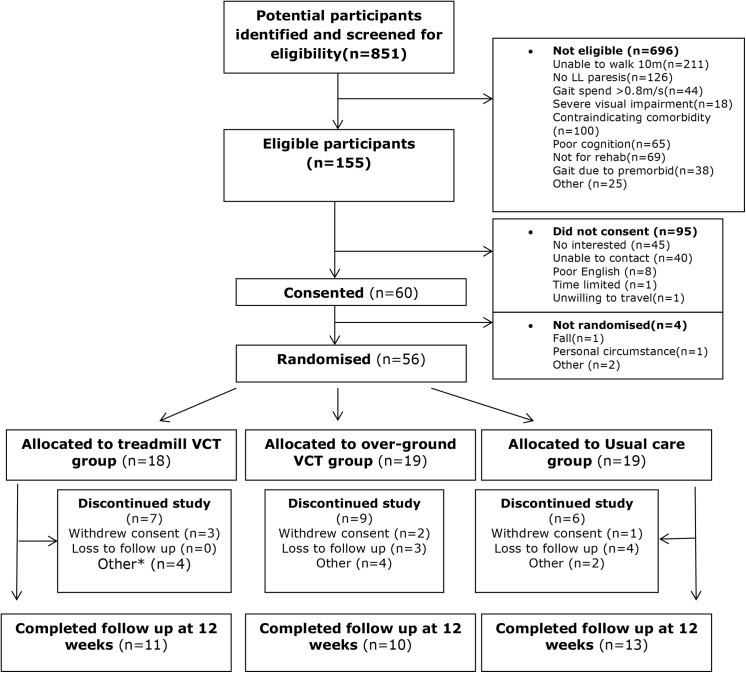
Results: Fifty-six participants participated (18 T-VCT, 19 O-VCT, 19 UC). Thirty-four completed treatment and follow-up assessments. Of the participants that completed, adherence was good with 16 treatments provided over (median of) 8.4, 7.5 and 9 weeks for T-VCT, O-VCT and UC respectively. No adverse events were reported. Post-treatment improvements in walking speed, symmetry, balance and functional mobility were seen in all treatment arms.
Conclusions: Outpatient based treadmill and over-ground walking adaptability practice using visual cues are feasible and may improve mobility and balance. Future studies should continue a carefully phased approach using identified methods to improve retention.
Trial registration: Clinicaltrials.gov NCT01600391.
Conflict of interest statement
Figures
References
-
- Hyndman D, Ashburn A, Stack E (2002) Fall events among people with stroke living in the community: circumstances of falls and characteristics of fallers. Arch Phys Med Rehabil 83: 165–170. - PubMed
-
- Weerdesteyn V, de Niet M, van Duijnhoven HJ, Geurts AC (2008) Falls in individuals with stroke. J Rehabil Res Dev 45: 1195–1213. - PubMed
-
- Cumming RG, Klineberg RJ (1994) Fall frequency and characteristics and the risk of hip fractures. J Am Geriatr Soc 42: 774–778. - PubMed
-
- Nyberg L, Gustafson Y (1995) Patient falls in stroke rehabilitation. A challenge to rehabilitation strategies. Stroke 26: 838–842. - PubMed
Publication types
MeSH terms
Associated data
LinkOut - more resources
Full Text Sources
Other Literature Sources
Medical
