


The Role of Patients' Age on Their Preferences for Choosing Additional Blood Pressure-Lowering Drugs: A Discrete Choice Experiment in Patients with Diabetes
- PMID: 26445349
- PMCID: PMC4596700
- DOI: 10.1371/journal.pone.0139755
The Role of Patients' Age on Their Preferences for Choosing Additional Blood Pressure-Lowering Drugs: A Discrete Choice Experiment in Patients with Diabetes
Abstract
Objectives: To assess whether patients' willingness to add a blood pressure-lowering drug and the importance they attach to specific treatment characteristics differ among age groups in patients with type 2 diabetes.
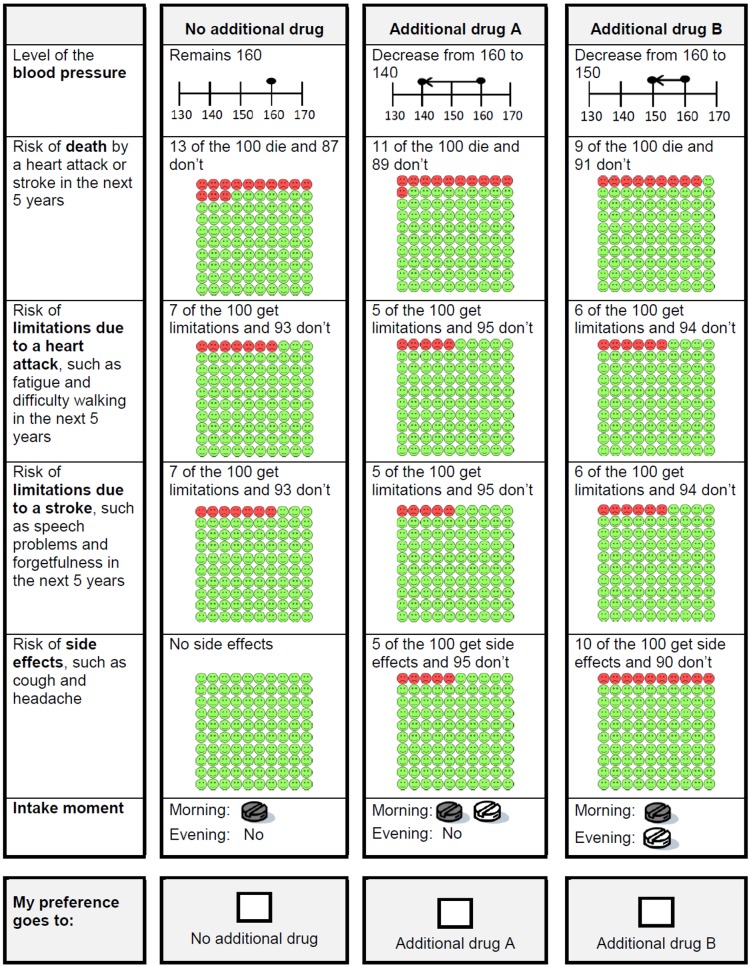
Materials and methods: Patients being prescribed at least an oral glucose-lowering and a blood pressure-lowering drug completed a questionnaire including a discrete choice experiment. This experiment contained choice sets with hypothetical blood pressure-lowering drugs and a no additional drug alternative, which differed in their characteristics (i.e. effects and intake moments). Differences in willingness to add a drug were compared between patients <75 years (non-aged) and ≥75 years (aged) using Pearson χ²-tests. Multinomial logit models were used to assess and compare the importance attached to the characteristics.
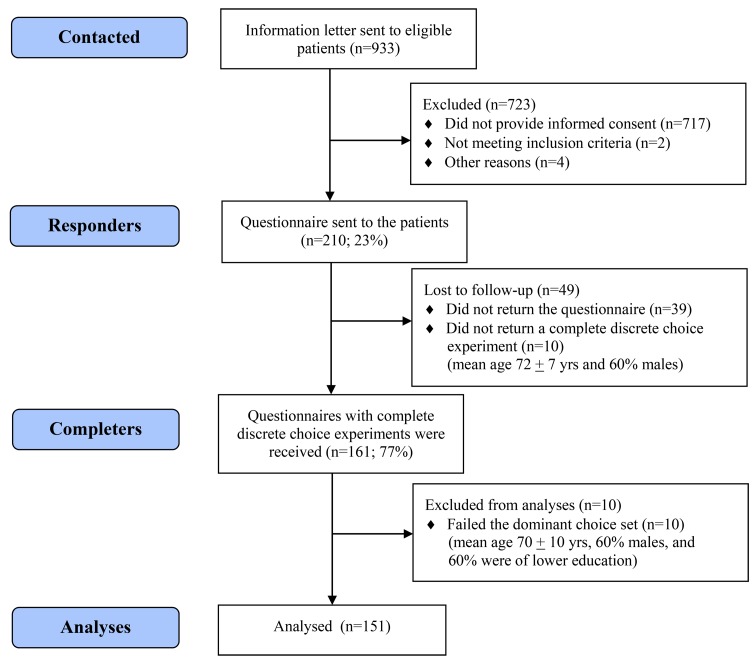
Results: Of the 161 patients who completed the questionnaire, 151 (72%) could be included in the analyses (mean age 68 years; 42% female). Aged patients were less willing to add a drug than non-aged patients (67% versus 84% respectively; P = 0.017). In both age groups, the effect on blood pressure was most important for choosing a drug, followed by the risk of adverse drug events and the risk of death. The effect on limitations due to stroke was only significant in the non-aged group. The effect on blood pressure was slightly more important in the non-aged than the aged group (P = 0.043).
Conclusions: Aged patients appear less willing to add a preventive drug than non-aged patients. The importance attached to various treatment characteristics does not seem to differ much among age groups.
Conflict of interest statement
Figures
References
-
- Aristides M, Weston AR, FitzGerald P, Le Reun C, Maniadakis N. Patient preference and willingness-to-pay for Humalog Mix25 relative to Humulin 30/70: a multicountry application of a discrete choice experiment. Value Health 2004;7(4):442–454. - PubMed
-
- Vermeire E, Hearnshaw H, Van Royen P, Denekens J. Patient adherence to treatment: three decades of research. A comprehensive review. J Clin Pharm Ther 2001;26(5):331–342. - PubMed
-
- Mitchell AJ, Selmes T. Why don’t patients take their medicine? Reasons and solutions in psychiatry. Adv Psychiatr Treat 2007;13(5):336–346.
-
- Gascon JJ, Sanchez-Ortuno M, Llor B, Skidmore D, Saturno PJ, Treatment Compliance in Hypertension Study Group. Why hypertensive patients do not comply with the treatment: results from a qualitative study. Fam Pract 2004;21(2):125–130. - PubMed
Publication types
MeSH terms
Substances
LinkOut - more resources
Full Text Sources
Other Literature Sources
Medical
