. 2016 Feb;78(2):232-41.
doi: 10.1227/NEU.0000000000001041.

Examining Recovery Trajectories After Sport-Related Concussion With a Multimodal Clinical Assessment Approach

Affiliations

Examining Recovery Trajectories After Sport-Related Concussion With a Multimodal Clinical Assessment Approach

Luke C Henry et al. Neurosurgery. 2016 Feb.

Abstract

Background: Previous research estimates that the majority of athletes with sport-related concussion (SRC) will recover between 7 and 10 days after injury. This short temporal window of recovery is based predominately on symptom resolution and cognitive improvement and does not accurately reflect recent advances in the clinical assessment model.

Objective: To characterize SRC recovery at 1-week postinjury time intervals on symptom, neurocognitive, and vestibular-oculomotor outcomes and to examine sex differences in SRC recovery time.

Methods: A prospective, repeated-measures design was used to examine the temporal resolution of neurocognitive, symptom, and vestibular-oculomotor impairment in 66 subjects (age, 16.5 ± 1.9 years; range, 14-23 years; 64% male) with SRC.

Results: Recovery time across all outcomes was between 21 and 28 days after SRC for most athletes. Symptoms demonstrated the greatest improvement in the first 2 weeks, although neurocognitive impairment lingered across various domains up to 28 days after SRC. Vestibular-oculomotor decrements also resolved between 1 and 3 weeks after injury. There were no sex differences in neurocognitive recovery. Male subjects were more likely to be asymptomatic by the fourth week and reported less vestibular-oculomotor impairment than female subjects at weeks 1 and 2.

Conclusion: When the recommended "comprehensive" approach is used for concussion assessment, recovery time for SRC is approximately 3 to 4 weeks, which is longer than the commonly reported 7 to 14 days. Sports medicine clinicians should use a variety of complementing assessment tools to capture the heterogeneity of SRC.


Figures
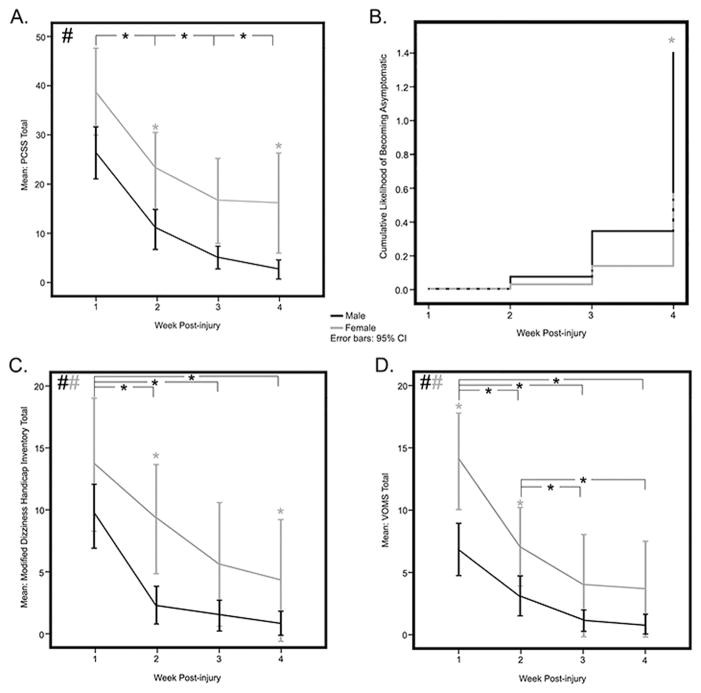
Figure 1
Figure 1
Subjective Symptom Measures. Representation of mean Post-Concussion Symptom Scale (PCSS) over four weeks post-injury (A), Likelihood of becoming symptom-free using a cox proportional hazard model (B), mean Dizziness symptoms reported using a modified Dizziness Handicap Inventory (DHI) over four weeks post-injury (C) and mean reported symptom provocation using a vestibular-oculomotor screening (VOMS) exam (D). Self-reported symptoms diminished significantly over the four weeks with individual week-to-week comparisons significant between weeks 1–2, 2–3, and 3–4 (A). The cox proportional hazard model (B) shows that males are significantly more likely than females to report being symptom-free by week 4 post-injury. Reported dizziness also diminished significantly over the four weeks with significant differences from weeks 1–2, 1–3, and 2–3 (C). There was also an overall significant effect of gender with females reporting more dizziness, with significant differences at weeks 2 and 4 (C). Provoked reported symptoms on the VOMS showed a similar overall diminution over the four weeks with significant differences from weeks 1–2, 1–3, 1–4 and weeks 2–3 and 2–4 (D). There was also an overall significant effect of gender with females reporting greater symptom provocation, with significant differences at weeks 1 and 2 (D). Black # depicts an overall change across the four post-injury weeks while black * depicts significant effects between specified weeks. Gray # represents an overall significant effect of gender. Gray * depicts significant gender differences at the specified time point.
Figure 2
Figure 2
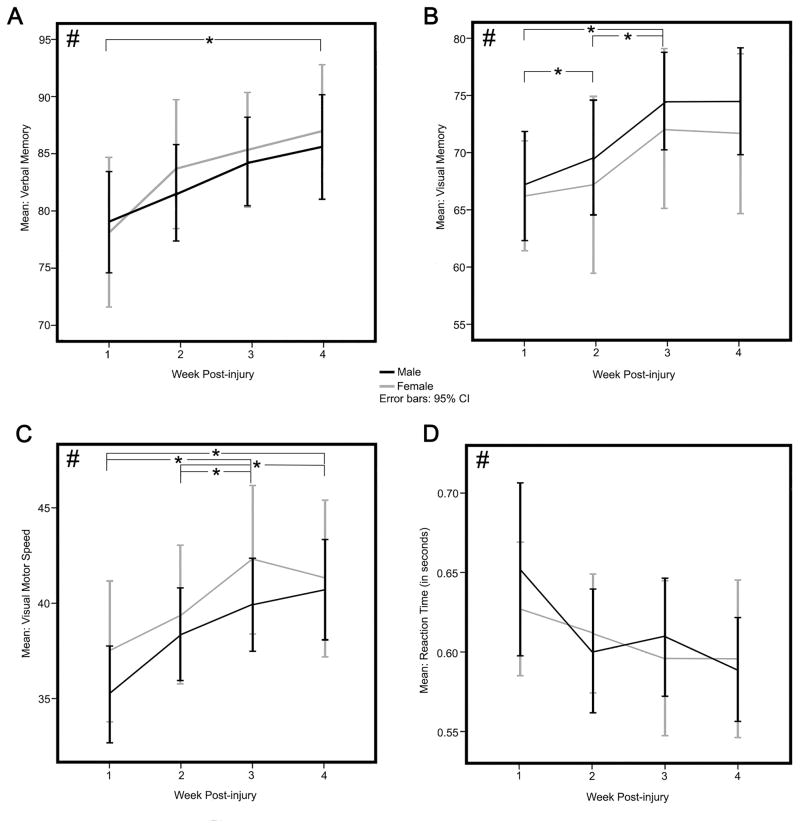
Neurocognitive Measures from the Immediate Post-Concussion and Cognitive Test (ImPACT). Representation of the mean performances across the four clinical composite scores including Verbal Memory (A), Visual Memory (B), Visual Motor Speed (C) and Reaction Time (D). Verbal Memory scores improve across the four post-injury weeks incrementally with significant week-to-week differences apparent between weeks 1 and 4 only (A). Visual memory scores also improve across the four post-injury weeks with significant week-to-week differences from weeks 1–2, 1–3, and 2–3 (B). Visual Motor Speed improves across the four post-injury weeks with significant week-to-week differences apparent between weeks 1–3, 1–4 and weeks 2–4 (C). Reaction Time improves significantly over the four weeks post-injury, but no single week-to-week comparisons are significant (D). Black # depicts an overall change across the four post-injury weeks while black * depicts significant effects between specified weeks.

References

    1. McCrory P, Meeuwisse W, Aubry M, et al. Consensus statement on Concussion in Sport-The 4th International Conference on Concussion in Sport held in Zurich, November 2012. J Sci Med Sport. 2013 - PubMed
    1. Giza CC, Kutcher JS, Ashwal S, et al. Summary of evidence-based guideline update: evaluation and management of concussion in sports: report of the Guideline Development Subcommittee of the American Academy of Neurology. Neurology. 2013;80:2250–2257. - PMC - PubMed
    1. Lau BC, Collins MW, Lovell MR. Cutoff scores in neurocognitive testing and symptom clusters that predict protracted recovery from concussions in high school athletes. Neurosurgery. 2012;70:371–379. discussion 379. - PubMed
    1. Eisenberg MA, Meehan WP, 3rd, Mannix R. Duration and course of post-concussive symptoms. Pediatrics. 2014;133:999–1006. - PMC - PubMed
    1. Meehan WP, 3rd, Zhang J, Mannix R, Whalen MJ. Increasing recovery time between injuries improves cognitive outcome after repetitive mild concussive brain injuries in mice. Neurosurgery. 2012;71:885–891. - PMC - PubMed

Publication types

MeSH terms