


Changing preferences: deformation of single position amino acid fitness landscapes and evolution of proteins
- PMID: 26445980
- PMCID: PMC4650171
- DOI: 10.1098/rsbl.2015.0315
Changing preferences: deformation of single position amino acid fitness landscapes and evolution of proteins
Abstract
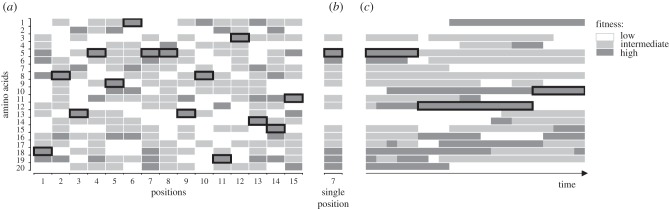
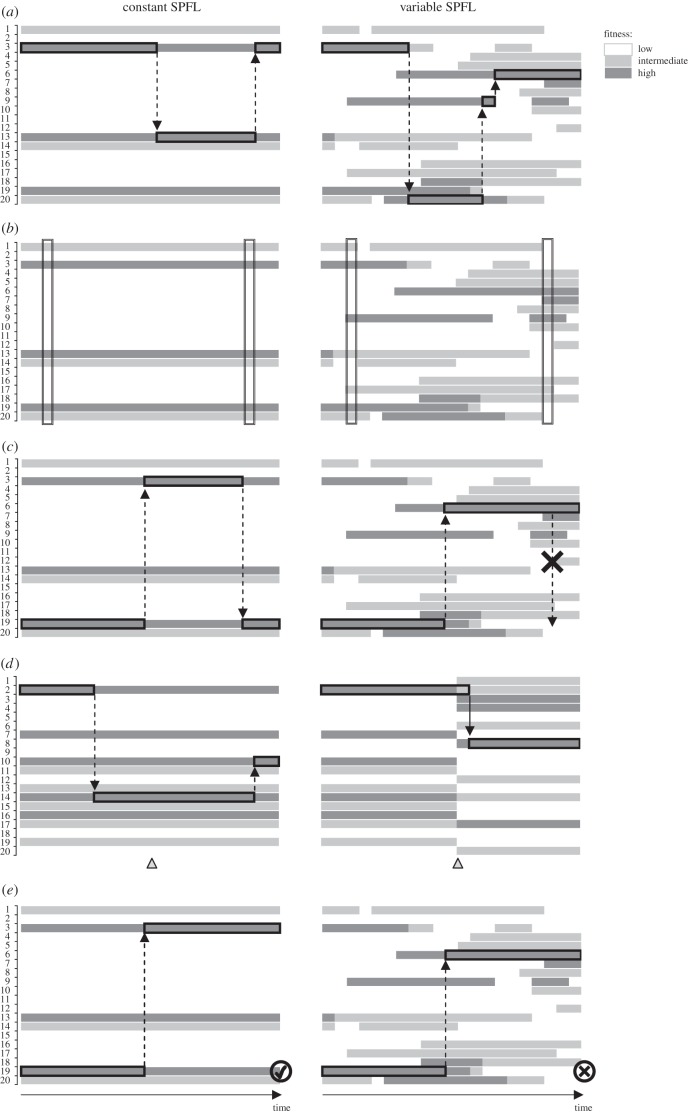
The fitness landscape-the function that relates genotypes to fitness-and its role in directing evolution are a central object of evolutionary biology. However, its huge dimensionality precludes understanding of even the basic aspects of its shape. One way to approach it is to ask a simpler question: what are the properties of a function that assigns fitness to each possible variant at just one particular site-a single position fitness landscape-and how does it change in the course of evolution? Analyses of genomic data from multiple species and multiple individuals within a species have proved beyond reasonable doubt that fitness functions of positions throughout the genome do themselves change with time, thus shaping protein evolution. Here, I will briefly review the literature that addresses these dynamics, focusing on recent genome-scale analyses of fitness functions of amino acid sites, i.e. vectors of fitnesses of 20 individual amino acid variants at a given position of a protein. The set of amino acids that confer high fitness at a particular position changes with time, and the rate of this change is comparable with the rate at which a position evolves, implying that this process plays a major role in evolutionary dynamics. However, the causes of these changes remain largely unclear.
Keywords: epistasis; macroevolution; microevolution; proteins; selection.
© 2015 The Author(s).
Figures
References
-
- Wright S. 1932. The roles of mutation, inbreeding, crossbreeding and selection in evolution. In Proc. of the 6th Int. Congress of Genetics, Vol. 1, pp. 356–366. Brooklyn, NY: Brooklyn Botanic Garden.
-
- Gavrilets S. 2004. Fitness landscapes and the origin of species. Princeton, NJ: Princeton University Press.
Publication types
MeSH terms
Substances
LinkOut - more resources
Full Text Sources
Other Literature Sources
