


Cambrian stem-group annelids and a metameric origin of the annelid head
- PMID: 26445984
- PMCID: PMC4650189
- DOI: 10.1098/rsbl.2015.0763
Cambrian stem-group annelids and a metameric origin of the annelid head
Abstract
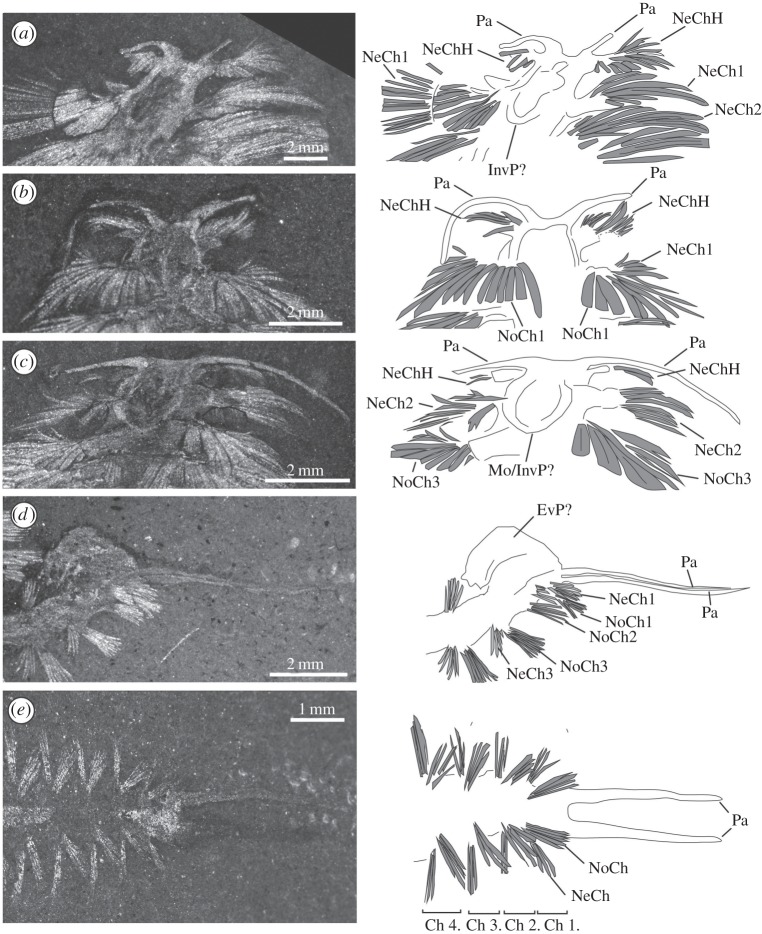
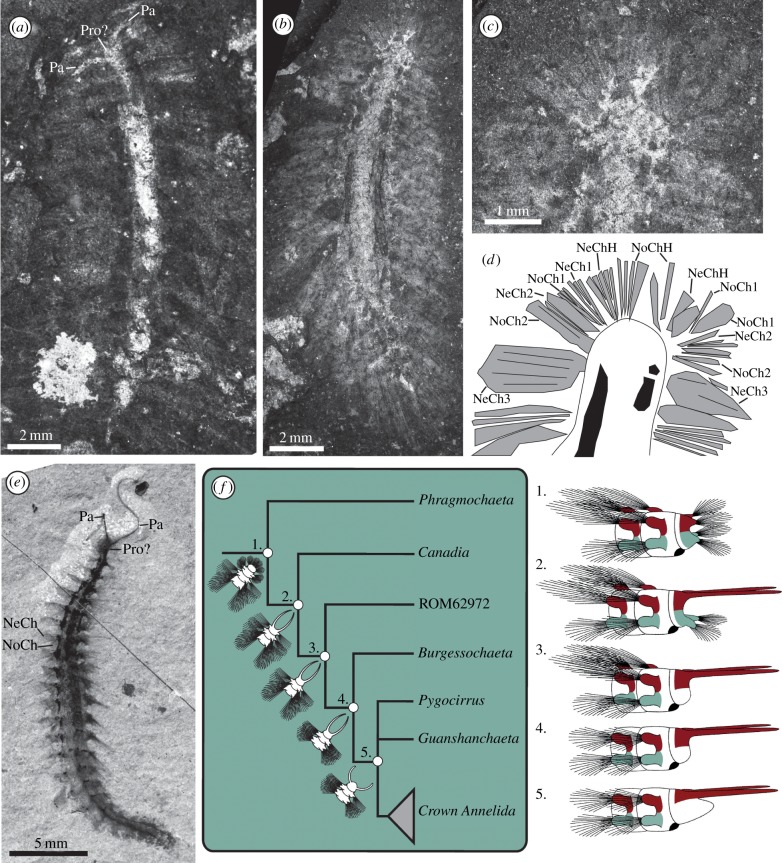
The oldest fossil annelids come from the Early Cambrian Sirius Passet and Guanshan biotas and Middle Cambrian Burgess Shale. While these are among the best preserved polychaete fossils, their relationship to living taxa is contentious, having been interpreted either as members of extant clades or as a grade outside the crown group. New morphological observations from five Cambrian species include the oldest polychaete with head appendages, a new specimen of Pygocirrus from Sirius Passet, and an undescribed form from the Burgess Shale. We propose that the palps of Canadia are on an anterior segment bearing neuropodia and that the head of Phragmochaeta is formed of a segment bearing biramous parapodia and chaetae. The unusual anatomy of these taxa suggests that the head is not differentiated into a prostomium and peristomium, that palps are derived from a modified parapodium and that the annelid head was originally a parapodium-bearing segment. Canadia, Phragmochaeta and the Marble Canyon annelid share the presence of protective notochaetae, interpreted as a primitive character state subsequently lost in Pygocirrus and Burgessochaeta, in which the head is clearly differentiated from the trunk.
Keywords: Annelida; Cambrian; Canadia; palps.
© 2015 The Authors.
Figures
References
-
- Hints O, Eriksson M. 2007. Diversification and biogeography of scolecodont-bearing polychaetes in the Ordovician. Palaeogeogr. Palaeoclimatol. Palaeoecol. 245, 95–114. ( 10.1016/j.palaeo.2006.02.029) - DOI
-
- Conway Morris S. 1979. Middle Cambrian polychaetes from the Burgess Shale of British Columbia. Phil. Trans. R. Soc. Lond. B 285, 227–274. ( 10.1098/rstb.1979.0006) - DOI
Publication types
MeSH terms
LinkOut - more resources
Full Text Sources
Other Literature Sources
