


Risk of Coronary Heart Disease in Different Criterion of Impaired Fasting Glucose: A Meta-Analysis
- PMID: 26448033
- PMCID: PMC4616744
- DOI: 10.1097/MD.0000000000001740
Risk of Coronary Heart Disease in Different Criterion of Impaired Fasting Glucose: A Meta-Analysis
Abstract
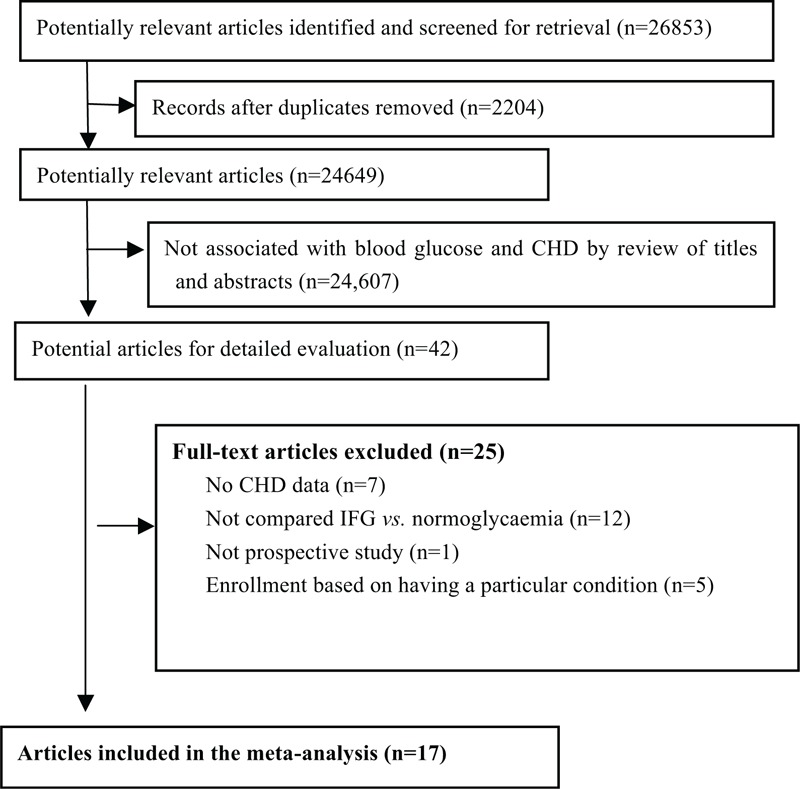
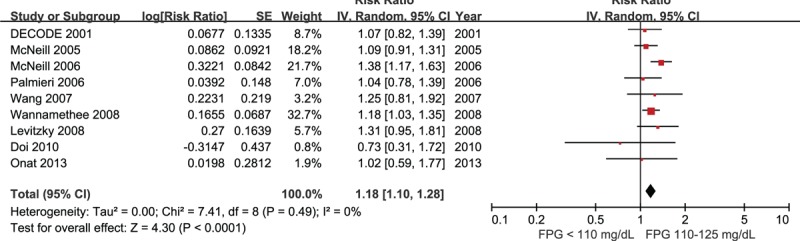
The cut-point for diagnosing impaired fasting glucose (IFG) had been dispute, as reports about the associated clinical events are inconsistent. This meta-analysis evaluated the risk of coronary heart disease (CHD) in association with different criterion of IFG according to the American Diabetes Association (ADA) or the World Health Organization (WHO) Expert Group. We included prospective cohort studies with multivariate-adjusted data on IFG and CHD for analysis. The relative risks (RRs) of CHD were calculated and reported with 95% confidence intervals (95% CIs). Seventeen prospective cohort studies, comprising 527,021 individuals were included. The risks of CHD were increased in both participants with IFG defined as the ADA or WHO criterion (RR 1.11, 95% CI 1.02-1.21; and RR 1.18, 95% CI 1.10-1.28, respectively). Subgroup analyses showed that in both definition of IFG, the risk of CHD was only increased in studies with possibility of enrolling patients with increased 2 hours plasma glucose (2-h PG), or in studies with inadequate adjustment, but not in studies excluded participants with increased 2-h PG or in those with adequate adjustment of other risk factors. Our meta-analysis demonstrates that the presence of IFG was significantly associated with future risk of CHD. The risk of CHD was increased when fasting plasma glucose was as low as 100 mg/dL according to the lower cut-point of IFG by the ADA criterion. However, the risk maybe confounded by the undetected increased 2-h PG or other cardiovascular risk factors.
Conflict of interest statement
The authors have no funding and conflicts of interest to disclose.
Figures

References
-
- Ferrannini E. Definition of intervention points in prediabetes. Lancet Diabetes Endocrinol 2014; 2:667–675. - PubMed
-
- Buysschaert M, Medina JL, Bergman M, et al. Prediabetes and associated disorders. Endocrine 2015; 48:371–393. - PubMed
-
- Faerch K, Vistisen D, Johansen NB, et al. Cardiovascular risk stratification and management in pre-diabetes. Curr Diab Rep 2014; 14:493. - PubMed
-
- De Caterina R, Madonna R. Impaired fasting plasma glucose and long-term cardiovascular risk: still a foggy relationship. Eur Heart J 2010; 31:1159–1162. - PubMed
-
- Expert Committee on the Diagnosis and Classification of Diabetes Mellitus Report of the expert committee on the diagnosis and classification of diabetes mellitus. Diabetes Care 2003; 26 (Suppl 1):S5–S20. - PubMed
Publication types
MeSH terms
Substances
LinkOut - more resources
Full Text Sources
Medical
Research Materials
