


Machine Learning Techniques for Prediction of Early Childhood Obesity
- PMID: 26448795
- PMCID: PMC4586339
- DOI: 10.4338/ACI-2015-03-RA-0036
Machine Learning Techniques for Prediction of Early Childhood Obesity
Abstract
Objectives: This paper aims to predict childhood obesity after age two, using only data collected prior to the second birthday by a clinical decision support system called CHICA.
Methods: Analyses of six different machine learning methods: RandomTree, RandomForest, J48, ID3, Naïve Bayes, and Bayes trained on CHICA data show that an accurate, sensitive model can be created.
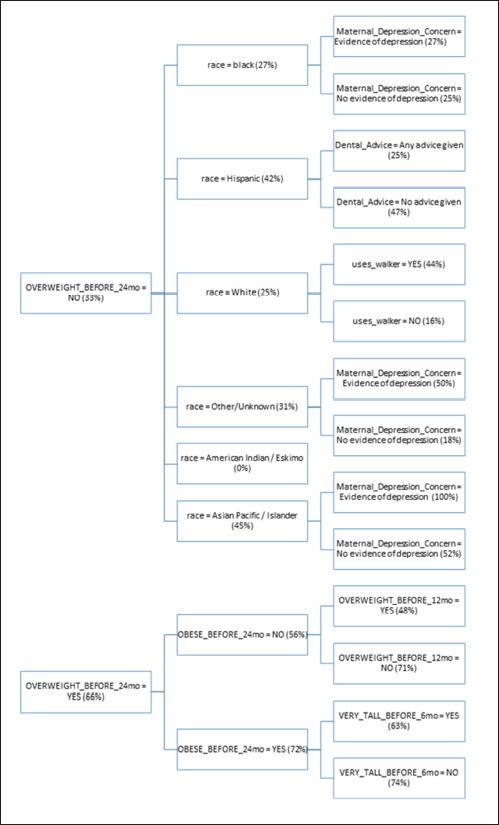
Results: Of the methods analyzed, the ID3 model trained on the CHICA dataset proved the best overall performance with accuracy of 85% and sensitivity of 89%. Additionally, the ID3 model had a positive predictive value of 84% and a negative predictive value of 88%. The structure of the tree also gives insight into the strongest predictors of future obesity in children. Many of the strongest predictors seen in the ID3 modeling of the CHICA dataset have been independently validated in the literature as correlated with obesity, thereby supporting the validity of the model.
Conclusions: This study demonstrated that data from a production clinical decision support system can be used to build an accurate machine learning model to predict obesity in children after age two.
Keywords: Bayes theorem; Obesity; artificial intelligence; decision trees; predictive analytics.
Figures


References
-
- CDC. [12/3/2013]. Available from: http://www.cdc.gov/healthyyouth/obesity/facts.htm.
-
- Mollard RC, Senechal M, MacIntosh AC, Hay J, Wicklow BA, Wittmeier KD, Sellers EA, Dean HJ, Ryner L, Berard L, McGavock JM. Dietary determinants of hepatic steatosis and visceral adiposity in overweight and obese youth at risk of type 2 diabetes. The American journal of clinical nutrition 2014; 99: 804–812. - PubMed
-
- Wing RR, Bolin P, Brancati FL, Bray GA, Clark JM, Coday M, Crow RS, Curtis JM, Egan CM, Espeland MA, Evans M, Foreyt JP, Ghazarian S, Gregg EW, Harrison B, Hazuda HP, Hill JO, Horton ES, Hubbard VS, Jakicic JM, Jeffery RW, Johnson KC, Kahn SE, Kitabchi AE, Knowler WC, Lewis CE, Maschak-Carey BJ, Montez MG, Murillo A, Nathan DM, Patricio J, Peters A, Pi-Sunyer X, Pownall H, Reboussin D, Regen-steiner JG, Rickman AD, Ryan DH, Safford M, Wadden TA, Wagenknecht LE, West DS, Williamson DF, Yanovski SZ. Cardiovascular effects of intensive lifestyle intervention in type 2 diabetes. New England journal of medicine 2013; 369: 145–154. - PMC - PubMed
Publication types
MeSH terms
Grants and funding
LinkOut - more resources
Full Text Sources
Other Literature Sources
Medical
