


Long-term Consistency in Rotavirus Vaccine Protection: RV5 and RV1 Vaccine Effectiveness in US Children, 2012-2013
- PMID: 26449565
- PMCID: PMC7724934
- DOI: 10.1093/cid/civ872
Long-term Consistency in Rotavirus Vaccine Protection: RV5 and RV1 Vaccine Effectiveness in US Children, 2012-2013
Abstract
Background: Using a multicenter, active surveillance network from 2 rotavirus seasons (2012 and 2013), we assessed the vaccine effectiveness of RV5 (RotaTeq) and RV1 (Rotarix) rotavirus vaccines in preventing rotavirus gastroenteritis hospitalizations and emergency department (ED) visits for numerous demographic and secular strata.
Methods: We enrolled children hospitalized or visiting the ED with acute gastroenteritis (AGE) for the 2012 and 2013 seasons at 7 medical institutions. Stool specimens were tested for rotavirus by enzyme immunoassay and genotyped, and rotavirus vaccination histories were compared for rotavirus-positive cases and rotavirus-negative AGE controls. We calculated the vaccine effectiveness (VE) for preventing rotavirus associated hospitalizations and ED visits for each vaccine, stratified by vaccine dose, season, clinical setting, age, predominant genotype, and ethnicity.
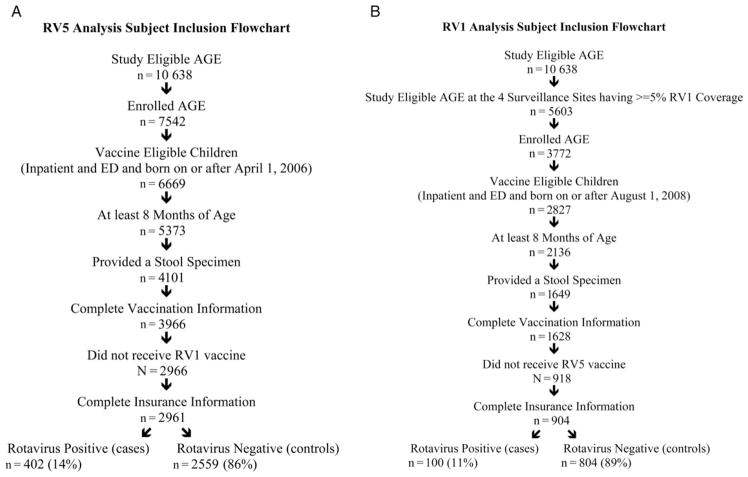
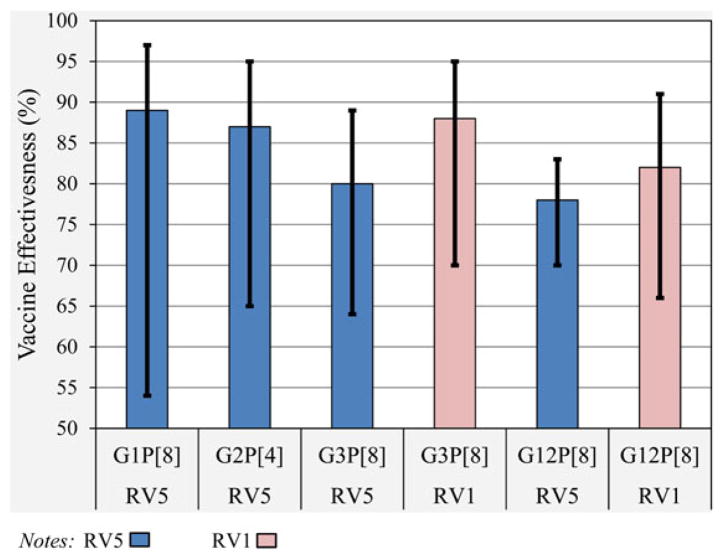
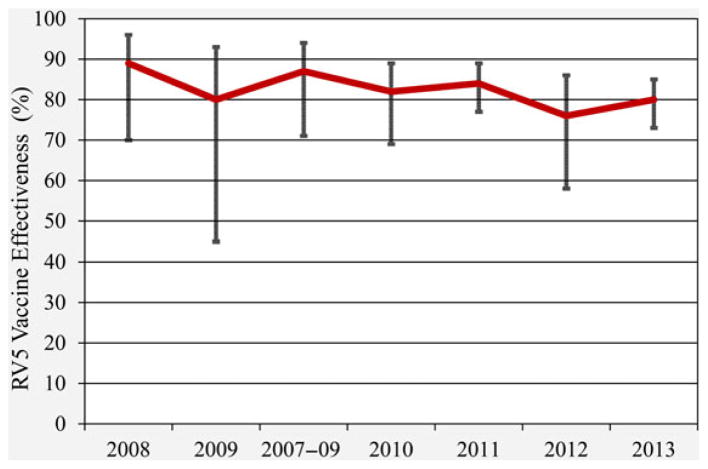
Results: RV5-specific VE analyses included 2961 subjects, 402 rotavirus cases (14%) and 2559 rotavirus-negative AGE controls. RV1-specific VE analyses included 904 subjects, 100 rotavirus cases (11%), and 804 rotavirus-negative AGE controls. Over the 2 rotavirus seasons, the VE for a complete 3-dose vaccination with RV5 was 80% (confidence interval [CI], 74%-84%), and VE for a complete 2-dose vaccination with RV1 was 80% (CI, 68%-88%).Statistically significant VE was observed for each year of life for which sufficient data allowed analysis (7 years for RV5 and 3 years for RV1). Both vaccines provided statistically significant genotype-specific protection against predominant circulating rotavirus strains.
Conclusions: In this large, geographically and demographically diverse sample of US children, we observed that RV5 and RV1 rotavirus vaccines each provided a lasting and broadly heterologous protection against rotavirus gastroenteritis.
Keywords: RV1-Rotarix; RV5-RotaTeq; acute gastroenteritis; rotavirus vaccine; surveillance.
Published by Oxford University Press on behalf of the Infectious Diseases Society of America 2015. This work is written by (a) US Government employee(s) and is in the public domain in the US.
Conflict of interest statement
All other authors report no potential conflicts. All authors have submitted the ICMJE Form for Disclosure of Potential Conflicts of Interest. Conflicts that the editors consider relevant to the content of the manuscript have been disclosed.
Figures
References
-
- Ruiz-Palacios GM, Pérez-Schael I, Velázquez FR, et al. Safety and efficacy of an attenuated vaccine against severe rotavirus gastroenteritis. N Engl J Med. 2006;354:11–22. - PubMed
-
- Linhares AC, Velázquez FR, Pérez-Schael I, et al. Efficacy and safety of an oral live attenuated human rotavirus vaccine against rotavirus gastro-enteritis during the first 2 years of life in Latin American infants: a randomised, double-blind, placebo-controlled phase III study. Lancet. 2008;371:1181–9. - PubMed
-
- Vesikari T, Karvonen A, Puustinen L, et al. Efficacy of RIX 4414 live attenuated human rotavirus vaccine in Finnish infants. Pediatr Infect Dis J. 2004;23:937–43. - PubMed
-
- Vesikari T, Karvonen A, Prymula R, et al. Efficacy of human rotavirus vaccine against rotavirus gastroenteritis during the first 2 years of life in European infants: randomized, double-blind controlled study. Lancet. 2007;370:1757–63. - PubMed
-
- Centers for Disease Control and Prevention. Prevention of rotavirus gastroenteritis among infants and children: Recommendations of the Advisory Committee on Immunization Practices (ACIP) MMWR. 2009;58:1–26. - PubMed
Publication types
MeSH terms
Substances
Grants and funding
LinkOut - more resources
Full Text Sources
Other Literature Sources
Medical
